


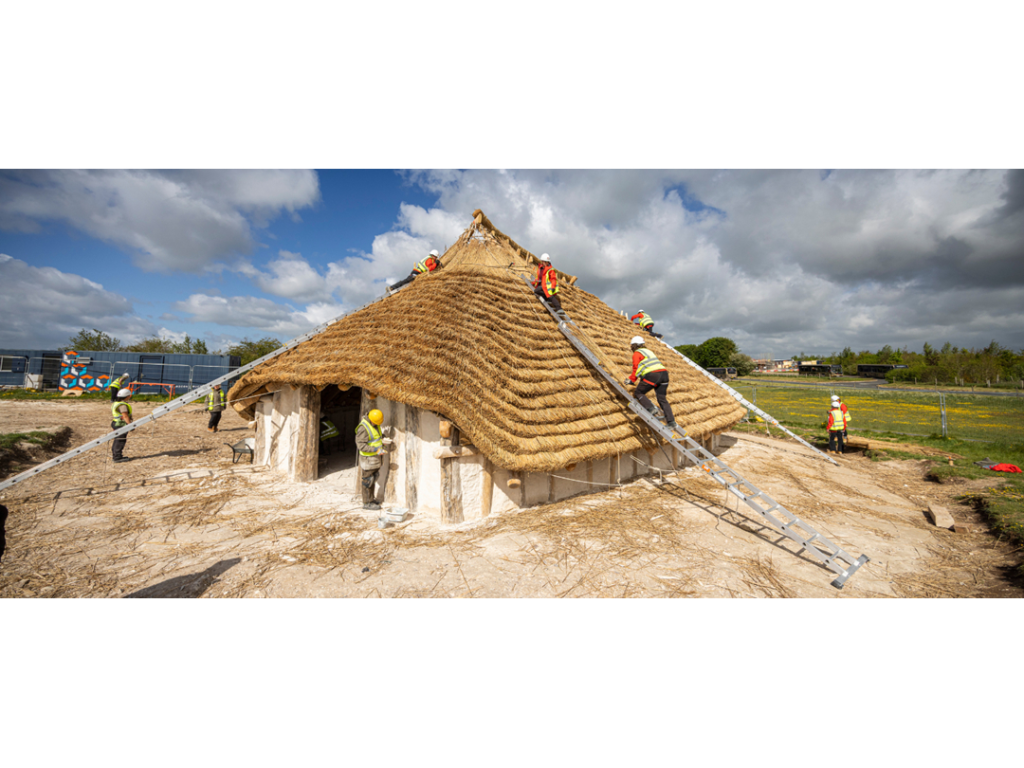
English Heritage, a charity that manages over 400 historic sites across England, unveiled their reconstruction of a 4,500-year-old building at Stonehenge on Friday. The $1.34 million, 23-foot-high Kusuma Neolithic Hall, which will open this summer, aims to help visitors imagine the lives of Stonehenge’s prehistoric builders.
The hall is based on the footprint of a long-vanished building at the nearby Neolithic archaeological site Durrington Walls and was built over nine months by more than 100 volunteers. Under the guidance of award-winning experimental archaeologist Luke Winter, the volunteers used only prehistoric tools, including stone axes, and locally sourced materials such as reed thatch, pine timbers, and chalk daub to raise the structure.
While the purpose of the original building is uncertain, animal bones and pottery excavated at the Durrington Walls suggest it was used for large celebrations or feasts. And whether or not there may have ever been a hall of this sort at Stonehenge itself, the project offers insight into Neolithic culture in the wider area.
“Seeing the structure take shape . . . has been incredibly rewarding,” said Emma Groeger, one of the volunteers. “But the most exciting part, for me, has been the installation of the two main oak door posts. This required everyone in the team working together to lift the posts into place while making sure they were accurately aligned.”
Matt Thompson, Conservation, Curatorial and Learning Director for English Heritage, commented: “Not only is the hall a wonderful addition to the Stonehenge experience for both visitors and learners but, by using historically accurate techniques and materials in its construction, we have also been able to develop a much keener understanding of the everyday lives of the Neolithic people who came to Stonehenge and settled in the locality.”
Part of an educational expansion at Stonehenge by English Heritage, the hall will be living-history learning space for school groups beginning in September.
