


The Katy Trail, a 3.5-mile urban greenway in Dallas, will be the venue for a new public art biennial launching in Spring 2027.
The KTX Biennial will unfold across the length of the Katy Trail, and the works will be on view for up to 18 months, the approved length for a temporary public work in Dallas. New York–based curator Jovanna Venegas will organize the inaugural edition of the KTX Biennial.
The Katy Trail runs through three Dallas neighborhoods, Uptown, Knox, and Highland Park, and is free to the public and open from 5am until 11pm. Conceived of as a public-private partnership in 1997, the Katy Trail is an early example of converting former rail lines into green space. It now sees some 2 million visitors.
“We thought that the most beloved trail in the city of Dallas, the Katy Trail, made a lot of sense of the location for a public art program,” Amanda Dillard Shufeldt, art director of the Katy Trail, told ARTnews in an interview.
The forthcoming biennial builds on an existing public art program that the Friends of the Katy Trail launched in 2021, partially as a pilot program for the biennial. Because the trail launched nearly three decades ago, “adding a new concept like Katy Trail Art needed to be vetted—we needed to prove that there was going to be financial support and a general enthusiasm for the project,” according to Amy Bean, executive director of Friends of the Katy Trail, which manages the park.
She continued, “People wanted to make sure that they were going to feel like the works were integrated into the natural experience, and we have noticed people have come to love the surprise of sculpture” as they traverse the trail.
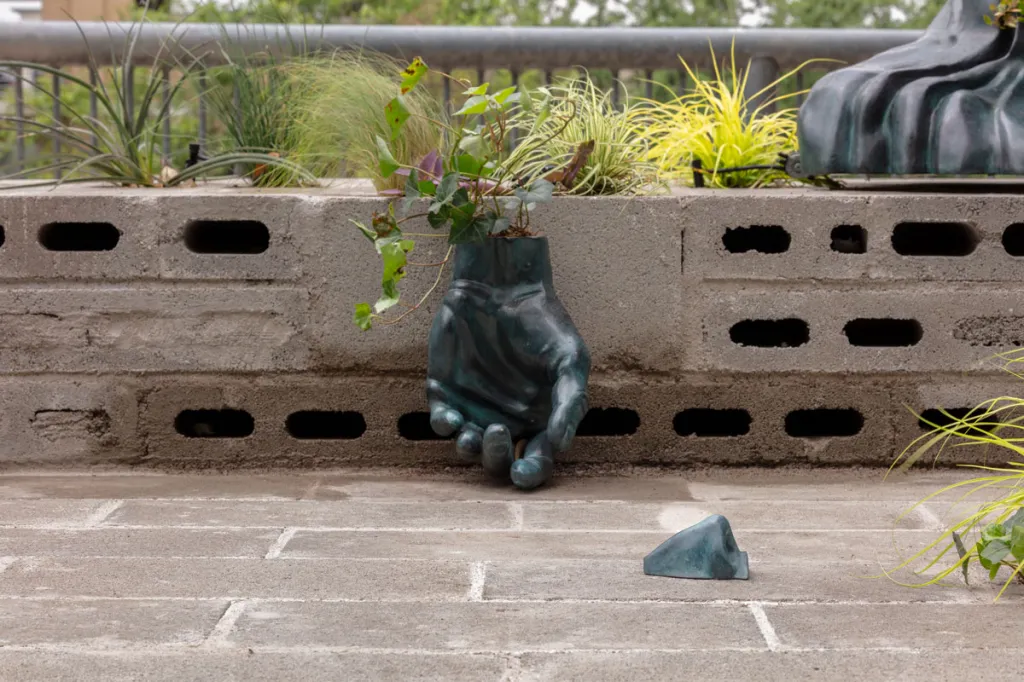
Hadi Fallahpisheh’s Guest 2 (left) and Guest 3, installed along the Katy Trail in Dallas.
Photo Kevin Tadora
The success got Bean and Dillard Shufeldt thinking about how to take that public art program to the next level. “The city’s temporary art policy, allowing for works to be up for 18 months, lends itself naturally to a two-year cycle, which led to the decision to make a biennial,” Dillard Shufeldt said. “We realized that to make a really significant impact, we needed to formalize the program and hire a curator. We thought the singular voice of an experienced curator would provide a more cohesive and enhanced experience for trail users.”
That led to the formation of a committee to nominate and select a curator, with them ultimately choosing Venegas. “There was a very clear consensus among the group that Jovanna showed a fresh and clear vision, and coupling that with her background, network, and experience, gave us the confidence that she was the right choice,” Dillard Shufeldt said.

Jovanna Venegas will curate the inaugural edition of the KTX Biennial.
Photo Yvonne Venegas
Venegas, who is currently curator at SculptureCenter in New York, told ARTnews that she was interested in taking on the KTX Biennial because her career has mostly been focused on working in institutions with walls, like SculptureCenter and the San Francisco Museum of Modern Art, where she worked from 2017 to 2023. At both places, however, she has focused on commissioning artists to make new work, including projects by Patricia Ayres and Elaine Cameron-Weir (SculptureCenter) and Fernando Palma Rodríguez and Liz Hernández (SFMOMA).
Dillard Shufeldt added, “Her enthusiasm for the project was really evident in her proposal. We could tell that she was excited and energized about the opportunity to work in a non-traditional setting, and that she would approach the project in the thoughtful, yet innovative manner that we were looking for.”
Venegas is currently at work on building out the artist list and range of commissions for the inaugural edition of the KTX Biennial. She said that in addition to working with sculptors and artists who have previously done outdoor public art, she is also thinking about including artists who work in painting and could present a mural, or performance art that could activate different parts of the trail.
Although it does not officially have a title yet, the first edition will be focused on “the imaginative and plural ecologies framework of the forest, examining the visible and invisible dimensions of shared space,” according to a release. Central to this is the writing of science fiction author Ursula K. Le Guin’ 1971 short story “Vaster than Empires and More Slow,” about a crew that is meant to observe a planet that is completely covered by a forest.
Venegas said she is especially looking forward to how the public would interact with it at various times throughout the day, since the trail is officially open from 5 a.m. to 11 p.m.. She also said she was thinking about how some commissions might be especially activated by the periods between dusk and dawn.
Venegas added, “I am interested in the potential for an encounter between distinct worlds on the Katy Trail: that of the visitor and those created by artists.”
