


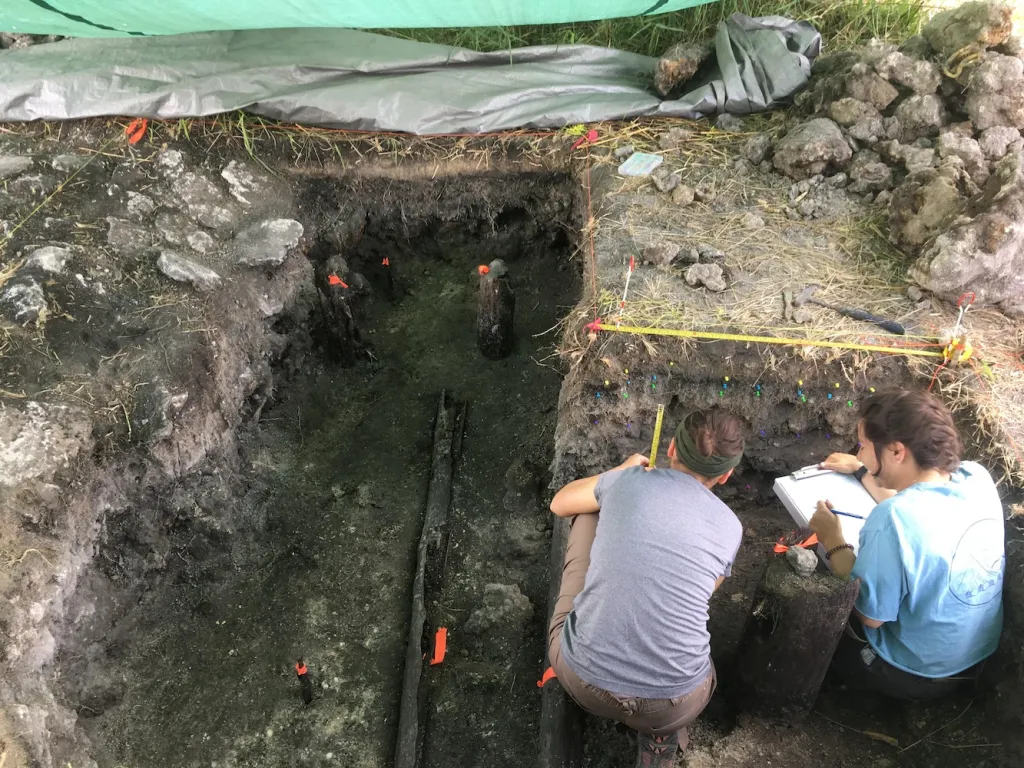
The Postclassic period of Maya civilization (800–1500 CE) was marked by significant environmental and societal stressors, including prolonged droughts and a shift from centralized authority to smaller, competitive polities. A new excavation at an archaeological site in Belize shows how despite these challenges, Postclassic Maya communities not only survived, but thrived.
The excavation was conducted by a team of archaeologists and geologists at the Birds of Paradise (BOP) field complex, located on the Rio Bravo floodplain in northwestern Belize. The culmination of 20 years of on-the-ground research, it provided evidence of Maya settlement of these wetlands after inland urban centers nearby had been abandoned.
“Our most exciting finding is the remarkable preservation of wooden architecture in a tropical wetland,” said Lara Sánchez-Morales, an assistant professor of anthropology at New York University and the lead author of the team’s research paper, published in the Proceedings of the National Academy of Sciences (PNAS) this month.
Sánchez-Morales and her colleagues, who included Timothy Beach, a professor of geography and the environment at the University of Texas at Austin, located the settlement using various methods, including LiDAR mapping. The subsequent excavation uncovered the remains of raised earthen, stone, and wood structures, as well as animal bones and domestic artifacts.
“Together, these reveal a highly adaptable community with diverse tools, foods, and building materials,” says Beach. “This shows us that Maya communities could shift habitats and persist through climate extremes.”
The paper’s authors note that the Maya response to the socioenvironmental pressures of their time holds lessons for our own era, writing that those communities’ transition to a riverine-based existence supports current calls for wetland conservation in the face of climate change and unsustainable land use.
