


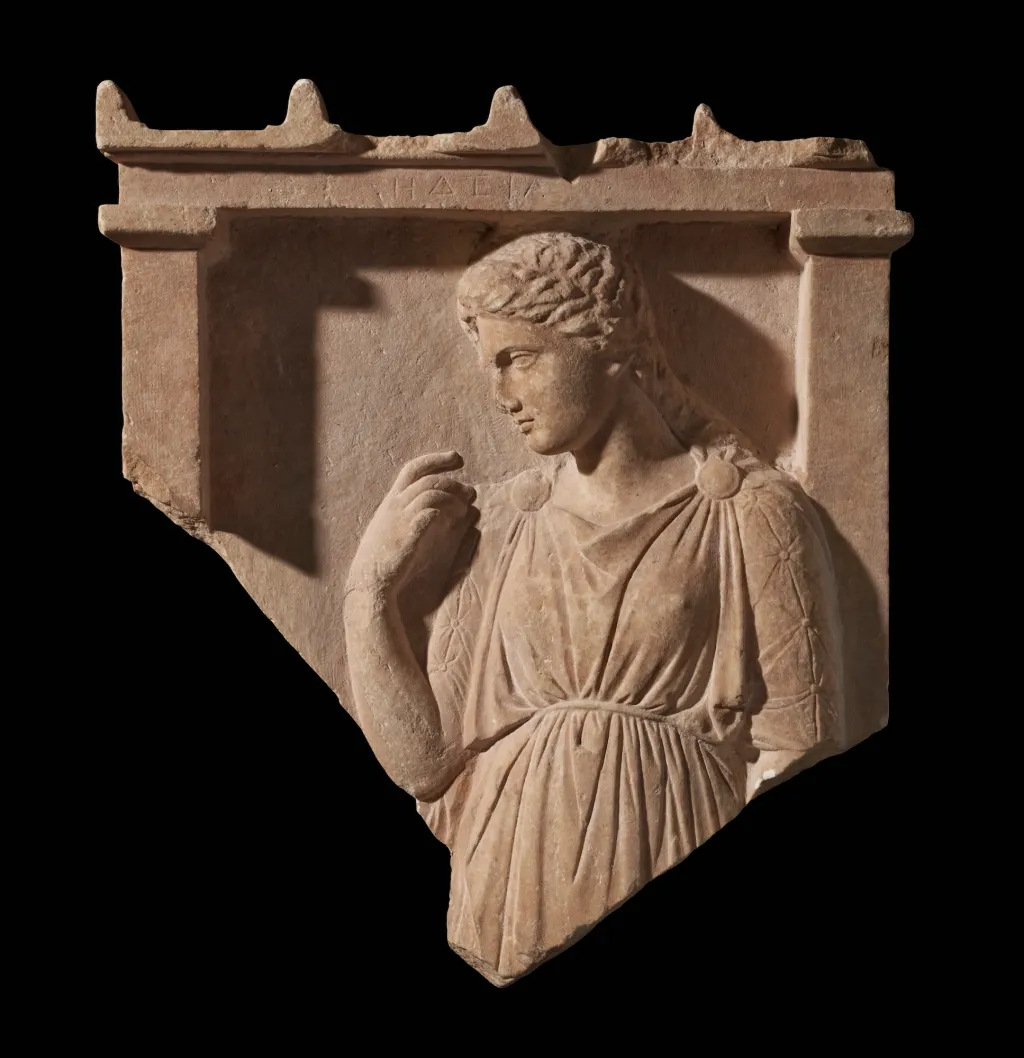
Most young women in ancient Greece were married early in their teenage years, and they were expected to produce children as a matter of public interest. So the death of a young woman of marriagable age was seen as a loss not only to her loved ones, but also to society.
A rare ancient Greek artwork headed to the TEFAF art fair memorializes the loss of one such young woman. On offer from London gallery David Aaron, Stele of Medeia, from the Attic region, dates to 375-350 BCE. The piece is tagged at £450,000 (about $615,000); there is already significant interest from a major US museum, says the gallery.
“It’s a masterfully, beautifully sculpted stele,” said director Salomon Aaron, adding, “It has a lot of its original pigment, which is fantastic.” Shown in profile in high relief in front of a doorway, the woman raises her right hand to her shoulder, her eyes downcast. She is identified by name in an inscription in the architrave, a decorative moulding around the door. She wears a traditional dress known as a chiton, a draped tunic belted around the waist and large brooches at her shoulders fastening a back mantle.
Her attire distinguishes her as a Parthenoi, or an unmarried young woman. The gallery notes that research by classical archaeologist Christoph W. Claremont indicates that just four percent of the Attic funerary reliefs he examined in an eight-volume series of books were devoted to Parthenoi.
The piece comes from a notable collection. It shows up first in the hands of Athenian art dealer Theodoros A. Zoumpoulakis, who sold it in 1923 to Hungarian gallerist Joseph Brummer, who worked at the New York branch of his family’s gallery, which had been founded in Paris around 1906. When Brummer died, much of his collection went to New York’s Metropolitan Museum of Art; the institution houses the largest collection of Brummer-provenanced works, over 600 that were acquired directly from the gallery or from its clients, as well as the Brummer archives. The stele that is headed to TEFAF, though, went to Brummer’s bother Ernest, and thence to his wife Ella Laszlo Baché Brummer, who founded the still-active cosmetics company Ella Baché.
Stele of Medeia (375-350 B.C.E.).
Salomon Aaron warns those interested in antiquities like the stele that they should be wary of pieces without well-documented provenance. “The auction market is robust for objects which tick all the boxes, which are beautiful and important, and have the requisite provenance,” he said, while pieces without documented provenance can’t command the best prices. “There are items on our stand that we acquired and spent five years researching the provenance,” he said. “That’s our value add.”
David Aaron Gallery was established in Iran in 1910. The gallery’s Soleiman Haroon opened a second showroom in Alexandria, Egypt, in 1920. The gallery relocated to London in 1980, and Haroon’s son, David Aaron, opened his own gallery on Berkeley Square in 1998. The gallery specializes in classical Greek and Roman, Egyptian, Near Eastern, and Islamic works of art. Top-quality pieces are rare, though, Aaron told ARTnews, and the gallery has branched out into natural history, including selling large dinosaur fossils, a market sector where exceptional prices have recently been achieved. Apart from TEFAF Maastricht, the gallery has also shown at fairs including TEFAF New York, Frieze Masters, Frieze Masters Seoul, and Art Basel Hong Kong.
Also on offer at the gallery’s TEFAF stand will be an Egyptian limestone Baboon (664–343 BCE) and a Roman Torso of a Youth (1st-2nd century CE) in a contrapposto position, whose provenance goes as far back as 1898.
