


Editor’s Note: This story originally appeared in On Balance, the ARTnews newsletter about the art market and beyond. Sign up here to receive it every Wednesday.
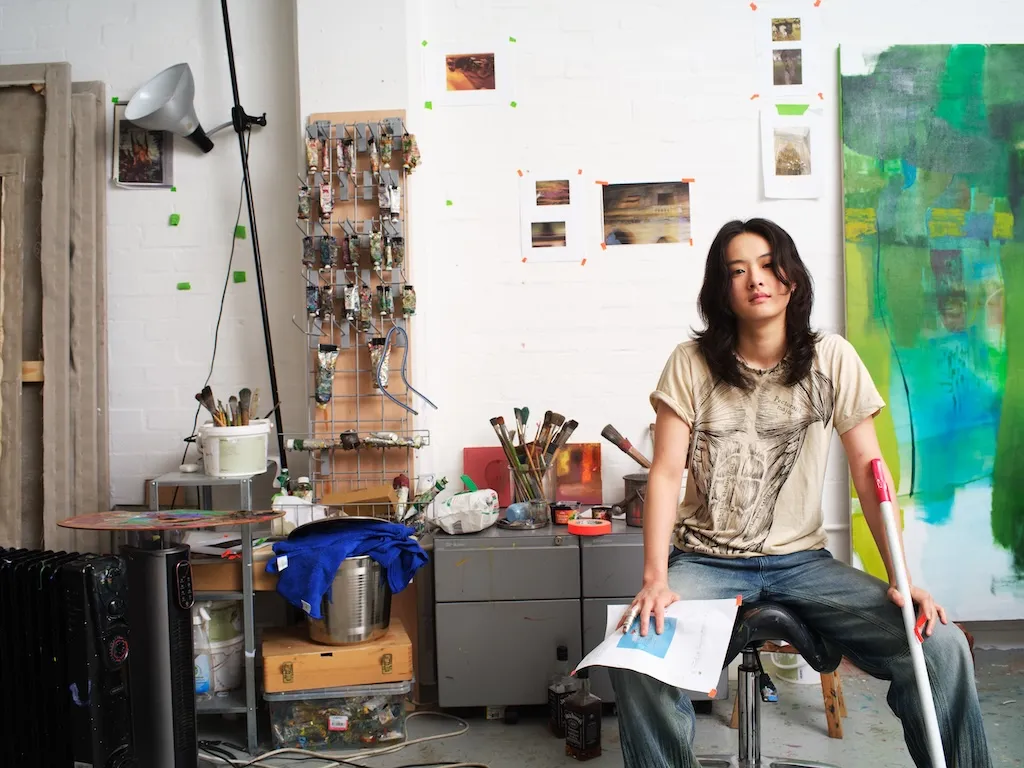
There are artists whose auction markets feel like accidents—brief flare‑ups of appetite fueled by novelty, narrative, or a single well‑placed sale. And then there are artists whose markets feel, even early on, like the visible surface of something deeper and slower moving. Li Hei Di, born in 1997 in Shenyang, China, and now based in London, belongs squarely to the latter category.
While Li’s auction history remains short, the artist has become one of the more closely watched young painters over the last two years, even as much of the ultra-contemporary category has fizzled. After becoming the youngest artist on Pace’s roster in September 2024, they began to see their first results at auction, with works from 2021 and 2022 entering sales in Hong Kong and New York that fall. So far, Li’s work has appeared at auction 12 times so far, with eight of those appearances in Hong Kong. Nearly every appearance has exceeded expectations, often decisively. Pictures with conservative estimates—sometimes at levels aligned more with current caution around emerging artists—have doubled, and in some cases nearly tripled, their high estimates.
The clearest signal that Li’s market is more than a blip came during Hong Kong’s annual fall sales. Both Sotheby’s and Phillips auctioned works that sold for more than double their high estimates. The work at Sotheby’s, There Was One Summer Returning Over and Over; There Was One Dawn I Grew Old Watching (2023), sold for HK$2.67 million on a HK$700,000–HK$1 million estimate. It set a new auction record for the artist; their previous record was set in March, also at Sotheby’s Hong Kong, at about half that figure.
But perhaps more important than the record was that the painting was a large-scale work from a recent series—precisely the kind of object that tends to anchor long‑term price trajectories.
Kevie Yang, deputy chairwoman and senior international specialist at Phillips, told ARTnews that the result should not be read as a sudden spike. “It’s not a flash‑in‑the‑pan situation,” Yang said. “It’s a slow buildup. The auction performance reflects years of interest forming before these works ever came to market.”
One of the more persistent misconceptions surrounding Li’s market is that it is regionally narrow, driven primarily by Asian collectors responding to a Chinese‑born artist. Auction data, dealers, and advisers suggested otherwise. Yang said that bidding and buying activity for Li’s works comes from across Asia, Europe, and the United States, with collectors based everywhere from Hong Kong and Seoul to Texas, South Africa, and Northern California.
“It’s not an ‘Asia‑only’ story,” Yang notes. “Collectors respond to the work first. The background adds depth, but it doesn’t limit the audience.”
That same breadth appears on the primary side, according to Pace vice president Joshua Friedman, who has worked with Li since their early career. Friedman told ARTnews that Li’s collector base includes both private collectors across continents and public institutions like the High Museum of Art, ICA Miami, and the Hepworth Wakefield in the UK. Foundations in Europe and Asia have also acquired works, he added.
The emphasis on institutions is deliberate. Friedman said the gallery’s pricing strategy is designed to keep works accessible to museums even as demand grows—a philosophy that has become increasingly rare in a market eager to declare winners early. “Once pricing becomes untethered,” Friedman said, “it’s much harder for institutions to participate. That’s something we’ve been careful about from the beginning.”
While Li’s practice is frequently discussed in terms of identity—gender, cultural displacement, self‑definition—the work prioritizes sensation before concept, according to Jessica Pfeiffer, an art adviser at the Fine Art Group and a former Christie’s specialist. That makes it unusually flexible in the market. Pfeiffer told ARTnews that she has successfully shown Li’s paintings to conservative collectors without foregrounding biography at all. “The work doesn’t need explanation to be compelling,” she says. “It can meet people where they are.”
At the same time, collectors who do engage more deeply often find that the work rewards sustained attention. Yang put it rather poetically. To her, the paintings are “always in a state of becoming,” emotionally, compositionally, and symbolically. That openness allows viewers across cultures to project their own narratives onto the work without flattening its complexity.
Le Hei Di’s cloud cloud cloud! (2025)
Robert Glowacki Photography
Despite all that talk of identity, geography, and market mechanics, Li’s success ultimately rests on the paintings themselves—and the works are difficult to pin down.
At first glance, many appear abstract: luminous fields of color produced from thin layers of oil paint. But with time, figures emerge—torsos, faces, bodies submerged or dissolving into their surroundings. The imagery rests suspended between the figurative and the abstract as if caught mid‑transformation.
Pace’s Friedman describes the experience of viewing Li’s work as “almost cinematic,” likening it to looking into water where forms reveal themselves gradually as the eye adjusts. That slowness is not incidental. Li works on paintings for months, sometimes over a year, without preparatory sketches. Each mark responds to the previous one, creating surfaces that feel accumulated rather than composed.
Pfeiffer recalled encountering Li’s work shortly after the pandemic, when many collectors were hungry for substance over spectacle. What struck her then was how familiar the work felt, even though it imitated nothing she had ever seen. “It feels historically grounded,” she says, “but it also feels completely ‘now.’ That’s rare.”
She added that Li’s engagement with Chinese fantasy literature and late 20th century Hong Kong cinema—films such as Green Snake(1993)—as a narrative undercurrent rather than a literal reference. The paintings don’t illustrate stories but instead are stories in and of themselves. Bodies become sites of emotion rather than identity markers, charged with desire, memory, and ambiguity.
Li’s market is clearly speeding up. In just over a year, 12 works have already appeared at auction—no small number for an artist born in 1997, and enough to show that demand has moved well beyond the primary market. What’s interesting is that these have largely been strong, recent paintings, which suggests the market is testing how fast it can move without falling on its face.
Li’s first New York solo exhibition with Pace will be in New York this fall; it will be accompanied by a publication from Pace Publishing. The show will be followed by recent outings at Pace Hong Kong and a show at the Pond Society in Shanghai that closed at the end of the year.
The key question is whether Li’s collector base will widen without losing coherence. So far, the signs are encouraging. Institutional interest is growing. Auction results have been consistent and mostly incremental. And perhaps most importantly, the work itself resists easy digestion.
I have a theory that markets built on difficulty—on paintings that ask viewers to slow down rather than scroll past—will tend to last longer than those built on instant legibility and Instagramability. Li Hei Di’s market, still young and still forming, looks like it might be building the kind of foundation that asks people to stick around for a while.
