





“When you listen to a song for the first time, it is like swallowing a whale.” So reads the wall text in an exhibition by Björk, a pop star whose relationship to music has long been unique, to say the least. She adds, in the same handwritten scrawl, “I don’t think of myself as a visual artist … Everything I do comes from a sonic point of view. This is something I have called ‘sonic symbolism,’ sound made visual, a reverse synesthesia.”
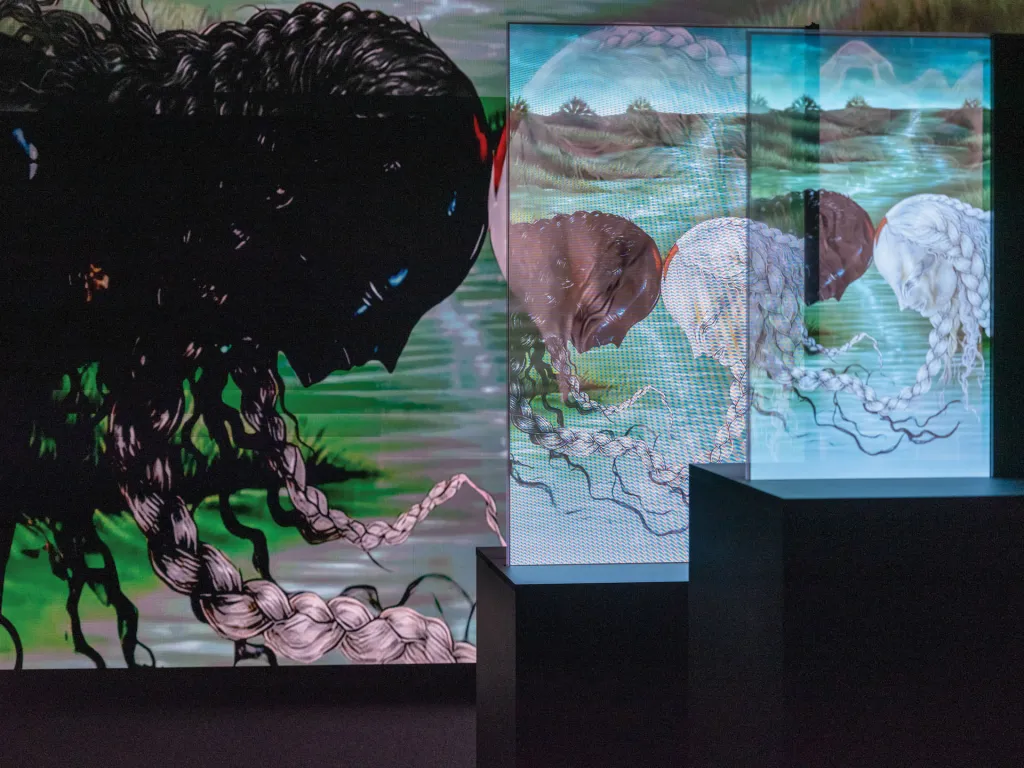
All of that prepares visitors to enter a room at the National Gallery of Iceland devoted to “Nerve Bloom,” a new song that Björk commissioned painter Natalia Kleszczewska and 3D graphics designer Natalie Liu to respond to for the show. Their collaboration greets viewers on a small screen on a pedestal, bearing a digital display of two animated figures slithering around each other and wrapping each other up. They appear plantlike, as if grown from a root system, but also humanoid, with fibrous muscles propelling them around virtual space. The hybridization intensifies farther into the gallery, where two floor-to-ceiling screens subsume the space and introduce the presence of horses that dissolve between realistic and fantastical forms, with heads slowly rising and falling, alternating between stare-downs and shows of deference. Meanwhile, over plangent piano and skittering minimalist percussion sounds, Björk’s voice coos, “I bow, I bow / This is appreciation / Of all the sensations / You are brought to me / Neurons glowing.”
The mind-melting amalgam of the “Nerve Bloom” installation is transfixing, psychedelic in a folkloric way that feels planted in a naturalistic past but projected into an otherworldly future, where painterly qualities coalesce with digital effects and music is nobly served by visuals and vice versa. It is also the most fully realized work in an exhibition whose ambitions are otherwise much more measured.
And understandably so: After a notoriously reviled 2015 survey at New York’s Museum of Modern Art, it is easy to imagine why Björk would want to keep expectations in check. (In The New York Times, Roberta Smith described elements of that MoMA show as “tacky,” “disappointing,” and “ludicrously infantilizing,” and fans of merciless criticism would be well served by looking into other reviews from the time.)
View of Nerve Bloom, 2026, featuring works made with Natalia Kleszczewska and Natalie Liu.
Courtesy National Gallery of Iceland, Reykjavík
While the blowback was mostly directed at the institution and not at Björk herself, the artist strikes a less lofty and more modest tone in her hometown, with a smaller-scale show whose two other major presentations focus on songs and videos already out in the world, though less immersively so. Both are from her 2022 album Fossora, and both relate to her mother, the environmental activist Hildur Rúna Hauksdóttir, who died in 2018.
“Sorrowful Soil” is the more moving of the two, played here in a new arrangement for which the members of a supporting choir were recorded on isolated microphones so their voices would sound more distinct. The presentation was inspired by Janet Cardiff’s canonical sound art work The Forty Part Motet (2001), and the aural effect is glorious, with surround-sound delivered by way of 30 high-fidelity speakers raised on stands to be appreciated at ear level. (In her wall text, Björk writes, “It turns out that speakers are human … or sound-puppets.”) On a large screen at one end of the ellipse is the video that accompanied the song upon release, with Björk sitting on a rock in front of lava flowing from the Fagradalsfjall volcano while singing lines like “In a woman’s lifetime / She gets 400 eggs / But only two or three nests” and “You did well / You did your best.”


View of Sorrowful Soil, 2022, in “echolalia.”
Courtesy National Gallery of Iceland, Reykjavík
“Ancestress,” written just two weeks after Hildur’s passing, pays poetic tribute while scrambling the senses: “You see with your own eyes / But hear with your mother’s.” The video for it, projected at large scale in a gallery space lined with a red textile woven with the song’s musical score, follows a ritualistic procession including Björk through an Icelandic valley.
Neither video is less than epic, but their availability on YouTube makes their inclusion in the museum less than revelatory. Still, Björk’s engagement with her mother in the place where she was raised adds contextual heft, as does the show’s role as a centerpiece of the programming for this year’s Reykjavík Arts Festival.
Courtesy National Gallery of Iceland, Reykjavík
The festival is an ambitious citywide initiative that also drifts into other regions of Iceland, and it includes another show at the National Gallery devoted to James Merry, who made many of the elaborate masks and jewelry works featured in Björk’s recent concert tours and videos (including those for “Sorrowful Soil” and “Ancestress”). Merry’s show includes other projects—like masks inspired by pagan fertility figures and sculptures informed by archaeological studies—but focuses mostly on his relationship with Björk, who hired him as an assistant in 2009, six years before he started making the work for which he has become known.
In a shared catalog, the curator of the two exhibitions describes them as “discrete yet intertwined” and writes about creative entanglement between Björk and Merry as well as others around Reykjavík. In a conversation with the two artists published in that book, Merry talks about a sort of symbiosis between them, noting that his masks were “never meant to completely obscure Björk, more like to blur her edges and bring other archetypal aspects into focus.”
It’s fitting, then, that his and her work harmonize at the museum—and even more fitting that Björk comes across less as an overextended polymath, as she did at MoMA, and more as a musical matriarch and decidedly collaborative creature.