


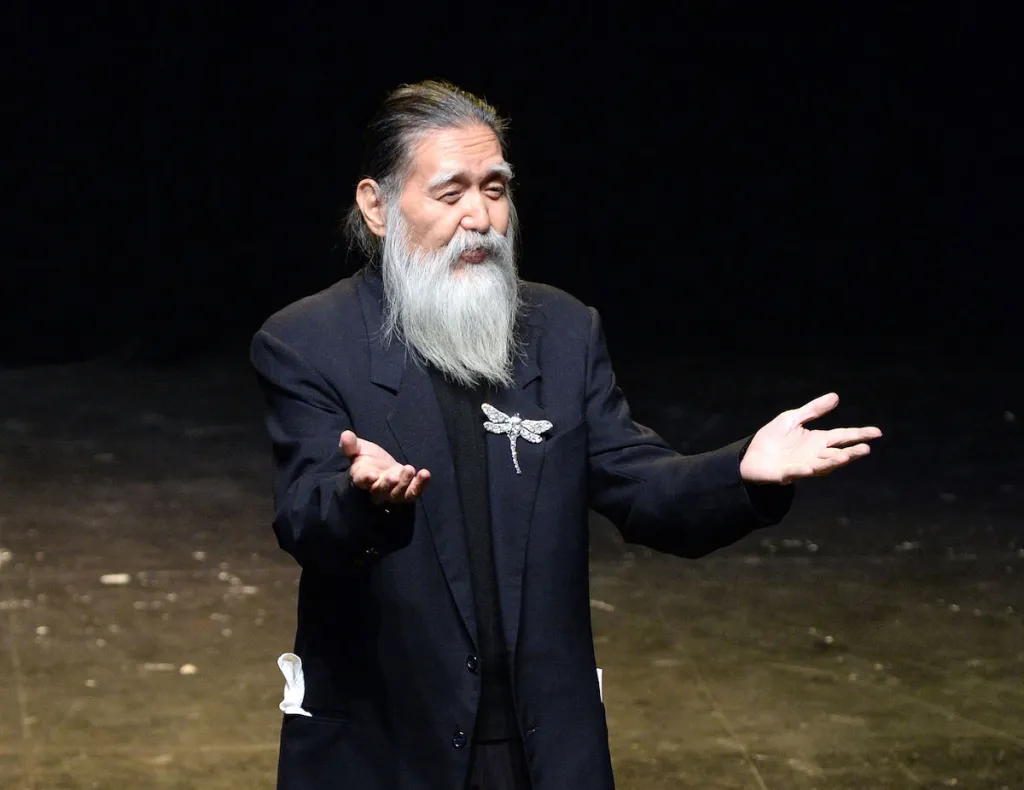
Agosto Machado, an artist and activist associated with the Downtown New York art scene whose altar sculptures currently appear in the Whitney Biennial, died on Saturday following a brief illness.
In keeping with his own wishes, his gallery, the New York–based Gordon Robichaux, did not announce Machado’s age in the obituary it sent out on Sunday. Speaking of his decision never to publicly share his birth year last year, Machado said, “A lady never tells.”
Within the art world, Machado is now recognized as an artist, though he has also been described variously as an archivist and an activist. In interviews, he opted for a different descriptor: “pre-Stonewall street queen.”
An active participant in the Stonewall uprising of 1969 and the Gay Liberation Movement of the 1970s that followed, Machado was part of a circle that included activists such as Marsha P. Johnson and Sylvia Rivera; artists such as Peter Hujar, Thomas Lanigan-Schmidt, Jack Smith, and Andy Warhol; and multi-hyphenates such as Candy Darling, Mario Montez, and Stephen Varble. Through his performances at venues such as La MaMa and the Pyramid Club, Machado established himself as one of the essential figures of the Downtown New York scene.
Even before the AIDS crisis, Machado had begun collecting ephemera related to his community, whose history was constantly at risk of being lost. From tchotchkes, printed matter, and refuse, Machado created portraits of people he knew and personal heroes. Once AIDS began claiming members of his community, these shrines took on a new valence.
Asked why he began making the altars in 2022 by the artist Tourmaline, Machado said, “Well, it’s really ancestor worship, my gratitude for all these people who came through my life. And—this is way before AIDS—many disappeared or went someplace. But they contributed to our community, and it behooves me to share my knowledge from the street with the new people.”
One of his shrines in the Whitney Biennial, for example, pays homage to Ethyl Eichelberger, a drag performer who died by suicide in 1990 while undergoing treatment for an AIDS diagnosis. That shrine, from 2024, is a sprawling array of objects related to Eichelberger: a Hujar photograph of him, a makeup compact, a glittery mask, a glass jar with ephemera in it, performance documentation, an oversized feather butterfly made by hand. The piece was acquired by the Whitney Museum last year, which had never owned a work by Machado before then.
Agosto Machado, Ethyl (Altar), 2024.
© Agosto Machado. Courtesy the Whitney Museum of American Art.
Machado’s work existed at the fringes of what museums might term art until very recently. His sculptures’ entry into New York museums is in large part thanks to the work of Gordon Robichaux, the gallery that organized three solo shows for Machado, including one held at Maureen Paley gallery in London—through a gallery share program—that closed last week.
Signs that Machado is now officially a part of ’80s art history can be found at the Museum of Modern Art, where one of Machado’s shrines hangs in the same gallery as paintings by David Wojnarowicz and Martin Wong and photographs by Hujar and Tseng Kwong Chi.
Few details are known about Machado’s early years. In an issue of Artforum last year, critic Alex Jovanovich reported that Machado “grew up an orphan in Manhattan’s Hell’s Kitchen neighborhood and spent much of his youth without a roof over his head and nary a dollar to his name.” Machado quit school during the sixth grade and took to the streets. According to Jovanovich, in the late 1950s, Machado gravitated toward Greenwich Village, a hotbed of artistic activity and a crucial neighborhood for the queer community.
A Chinese-Spanish-Filipino-American, Machado recalled that he “came into being” in 1959, the year he took on an alias inspired by the model China Machado. She appeared in the pages of Harper’s Bazaar around the same time, qualifying her as the first model of color to figure in a major American fashion magazine.
Machado said that during the ’60s, he was a “street queen.” He began his practice of accruing materials of all kinds—“mementos,” as he called them in the Whitney Biennial catalog—during this era.
Recalling this practice in a 2025 interview with the Paris Review, he said, “Emotionally, this is what I embraced because I had nothing. I thought, These memories dwell within my heart. These people, if they’d had time, would have done so much more. So I collected these mementos of the street queens.”
His act of collecting all this ephemera was often read as a means of preserving queer history when it was under attack. In 1969, police raided the Stonewall Inn, spurring an array of demonstrations from the queer community. “It wasn’t the first time Stonewall, or any of the gay bars, had a raid except the situation at hand was like a magnet,” Machado said in a 2019 oral history conducted by the LGBTQ History Project. “With street kids like me, we had nothing to lose.”
Machado expressed admiration for Marsha P. Johnson and Sylvia Rivera, who “put their lives on the line,” as he told Tourmaline. Feeling that he was “too timid” to do the same, he joined the Gay Activists Alliance and attended demonstrations.

Agosto Machado, Downtown (Altar), 2024.
Photo Greg Carideo/©Agosto Machado/Courtesy the artist and Gordon Robichaux, New York
During the AIDS era, Machado spent 12 years organizing caregiving efforts. “Word got out that Agosto is helping those people, so when I would go to a gay bar or a gathering, people would move away from me; they’d barely acknowledge me,” Machado told Charlie Porter in the 2026 Whitney Biennial catalog. “I said, ‘Well, I’m an untouchable, but I don’t care. I’m going to help my friends.’ They lived in my building, on my block, in my neighborhood—hardly anyone wanted to visit them or boost their morale or help them get to doctors. But there was a network of wonderful people who did. Unsung heroes.”
While museums and other institutions commonly entomb history, Machado ensured that his shrine sculptures kept his memories alive. According to Gordon Robichaux, Machado was frequently on hand during public visiting hours for his shows, where he would personally regale viewers with stories related to the works he was presenting. And in interviews, Machado also said that he intended to make sure that he was himself never interred.
“My body will be taken over to Elizabeth, New Jersey, and cremated,” Machado said in the Whitney Biennial interview. “And then, quietly, my ashes will be mixed with those of eleven other people, including Jack Smith and Marsha P. Johnson—you know, a little portion of many dear friends—and it will be put in the Hudson, not far from where Marsha’s body was found in the river after she died.”
He continued, “The transitory nature and continuum of life is the reason I don’t feel I need a funeral or a memorial that people will remember. I remember all the people in my heart.”
