


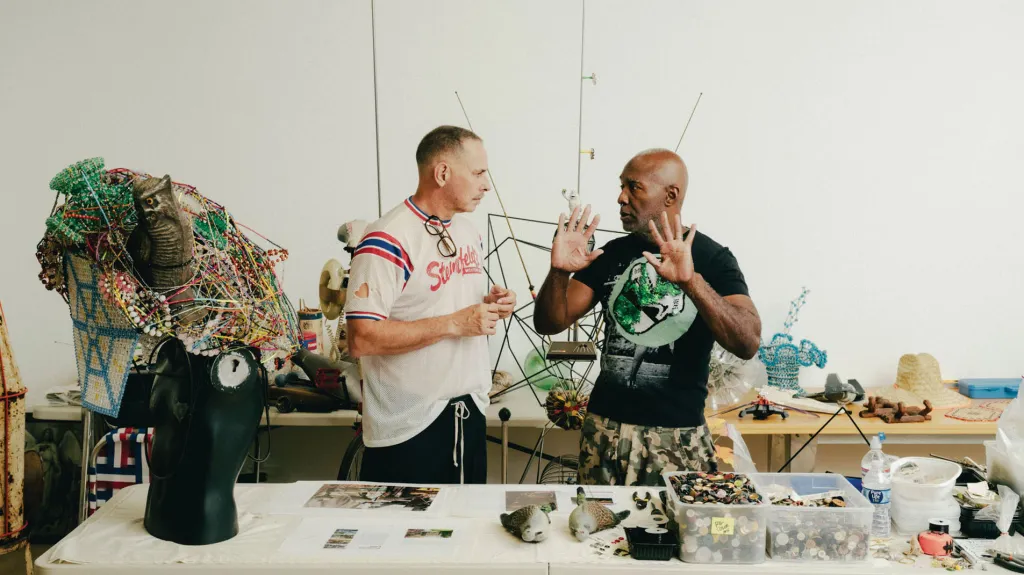
Nick Cave and his longtime partner, artist and designer Bob Faust, moved into an abandoned textile factory on the northwest side of Chicago in 2018. The 18,000-square-foot building was dilapidated, so they spent three years renovating it into a mixed live-work-gallery space they named Facility. Upstairs is the couple’s chic but minimalist apartment; downstairs are studios where they and their 10 assistants labor amid tropical and desert succulents, a tidy profusion of fabrics and buttons and beads, and art from their personal collection, featuring mostly—but not exclusively—Black and brown creators. Facing the street is a long storefront gallery in which three emerging artists per year are invited to mount exhibitions viewable to passersby.
On the morning I visited in late August, the studio was industrious but serene. Nearly all the assistants were sewing and beading in silence, clad in headphones and unbothered by my presence. Cave, hunched over a table in the back room, was preparing work for “Mammoth,” his exhibition opening on February 13 at the Smithsonian American Art Museum. Other projects in development at the time included a 37-foot-tall wall relief for the Princeton University Art Museum inspired by one of his early soundsuits, the exuberant, wearable sculptures that conjoin fashion, performance, and art, and rank among his signature creations. In October, Amalgam (Origin), a 26-foot-tall bronze sculpture inspired by the soundsuits, debuted at the Frederik Meijer Gardens & Sculpture Park in Grand Rapids, Michigan. That same month, Cave also unveiled a commissioned two-story virtual reality sculpture at the Shepherd Arts Center in Detroit. And then there was a textile-and-sound installation conceived in collaboration with Indigenous artist Marie Watt for the Obama Presidential Center, scheduled to open next spring on Chicago’s South Side.
Although much of this work takes its cues from the formal legacy of the soundsuits, Cave is also in a generative phase that he describes as a “very, very new” way of working. For “Mammoth,” he’s excavating his own ancestry and the psychic weight of his family’s material history. Cave, who grew up in Missouri in the 1960s and ’70s, was raised by a single mother who encouraged his interest in art and fashion. He has six brothers and has credited the family’s hand-me-down culture for his ingenuity with assemblage and found objects. (His more than 500 soundsuits are made from an eclectic mix of human hair, toys, feathers, twigs, upholstery, metal, and miscellanea from thrift stores and flea markets.)
Faust, who is designing a book for “Mammoth” and assisting with a new wall work for the show, is investigating alongside him. Since they met in the late 1990s, the couple have collaborated on projects ranging from books to installations to merchandise. Faust’s interest in typography and pattern is evident in the wall works he designs for Cave, which are immersive environmental elements with core imagery sourced from Cave’s art. The two also work closely when programming Facility. The site’s inaugural project, “AMENDS,” played out in the summer of 2020, as protests over the murder of George Floyd convulsed the country. Cave and Faust invited Chicago leaders and everyday citizens to reflect on how they’ve perpetuated racism, giving testimonies that were committed to handwritten notes and yellow ribbons tied to a clothesline on the grounds of a nearby public high school.
When I visited, “SALT,” an exhibition by the New York–based multidisciplinary designer Tanya Quick, was on view in Facility’s storefront gallery. A three-channel video featuring subtly emotive portraits of Quick’s friends and family was projected on the wall, while mounds of road salt on silk occupied the floor. The idea was that passersby on bustling Milwaukee Avenue would see something different—some new emotional register—each time they glanced in the windows.
To discuss how Cave and Faust live and work together, I joined them at the kitchen table in their home, where they shared thoughts on their intertwined creative process and exchanged playful barbs about living creative lives in tandem.
Jeremy Lybarger How do you define collaboration?
Nick Cave Collaboration is when two people—or it could be a community—choose to come together and leave our egos, leave ourselves, at the door, and come into a space where we are open and available to work together.
Bob Faust I think the purest form of collaboration is when the final result couldn’t have happened without those two people making it together. There’s some give-and-take within it.
Bob Faust and Nick Cave in front of their library.
Photo Lyndon French
Lybarger When you’re working on a collaboration, do you see your roles as defined or more fluid?
Cave If I ask Bob to do a wall work in support of my project, then it’s sort of individual for the most part—carte blanche—and Bob responding to the work. Our collaboration comes through us talking about the project. I’m interested in him pushing himself and moving forward, but I think we collaborate really when it comes to Facility and what happens, particularly, in that storefront gallery.
Faust I’m trying to decide if I agree with you. I mostly do. Even with a book, the collaboration happens because of our understanding of each other’s way of working. I’m doing something and not necessarily even showing it but describing it to get input that might not be aesthetic input but is context that helps form it. It is collaborative, and it’s pretty dancy.
Lybarger What happens when you disagree?
Cave We don’t really disagree. If I have a concern, I will bring it to Bob’s attention. I have my own things I have to be focused on. We all have to rise to the occasion, and everyone’s process is different in how they get there, but it’s always this goal, like this is what the outcome is. We both are interested in pushing ourselves and our ideas forward and expanding on new ways of coming to a project and ways of working.
Faust Maybe we should step back a little bit and be more like: How does something become? Because that’s collaborative too. Think about the process of naming—naming a show, naming objects, naming a new sculptural work or an experience. That’s just as collaborative, right? And we will go through a process that’s probably familiar to other people, where it’s words and concepting and riffing and that kind of thing. But the way that we collaborate is we live together, we work together, we experience life together. And because our passion is our work, conversations are nonstop and very porous. Our collaborative process is mostly language-based.

Nice Cave testing the headpiece of an in-progress Soundsuit on Bob Faust.
Photo Lyndon French
Lybarger When you work on your own projects separately, do those begin in the same way?
Faust Mine always start with words, regardless of what the outcome is going to be.
Cave Mine always starts with making, putting things together. I don’t draw anything. I have an idea in my head, but it’s very loose, and I just need my materials so that I can then start to imagine or start to build the idea.
Lybarger You don’t know exactly what you’re going for?
Cave No—not even till the last minute.
Lybarger Bob, do you get uncomfortable with Nick’s style of not knowing where he’s going?
Faust I don’t know if it would be discomfort. For me, I need to see progression. I’d love to say I can be that loose, but I can’t. I need to know and measure something by [whether] it supports the idea I wrote on
the piece of paper or it doesn’t. Then I adjust it.
Lybarger Are there collaborations that haven’t worked for whatever reason?
Cave No. We wouldn’t even allow that to be in the world. It takes a minute for us to finalize [what something is] going to be, particularly
for Facility. It’s not really for us—it’s for the public. We have to somehow step out of it and ask: How do we provide for the community at large?
Faust I’m glad you brought that up, because when you think about a collaborative project from beginning to end, you can look at the “AMENDS” project that was here a few years ago. Nick instigated that. He said, “This needs to happen now.” Then all the pieces and parts were developed by both of us, hand-in-hand. But one big idea initiated this chunk of it and [another] initiated that. None of the final results were one person’s. They were all about the constant informing of one another.
Cave Yeah, it started out as us collaborating. But then the community was collaborating, and then a poet responded to what the community produced. Before you knew it, it was this enormous project.
Faust It goes back to how we both work. There are so many decisions that are about, how does the object make somebody feel so that they sit in the space the right way to receive it the right way? I could probably put the majority of that thought in Nick’s camp. Whereas I’m like, how do we make sure that this is available and can work for as many people as possible? And how do we inform people to let them even know? That strategy, which comes from a design background, really enriches a visual something. I used to say when I collaborated with Nick that I amplify what he’s doing. I don’t really use that word anymore, but that’s kind of what I just described. We’re making each other’s ideas fuller and richer.
Nick Cave: Soundsuit, 2011.
©Nick Cave/Courtesy Jack Shainman Gallery, New York
Lybarger How would you describe your aesthetic differences?
Faust We like the same things at the end. But his world is way more flowy and loose, and mine’s way more tight. Even though there might
be elements that are loose, it’s still pretty tight.
Cave I think we both are trying to arrive at a place where things are clear. At the end of the day, how do we get rid of all the noise and get down to the key elements that make it sing? Bob starts out with it already clear—he thinks. I start out with it all out here, and then bring it into focus.
Faust I like spontaneity. You just have to make space for it.
Lybarger Are there aesthetic differences unrelated to your work that are significant between you two?
Cave I think I’m more expressive.
Faust Flamboyant.
Cave Not flamboyant! Absolutely not! Why would you use that word that is not even me?
Faust You’re so not telling the truth.
Nick Cave in his Chicago studio, surrounded by assemblages.
Photo Lyndon French
Lybarger What’s an example of his flamboyance?
Faust If he goes into his closet to get dressed for an event of some sort, he’s doing it to feel good about himself—not to call attention but to be seen in a way he wants to be seen.
Cave I come out of the closet very confident in my style. I’m very much interested in fashion.
Faust You might have boots that come up to the top of your thigh.
Cave It’s not for attention, though. I don’t need attention.
Faust You’re putting it on for yourself first.
Cave Only. Always. Period.
Lybarger How did you conceive your upcoming Smithsonian show?
Cave The Smithsonian just started this program where they invite an artist to produce a new work, and that means I can push everything else to the side and think differently about an idea. The project is sort of diving deep into family history and how I was made—how I became Nick Cave. I come from a family of makers, so I’m creating this sort of illuminated island that has all of these handmade or fabricated [objects] that I’ve collected from the home. It’s supported by what I call antenna towers, where I’m reconnecting to my ancestors. I’m just putting shit together and making wild and crazy things to trigger some sort of enlightenment. I don’t know how it will all come together, but it’s an assemblage of sorts. Bob is collaborating on that project.
Faust There’s a giant wall work that will feature images from his family’s farm and other elements that might conjure growing up as a boy. They’ll be beaded, with netting over the top—a palimpsest that will
layer over the top. It operates like a landscape for the whole show.
Cave I’m producing a new performance called Mammoth, which is a collaboration with the Washington, D.C., music community and Kahil El’Zabar, who is a percussionist [in Chicago].
Faust It’s interesting because it’s called Mammoth, and everybody’s conjuring the idea of big woolly mammoths coming to life. But the exhibition itself doesn’t feature a woolly mammoth, except in one room that’s going to be a film gallery for a mammoth movie. The only time the mammoths actually come to life are during the performance, which will happen in the middle of the show’s duration. We’re trying to use the word mammoth to conjure ancestry, but also the weight and importance of the tiny—like a collection of his grandmother’s thimbles having a mammoth impact, or being just as important as an animal that might weigh several tons.
Detail from A Lit History, 2025, a large installation included in “Mammoth,” Cave’s exhibition at the Smithsonian American Art Museum in 2026.
Photo James Prinz/©Nick Cave
Lybarger Has the politicization of the Smithsonian under the current presidential administration affected your work or your thinking about what this show should mean or how it should be received?
Cave It has not. I mean, I’m going forward with everything. I must.
Lybarger Has the show taught you anything about yourself or your family?
Cave I think what it has taught me is that there’s this generation of family members that never would consider art as a pathway, as a career. It just was not practical. It’s interesting to think I have an uncle that’s an amazing painter, or seamstresses that are amazing at construction and clothing and building garments, and quilters, woodworkers, musicians, but everyone looked at [art] as sort of like …
Lybarger What was your family’s relationship to art—not making it but as viewers?
Cave They didn’t really frequent museums and things of that sort. And whether or not they really understand what I do, I’m not sure they do. They certainly respect what I do, and they’re there in terms of supporting all of it. But it’s sort of sad to think they didn’t have the guts to sort of … I don’t even know if it’s guts. I just think that it wasn’t what was practical.
Lybarger Did you feel from a young age that art could be your path?
Cave I knew always. Definitely.
Faust You used to tell a story about seeing Michael Jackson on TV and knowing that you wanted to do something that had that kind of power.
Cave I knew I was special, let’s say.
Lybarger Do you consider yourself part of any lineage of artists, or do
you think of yourself as separate?
Cave Separate.
Faust Wow, separate. OK.
Lybarger You’re from Missouri, and you’ve lived in Chicago for a long time. Is there any way in which you think of yourself as a Midwestern artist?
Cave I don’t think of myself in that way at all. There’s a world out there. And when you have explored that, you expand in ways you couldn’t possibly imagine.
Lybarger Has living in Chicago influenced your practice or the way you view the world?
Cave If I was in New York, the distractions and the things I would be involved in [would be a detriment]. Here, I’m able to get clear and get focused. It has allowed me to find a path and to build on that.
Lybarger Is there anything I didn’t ask that you want to add?
Cave No. Are we boring?
Faust I didn’t think so. It wasn’t boring.
Cave We respect each other in this remarkable way, and we give each other space, and we are extremely supportive toward each other. We have each other’s back. Just living together—it’s a collaboration, right?
