


The story goes that in 1986, the same year he was diagnosed with the then-deadly human immunodeficiency virus (HIV), Robert Mapplethorpe signed his first licensing agreement, with the tableware producer Swid Powell. The deal was to produce a series of dinner plates adorned with versions of his distinctive black-and-white studio photographs of lilies and orchids.
Mapplethorpe had by then earned a public reputation as a queer bad boy, best known for photographs depicting hardcore BDSM gay sex in a solemn studio setting. His forays into mass culture had been limited to photographing album covers (for the rock band Television and avant-garde composer Philip Glass, as well as his best friend and roommate, Patti Smith). For his entry into the homeware market, though, he chose his most palatable image series, flowers, which he had started photographing as early as 1977. In the face of death, why the sudden turn to merchandising—this altogether different way for an artist to leave his mark on the world?
Coincidentally or otherwise, it was gay American men who largely mapped the merchandising of late 1980s contemporary art. Joining Mapplethorpe in the highest tier of this booming economy were Keith Haring and Andy Warhol, all three of whom died within the span of three years (Haring of AIDS, Warhol from surgical complications), between 1987 and 1990.
The origin of Mapplethorpe’s partnership with Swid Powell remains shrouded in considerable uncertainty, with some provenance citing 1984 as the actual year of first manufacture. Swid Powell itself ceased operations in 2001 but was known in the 1980s for its high-profile ceramic collaborations with architects and designers ranging from Ettore Sottsass to Calvin Klein. The brand’s foray into fine art merchandising began in 1983, when American conceptualist Sol LeWitt agreed to decorate a set of Rosenthal plates with geometric patterns derived from his minimalist compositions. Today, new versions of Mapplethorpe’s plates circulate in museum gift shops, fashion boutiques, and on eBay, including numerous counterfeit ones. The company Ligne Blanche Paris, the merchandising enterprise of French art collector Pierre Pelegry, offers seemingly identical Mapplethorpe plates, in addition to scented candles, decorative trays, and coffee cups adorned with the artist’s floral imagery.
Robert Mapplethorpe: Orchid (plate), 1987.
©Robert Mapplethorpe Foundation/Courtesy Manfred Heiting Collection
Mapplethorpe himself succumbed to AIDS in 1989, at the devastatingly young age of 42. But therein lies the poetic (if macabre) irreverence of merch: It allows an artist’s creative process to “live on” beyond them. Merch disperses artistic authorship by diversifying it beyond the standard temporal and material limits of traditional artworks. The Ligne Blanche plates are simply the result of a “license,” and as mass-produced objects, they exist simultaneously as registered fine artworks in museum collections, as collectibles in gift stores, and as salad plates in private homes.
Does deadly illness change the stakes of dissemination for the artist and his wares? British art critic John Russell Taylor once said of Mapplethorpe that “perhaps no photographer ever … has been so ruthlessly hyped, so skillfully merchandised.” But he wasn’t talking about dinner plates: Instead, he meant the proliferation of his photographs along with the publicity surrounding his bohemian—to some, outré—social world, which was catnip for the popular press during the Reagan era. As the artist’s biographer, Patricia Morrisroe, already understood in 1995, Mapplethorpe’s impending death from AIDS only served to enhance the myth around his work, attracting huge crowds to his final exhibitions “out of morbid curiosity.”
The artist himself approached his legacy managerially and had before his passing not only selected an official biographer to pen his life story based on hundreds of interviews with himself and his friends, but set up a foundation, Robert Mapplethorpe Foundation, Inc., whose mission remains to protect the artist’s “work, to advance his creative vision, and to promote the causes he cared about.” Upon establishment, the Foundation stepped up as an aggressive philanthropic funder, donating millions of dollars to AIDS research, treatment, and care in the first decade of its existence.
At the turn of the millennium, the philanthropic mission of artist foundations increasingly relied on highly lucrative licensing deals with lifestyle consumer brands, which soon became all the rage. For Mapplethorpe’s foundation, this has included partnerships with brands as diverse as Hollywood jeweler Chrome Hearts in 2007, Belgian avant-garde fashion designer Raf Simons in 2016, and fast-fashion manufacturer Zara in 2020.

Ludovic de Saint Sernin’s Fall/Winter 2024 collection was created in partnership with the Robert Mapplethorpe Foundation.
Photo Arturo Holmes via Getty
As far as consumer deals go, posthumous art licensing takes the prize as the most ghostly practice, a paradoxical business promising the proximity of the artist’s hand through the extreme distance that is the trademark. Most recently, the fashion designer Ludovic de Saint Sernin “brought to life” (I quote directly) Mapplethorpe’s images as high-contrast patterns on shirts, skirts, and dresses for his Fall/Winter 2024 collection. “In my own fantasy, this was a collaboration with him,” the Parisian designer told journalists, calling on the artist’s dark eroticism and stylish sublimation of gay sex into glamour as an extension of his own dandyish post-millennial aesthetic. Though the press material made it clear that this did not have Mapplethorpe’s creative endorsement but instead, the Foundation’s, de Saint Sernin was not shy in evoking the artist himself front and center. “I imagined he was still alive today, and that we were creating silhouettes that he would want to photograph,” he said, adding, “clothes that he would love, and that feel as much him as they do me.”
To a philosopher, making artifacts of the dead offers no shortage of spiritual metaphors. Giorgio Agamben found in the relic an intensification of a given saint’s sacred body precisely because of its fragmentation; Jacques Derrida saw in his idea of “the trace” the remains of a past presence as it slips away; while José Esteban Muñoz recognized vestiges of feeling in low-fi collectible queer ephemera. But however evocatively these poetics of a body extended and distributed across time and space might be, they miss the conceptual minutiae of art merchandising, a full-blooded child of modern consumer capitalism. While art licensing may technically have sourced its business model from the Catholic Church—a commercial property owner (the Vatican) licenses a local businessperson (a local congregation) to act in their name in return for a royalty—its commercial genealogy is found equally in the throes of the American entertainment industry of the 1930s, in the merchandising of early Hollywood child star Shirley Temple, and in the savvy dispersion of Disney characters on lunch boxes, jewelry, and toys. In light of these histories of commodity tie-ups and tie-ins, contemporary art looks as much like a business as any other: An amalgamation of names, bodies, objects, styles, and images protected as property owing to their lucrative potential.
A model wearing a paper dress designed by Andy Warhol.
Photo Ian Nicholson/PA Images via Getty; Bottom: P
WARHOL WAS NOT the first artist to embrace crude commerce, but certainly the most performative, placing an ad in the Village Voice as early as 1968 announcing “I’ll endorse with my name any of the following: clothing, AC-DC, cigarettes, small tapes, sound equipment, ROCK ‘N’ ROLL RECORDS, anything, film and film equipment, Food, Helium, Whips, MONEY!! love and kisses ANDY WARHOL.” In reality, he worked with only a handful of product manufacturers in his lifetime, and never signed licensing agreements per se; as late as 1993, his foundation was still debating whether or not to market Andy Warhol bedding for fear it would cheapen his painted canvases.
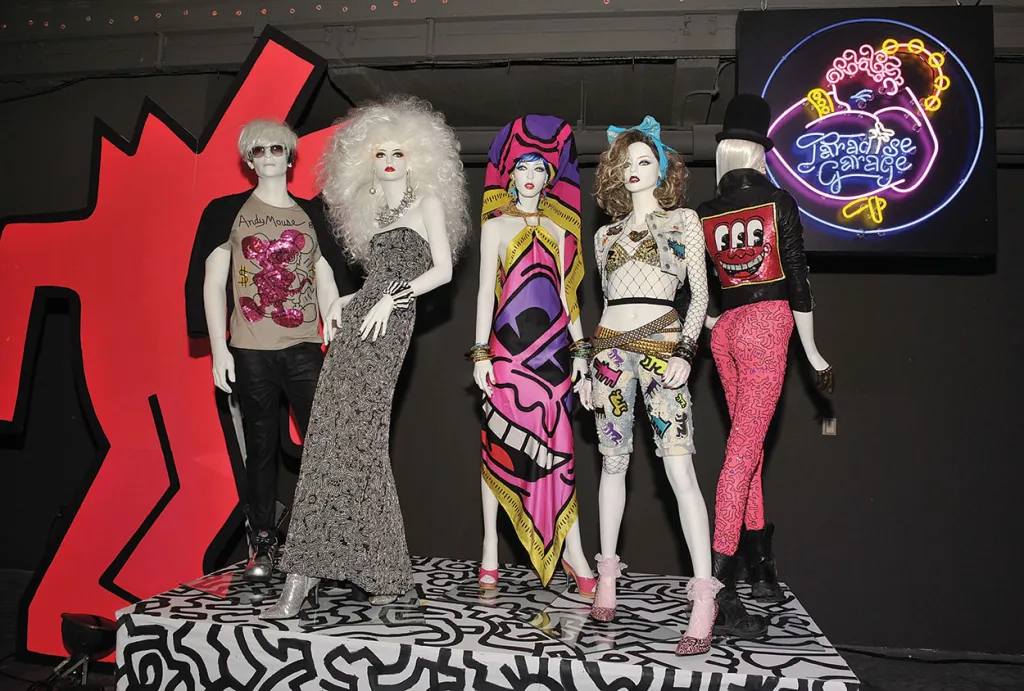
Similarly, his friend Keith Haring is known by many as the ultimate merchandiser, opening his Pop Shop in 1986 on Lafayette Street in Lower Manhattan during the peak of the East Village art scene’s blending of high and low, commercial and creative. Haring drew on the ingenious merch program of the 1970s Jesus People movement, members of which had spread their countercultural take on evangelicalism by dispersing charming clothespins and T-shirts for cheap throughout California and beyond. In the Pop Shop, an abundance of ephemera offered a populist pendant to Haring’s graffiti and fine art canvases. By then, collectors had been ripping the artist’s tagged billboards out of the subways in an attempt to commodify the impossible, a situation that logically called for other modes of merchandising—whether high-priced original paintings in the gallery or mass-produced clothespins on the street.
But in actuality, Haring never found peace in the balancing of these product worlds, balking at most licensing opportunities while insisting on manufacturing his merchandise in-house even if it meant compromising revenue (one high-profile exception was his collaboration with Swiss watch manufacturer Swatch, produced for the 1984 Swatch World Breakdance Championship). “Look, if I really wanted to get rich I could have signed with Sears or J.C. Penney like they were asking me to do,” he told an interviewer before his death. “I know how to play the retail game.” The Keith Haring Foundation closed the Pop Shop in 2005 citing profit loss, which ultimately distracted the entity from its mission (to advance Haring’s work and support his philanthropic causes, which include HIV advocacy and inner-city arts education).
Keith Haring at the opening of his Pop Shop in Lower Manhattan in 1986.
Photo Nick Elgar/Corbis/VCG via Getty
After the closure, the Haring Foundation immediately shifted to a licensing model, with third parties soon producing and distributing all Haring merchandise. The decision was seismic: It paved the way for a new modus operandi for artist foundations big and small. Free from retail and production costs, and generating sizable income through royalties, this decision allowed the foundation to become not only a stable institutional caretaker of Haring’s legacy but also a major philanthropic player. “Contrary to what people think, when Keith died, he wasn’t rich…,” Julia Gruen, Haring’s former studio manager and long-term executive director of the Keith Haring Foundation, told The Huffington Post in 2014. “So the amount of philanthropy the Foundation can do is entirely dependent on the good management of our assets.”
These days such “assets” less and less involve authenticating and lending original artworks, which have historically been the mission of foundations, and more and more revolve around licensing images for either publishing or merchandising. It was the Warhol Foundation that pioneered this business model when in 2011 they disbanded their authentication board and liquidated their art holdings entirely; the advancement of Warhol as art historical brand and legacy, it had become clear, demanded a different kind of management.
As Amy Raffel observes in her authoritative 2021 book, Art and Merchandise in Keith Haring’s Pop Shop, such posthumous management rests on a paradox: that despite evidence of their skepticism toward the practice in their lifetime, the licensing deals of foundations such as Haring’s are still advanced on the intuitive estimation “of what [Keith would] have done.” Even if dead artists today engage third-party agencies to broker the licensing of their copyright much as musicians and other celebrities do, the process of developing deals remains closer to curatorial opportunities in that they demand strict alignment of aesthetic, institutional, and audience goals—as if the artist were still around with rights to veto ideas too crass or far-fetched. This is quite like any other type of rarefied celebrity, whose status as a living brand is in need of particularly delicate management. The Mapplethorpe Foundation, for example, is described by its agency, Artestar (which also represents Haring and Warhol), as a type of brand whose “licensing activities are centered on high profile, fashion, and elite brand extensions,” thus implying that for this particular artist, bedsheets are a no-go, at least for now (even if both Warhol and Haring’s foundations have since capitulated to duvet covers).
If luxury fashion’s brand-building incentive behind the licensing of fine art seems fairly obvious (signaling a position of high cultural capital to its aspirational consumers), artists too can benefit from being managed as a brand that operates across numerous product spheres, each of which requires strategic upkeep and protection from devaluation, and whose dealings may influence each other. This much was evident in the case of Raf Simons’s licensing of more than 70 black-and-white Mapplethorpe photographs to be used as prints on tank tops and aprons for his SS17 collection. When asked about the “collaboration,” Michael Ward Stout, longtime friend of Mapplethorpe and president of his foundation for the last four decades, explained that it had begun when the Foundation learned that Simons was a significant collector of Mapplethorpe’s “work,” that is to say, the original photographic prints the artist himself editioned.
THE WARHOL, HARING, MAPPLETHORPE TRIAD presents an additional lesson in the theory of the artist as brand in that their original artworks were made in reproducible mediums: photography, silk screen, and consumer ephemera. They all lend themselves to Walter Benjamin’s dictum that “in principle a work of art has always been reproducible,” but contrary to the philosopher’s much-cited prediction that an artwork’s “aura” would wither in the age of mechanical production, these artists have successfully stretched it across an endless, if highly regulated, range of mass-produced goods. They achieved this using sophisticated capitalist technologies of artificial rarity: copyright protections and trademarking practices.
This managerial model of authorship—artist not as a producer of objects but as supervisor of permissions to (re)produce—is rooted, as art historian Miwon Kwon has argued, in avant-garde art movements of the 1960s and ’70s, when artists were generally turning away from making stable objects and instead toward situations, multiples, cassettes, paperwork, and other ephemera verified only by certificates. This dematerialized approach is far more general than the specific practice of merchandising, but both emerge in response to the art market’s commodification of ideas, experiences, and myths while forgoing the artist’s hand.
View of Andy Warhol’s Flowers, 1964, at Sotheby’s, London, 2024.
Photo Tristan Fewings via Getty
For all the seeming “populism” of Haring—whose past licensing deals include Donna Karan, Patricia Field, Jeremy Scott, Tommy Hilfiger, Nicholas Kirkwood, Joyrich, Comme des Garçons, and Lucien Pellat-Finet, not to mention Samsonite luggage, Tenga sex toys, Adidas sneakers, Johnnie Walker whiskey, Izola Shower Curtains, and, of course, the 20+ year partnership with Japanese fast-fashion behemoth Uniqlo—his multitiered business model operates quite like any other successful brand in the 21st century. Licensing not only allows an intellectual property holder to participate in several markets simultaneously, it generates opportunities for more licensing in the future as each act of licensing in fact strengthens brand recognition.
In reality, the ominous predictions remain grossly overblown that mass-merchandising of the Warholian kind marks the end of fine art in the age of mass consumerism—or inversely, the beginning of a truly “democratic art” in the same age. To prove this, we need only look at the numbers. In a 2006 interview, the president of the Warhol Foundation (which oversees Warhol’s commercial licensing partnerships) proudly declared a quadrupling of revenues from licensing deals, generating $2.25 million in royalties in support of the Warhol Foundation’s endowment. This would effectively quadruple their philanthropic capacity: Like the Haring, the Warhol Foundation is a key funder of contemporary art exhibitions and publishing in the US. But the following month, a work from Warhol’s 1964 “Flowers” series—for which the artist produced a staggering 900-some individual works—sold at auction for $6,848,000. These numbers show us that, while art today may indeed function as a brand, it rarely does so in the service of merchandising to the masses who dream of wearing a Haring, sleeping in a Warhol, or eating off a Mapplethorpe. Rather, it does so in the service of obscene luxury.
