


A fanciful marquee has risen on Miami Beach’s Lincoln Road for this week. In red text, the marquee reads “Alex Prager’s Mirage Factory,” and it is the latest project by the Los Angeles–based artist. Once inside, visitors to Mirage Factory will experience three distinct constructed set pieces that show various parts of Los Angeles history. “I wanted to have Mirage Factory to be like a poem, a kind of a visual poem, in a way, about certain movements that happened that were so significant to the city’s creation,” Prager told ARTnews in a recent interview.
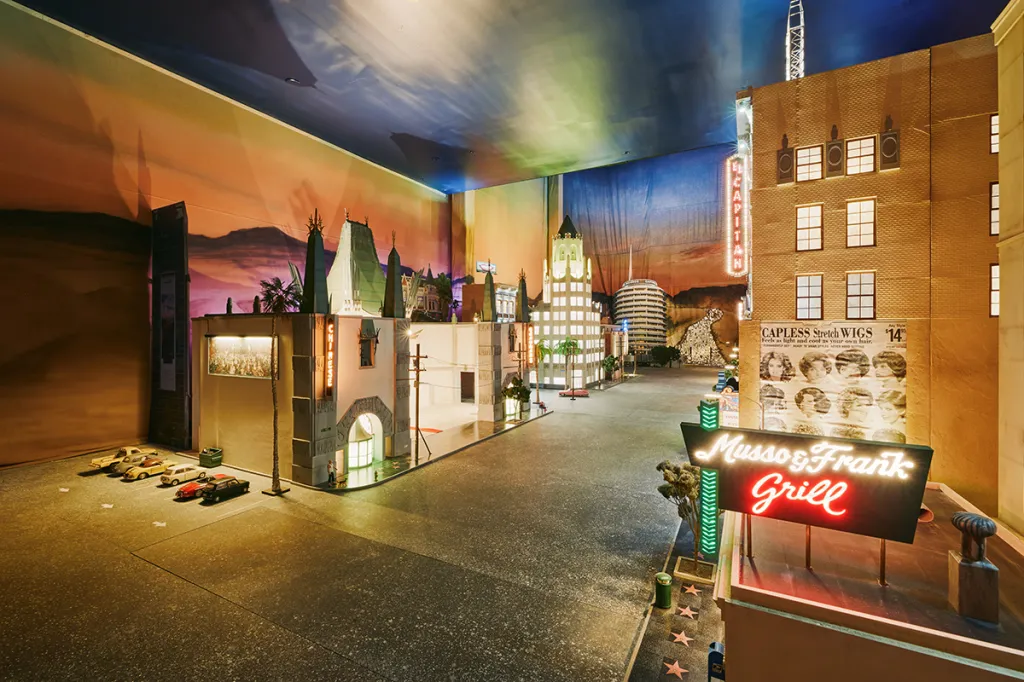
At the center of Mirage Factory a miniaturized version of Hollywood Boulevard with landmarks like Grauman’s Chinese Theatre, El Capitan, Musso & Frank’s, and the Hollywood Hotel, as well as a Hollywood memorabilia souvenir shop, an Arby’s sign, red-brick buildings, muscle cars, and billboards from different eras like one for an upcoming election in the ’30s that reads “VOTE FOR WATER OR DESERT.” It all ends in a glimmering silver depiction of the water coming from the Los Angeles Aqueduct, the creation of which was essential to the building up of LA. Walking through this 1:12 scale of Hollywood Boulevard gives you a different perspective, perhaps an unnerving one. You start to notice all is not what it seems—the street has been condensed, and some structures have been lifted from other parts of LA, like downtown. It’s not too far off from how a set designer might try to encapsulate the highlights of Los Angeles in a film so that they are all within walking distance for a given scene.
The surrealist-inflected installation is bookended by a room filled with an orange grove of real trees (to which fake oranges that smell of the real citrus have been added) and a lush green garden party, set in Griffith Park, with a kidney-shaped pool and a martini bar. Hidden behind one curtain is a work by Prager showing elegant people at a cocktail party, with chilling special effects make-up that makes them look slightly sinister.
Throughout, each room plays different soundscapes that show how Hollywood has been packaged. The orange grove room, for instance, has a man, who vaguely sounds like Danny Devito, trying to coax people to move to Los Angeles: “The beaches are wide and inviting, and the orange grove stretch as far as the eye can see. There are jobs of plenty. Land is cheap. Every working man can have his own house, and inside every house a happy all-American family. You can have all this. Who knows—you could even be discovered, become a movie star, or at least see one. Life is good in Los Angeles. It’s paradise on earth. That’s what they tell you, anyways.”
Mirage Factory is part of an ongoing collaboration between Capital One and the Cultivist that has brought a Marrakech tea shop by Hassan Hajjaj and a frozen yogurt shop by Alex Israel to Miami Beach, which are often accompanied by dining experiences by world-class chefs. For her project, Prager has taken over the former Beach Theatre, designed in the Streamline Moderne style and opened in 1940, and was a requisite stop for movie stars during Hollywood’s Golden Age while they were wintering in South Florida. The installation is accompanied by an immersive dining experience by chef Dave Beran, who runs Seline and Pasjoli in Santa Monica, California. “I chose him because he’s also very much a storyteller,” Prager said. “He tells stories through his food, and he’s very surrealist in his presentation.” The Wednesday night dinner will be accompanied by a performance by Diana Ross.
To learn more about the project, ARTnews conducted two interviews with Prager, first via Zoom ahead of the exhibition, and then this week on-site at Mirage Factory, which is open to the public on December 4 and 5, from 10am to 3pm, at 430 Lincoln Road in Miami Beach.
This interview has been edited and condensed for concision and clarity.
ARTnews: How did the commission for Mirage Factory come together, and what your interest was in taking on this project?
Alex Prager: Joey Lico at the Cultivist came to me and asked me what I would do if I had the opportunity to do something [with them]. Los Angeles had just gone through the wildfires—one of the biggest environmental disasters in history. Tons of people I know were affected by the fires, so I was in a state of wanting to make something about the city of Los Angeles. I was born there. I grew up there. I’ve always lived there. It was a really emotional time. It seemed like the perfect opportunity to dive into the city.
Had you thought about creating a large-scale film installation before this project came together?
Yeah, I’ve wanted to bring my constructed worlds into the real world. I’ve done it in small amounts with my life sculptures and oversize people. My 2023 New York show [“Part Two: Run” at Lehmann Maupin] had a silicone life-size sculpture [of a woman] with a large sphere rolled over her. That was from my film Run that I made. I brought figures and installations into spaces before but never at this scale, and it’s something I’ve wanted to do for a long time. With Capital One’s support—and they were so supportive—I was able to finally able to realize that.
Mirage Factory is sited at Beach Theatre, an iconic cinema on Miami Beach’s Lincoln Road that dates to the ’40s. How does this space relate to the work overall?
The moment we found the space we knew about its history. The movie theater was really important to me. Because of the time we’re in, we’re experiencing such a huge self-reflection on what movies mean to us. We have TikTok and so many different short form ways that people have created places for storytelling. So, the movie theater is a shared space with stranger. The moment you cross that threshold, you’re committed to the sense of imagination, magic, and suspension of disbelief. I wanted there to be that threshold that people could cross that meant something. There’s such a big conversation—at least in Los Angeles and, I think, in the world—of what movie theaters mean to us now, where we can do everything at home. When you have that great emotional jerk with people, there’s an energy that happens in that place to experience movies. Once you walk into the space, it’s completely deconstructed and empty. In a way, it reflected what I wanted to do with Mirage Factory, which was to take a place that was never meant to be a city and use craftsmen to imagine what it could be, construct a full experience within that empty space, and create something magical.
Can you give us a sense of what Mirage Factory as a constructed city will feel like?
You’re first met with orange groves, which is what Los Angeles was before it became a city. Then you’ll pass through a painted backdrop, and you’re met with a [reproduction of a] mural, You Are the Star [1983] by Thomas Suriya on Hollywood Boulevard. I grew up on Hollywood Boulevard for a while, so I looked at that mural almost every day as I was walking Hollywood Boulevard. Then you’ll see the Los Angeles Aqueduct at the end of the space and several miniatures of Hollywood Boulevard in 1:12 scale, so you’re basically at the scale of [Allison Hayes in] Attack of the 50 Foot Woman walking through Hollywood, but it’s Hollywood Boulevard through the ages, from the 1880s up to now, with a focus on the 1920s through the ’60s. But it’s meant to be a distorted mix of dreams and reality. Then you go into the next room, and you’re met with Griffith Park, which is also where I was born and grew up, and the skyline of Los Angeles. The first room with the orange groves shows LA with a blue sky in the day, the aqueduct is LA dusk, and the last room—the green room, we call it—is like a garden party at night.
Walking through Mirage Factory you start to notice that this isn’t a one-to-one miniaturization of Hollywood Boulevard.
It’s my memories and the collective memories of others. I feel what’s been depicted about Los Angeles is, actually truer than the city itself. That’s where people get their ideas about LA. I wanted to blur the lines of what it really is versus how we think it is. That dream of “what it could be” and “what it is” is very much what moves the city forward.
Some elements we took from downtown LA, especially if they’re more background. We started mashing up other places. I wanted the experience to feel really impactful versus what’s actually real. Because if we did the real Hollywood Boulevard, it would be too literal, and the buildings would all be really low, because most of the buildings on Hollywood Boulevard are really low. I wanted to create this feeling that you were in the city, in a way, and that you could be a part of the city.
Installation view of Alex Prager’s Mirage Factory, 2025, with Capital One and The Cultivist, at 430 Lincoln Road in Miami Beach.
Photo Daniel Lee
What’s the significance to each room?
They each represent something different to me. The orange groves are more obvious. The representation is the beginnings of a city built on dreams—dreams that can come true but also broken dreams. The next room is really about Hollywood as a commodity, and the city being sold and packaged like anything else: toothpaste, condoms, and alcohol. Los Angeles was never supposed to be a city—unlike any other city in the world it really never should have been. But it was because of the aqueduct and the water that was brought in that LA was able to be imagined as a city. That’s just fascinating to me.
There’s a certain hard work and work ethic in Los Angeles that you don’t really find anywhere else because it really is a city built on imagination. The people built it despite all odds. And it’s also full of corruption and spectacle, which adds to a certain madness that you feel in the city when you’re here. I think a lot of people come here expecting something, and then they get here and they just see the corruption, grime, and madness, and maybe they’re turned off by it. Underneath all of that, there’s this ever-constant feeling of “what if,” and that’s part of the magic that makes Los Angeles so special, and unlike a lot of other cities.
The third room is about the unorthodox social thought here. The city’s kind of always had little weirdos coming from all parts of the world to build their dreams, not just in Hollywood. There are shopkeepers, religious leaders, cult figures, astrology workers, and magicians. Different types of people come here who think differently. Some are really into, you know, physical wellness—that’s such a big movement that I think we created here that went worldwide. I think the identity of the city is very much in those things.
Going back to the to the miniatures of Hollywood Boulevard through the ages, were you inspired by Ed Ruscha’s photobook Every Building on the Sunset Strip (1966)?
I love that book. I was afraid of this question to be honest because growing up in Los Angeles is so much a part of me. And it’s one of the most photographed cities in the world, and there’s been so many stories about Los Angeles as a set of cultural collective memories that we all share, so it’s really hard to talk about specific references. But, yes, Ruscha, Joan Didion, and Kenneth Anger are influences. There’s [perhaps more] obviously Gary Krist’s [2018] book Mirage Factory: Illusion, Imagination, and the Invention of Los Angeles and City of Quartz [1990 by Mike Davis]. Another influence is the Hollywood craftsmen who I work with; they are from three or four generations of Hollywood craftsmen, making special effects and visual effects in Hollywood. Jeremy Dawson was a producer of mine a while back, and he’s a producer for Wes Anderson, who uses the same miniaturist company that I work with. That’s one of the great things about living in Los Angeles. It’s like no other place for excellence of craft in film. I really wanted to focus on the hand-crafted element because over a hundred people worked on it to bring it life. In our digital/AI day, I wanted people to feel that tangible aspect of the work that these craftsmen put into what you see. Mirage Factory is really about the state of Los Angeles now, Hollywood in particular, because it’s going through such an upheaval and major transition.
Why did you want to borrow the title Gary Krist’s book for this project?
That book is so great, as is City of Quartz. But Mirage Factory has a little bit more of that feeling that I connect to about the city, that it’s a constructed city, built from individuals’ imaginations and dreams. There’s this romanticized sense of the mirage, this idea that it can come up out of nowhere from the water. Water is so important to this city. It’s just a constant thing, because the water comes from so far away, and then it has to be filtered. There are always conversations about the water, from the droughts that we’re having to whether is the water safe to drink, especially after the fires.
You mentioned that Mirage Factory was developed in the wake of the wildfires, but you seem to have avoided a direct representation of the wildfires. Why did you approach it that way?
I wanted Mirage Factory to be a kind of a visual poem, in a way, about certain movements that happened that were so significant to the city’s creation. For my entire life, I’ve really had this just ongoing tension with the city. I’ve fallen out of love with it so many times, and I’ve become disillusioned with it. It just seems like an impossible place to live at times. But we’ve always been this way, since the beginning of time. The wildfires represented an aspect of that, but there’s always been fires. There’s always been earthquakes. We have the Santa Ana winds. There’s been riots and floods. That’s why there’s this energy in the city because it really wasn’t supposed to be here. I think that plays a constant set of conflicting moments. There’s a self-awareness I feel when I’m there. There’s so much about Los Angeles that I love. The constructed myths and allegories that I create through my photography and these moments of tension are all about that feeling of my love-hate relationship with this city. It’s always been this way, and it will never change. It’s a city in constant transformation. That’s something that I came to terms with after the fires. I grew up my whole life on the East Side [of Los Angeles]. After the fires, we moved to London for a while because I needed some time away for self-reflection—and maybe just leave forever. Then I found myself wanting to go back so bad because there’s something about LA. There’s a magic underneath everything. It’s feeling of “what if” that is just ever present—it’s addictive. If you dream big naturally, then you need to dream big there because everything is possible there.

Installation view of Alex Prager’s Mirage Factory, 2025, with Capital One and The Cultivist, at 430 Lincoln Road in Miami Beach.
Photo Daniel Lee
What about Los Angeles and Hollywood continues to fascinate you and keeps being such inspiration for your work?
The Golden Age in particular is fascinating to me because of the machine that it was. It was an assembly line of excellence. There was an unmatched level of artistry. MGM was putting out like 50 movies a year—every studio was back then. It was a time ripe with healthy competition among the studios. The true Hollywood factory was created then, and it was running so smoothly for a while, but it was also so dark underneath. It offered many side doors for people to get in if they wanted it bad enough. All of that is really fascinating to me.
Los Angeles is so much a part of who I am. All of my work has had Los Angeles as a character in it, and I made everything within like a 10-block radius of where I grew up pretty much. All of that played a significant role in wanting to construct something really ambitious and emotional with tension around the city. It’s an extension of who I am, where I grew up, and what this city means to me—all of my work is about that too.
What do you make of presenting such a Los Angeles–centric work in Miami?
Because Los Angeles is one of the most photographed cities in the world, the stories that have been told around LA are global. Everyone has ideas about what Los Angeles is, even if you’ve never visited. Hollywood, as a machine, is also something that everyone is very aware of and it’s very present as a place, as well as a business. I don’t think I would have been able to do this with just any city. It’s because Los Angeles is a shared place. Everyone has a place for Los Angeles in their memories or their imagination of what it was, what it is, and what it might be. I’m hoping that when people walk through the space that they are able to connect with it on a personal level because of whatever their ideas about Los Angeles and the city are. There’s so much magic that’s infused in the space that I’m hoping people will enjoy it. It’s definitely surrealist in the way that I approached it. I didn’t want to be literal. There’s that timelessness in it. It’s supposed to kind of be more of a metaphysical experience where you can walk through and tap into your more childlike dreamers’ head space.
