


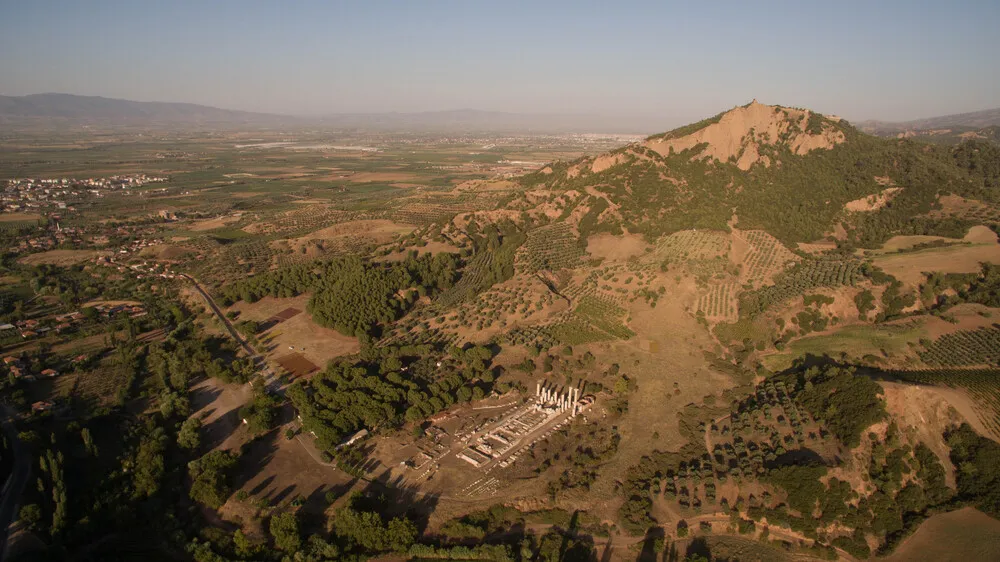
The Iron Age city of Sardis in western Turkey has been designated a UNESCO World Heritage Site, marking a milestone in one of the longest-running archaeological projects in history.
Every year since 1958, archaeologists have returned to the ancient city as part of the Harvard-Cornell Exploration of Ancient Sardis, and excavations are still ongoing. Once the capital of the Iron Age kingdom of Lydia, Sardis stood at the crossroads of the Mediterranean and the Anatolian Plateau, a position that endowed it with a rich cultural legacy and a striking array of well-preserved ruins.
Speaking to ScienceDaily, Benjamin Anderson, associate professor of history of art and visual studies at Cornell’s College of Arts and Sciences, said that in recent years, investigations have focused on the Sardis acropolis and adjacent Temple of Artemis.
“Many of us know and have been mentored by colleagues of the previous generation of excavators,” Anderson said. “As a result, it’s one of the few long-term archaeological projects in the region that has generated a critical mass of data.”
He added, “This is a city that shows up in lots of ancient historical sources. But now, just in the last 75 years or so, we have the possibility of telling that story, too, through what the project has found archaeologically.”
Lydia’s importance to world history is difficult to overstate. Lydians are widely recognized as the inventors of coinage, helping to make their capital, Sardis, synonymous with fabulous wealth in the ancient Mediterranean. The kingdom lost its independence when it was conquered by the Persian king Cyrus the Great in the 6th century BCE. Centuries later, Alexander the Great captured Sardis from the Persians, after which the area came under Hellenistic, Roman, Byzantine, and finally Ottoman rule.
Annetta Alexandridis, associate director of the excavation and associate professor of history of art and classics at Cornell, said in a statement: “These layers are all there, and make it sometimes difficult to excavate, because they are not clearly stratified. They interfere with each other, but, in a way, it’s an ongoing history, and that makes it so fascinating for us.”
The UNESCO inscription includes Sardis and the associated tumuli, or man-made funerary mounds, at Bin Tepe, a vast, undulating cemetery linked to the ancient city. One of the benefits of UNESCO designation is the promise of additional resources for preservation and protection, both of which, Alexandridis stressed, are urgently needed. Tumuli across the Sardis landscape have been damaged by farming and natural erosion, while increasingly sophisticated looters have inflicted further destruction. Treasure hunters now operate on “an industrial scale,” she said, using explosives and bulldozers to plunder the site.
“As a local, I can say it is very important,” she said of the UNESCO designation. “First of all, now it is known worldwide and because of UNESCO, there can maybe be more funding for the excavation, also people, more tourists and more research. People will know the area much better, and there will be more protection.”
