


Germany’s Kunstmuseum Magdeburg may be housed in a building dating all the way back to the 11th century, but it has become a standard bearer of contemporary art in the Saxony-Anhalt region, a stretch of the former German Democratic Republic west of Berlin.
The municipally-funded museum, situated in the region’s capital city, relies in part on regional funding to stage special exhibitions, and it is currently mounting a diverse but pointed show about agents of instability in contemporary life called Das Geteilte Jetzt/The Shared Now. This weekend, just as the show is set to close, Germany’s wider electoral instability threatens to catch up with the museum and the region it serves.
On Sunday, the eyes of the country will be on Magdeburg, a city of some 250,000, when Saxony-Anhalt holds a crucial regional election on track to deliver a momentous victory for Alternative für Deutschland (Alternative for Germany, or the Afd), a far-right party that has become the most popular in the former East Germany while making dramatic headways in the former West. In the final round of polling ahead of the election, released this past weekend, the AfD was forecast to receive more than 40% of the vote, up from just under 25% in the last state election, held in 2021. The Christian Democrats (CDU), who have largely dominated political life here since the fall of communism in 1989—and who are currently leading the state’s regional coalition government—are polling at just over 20%, down around 1/3 from 2021.
If those polls are correct, it will be hard for a government to form in the Magdeburg Landtag, or state parliament, without the participation, if not the outright leadership, of the AfD, marking the first time since the defeat of Nazism that a far-right political party achieves this level of power in Germany. And culture, it turns out, is on the ballot.
The AfD was founded in 2013, against the backdrop of the Eurozone crisis of the early 2010s. During that period, it took a strident stance against the bailout of southern European countries, most notably Greece, that had run up large budget deficits following the 1999 introduction of the single European currency in financial markets, ahead of the euro’s wider launch in 2002. Like rightwing populist movements elsewhere in Europe, the AfD has evolved over the years, voicing strong objections to a range of mainstream policies, including Germany’s asylum laws and COVID-era lockdowns. In its most recent incarnation, it has begun to actively promote a more restrictive idea of German culture, taking on as bogeymen anything from the century-old Bauhaus movement, associated with the Saxony-Anhalt city of Dessau, to the country’s famously radical theatre productions.
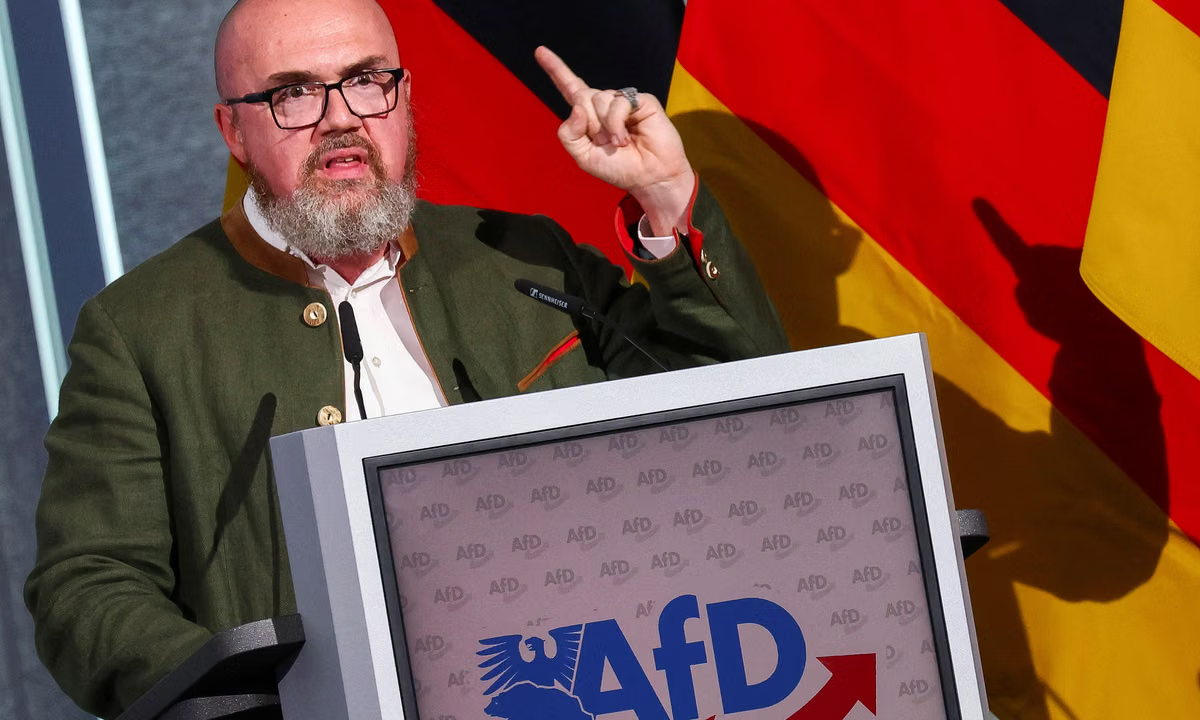
The lead candidate in Sunday’s election is Ulrich Siegmund, a 35-year-old Saxony-Anhalt native and longstanding member of the Saxony-Anhalt Landtag, however the party’s leading intellectual figure (and “mastermind” behind Siegmund’s campaign, according to the Die Zeit, the German weekly), is Hans-Thomas Tillschneider, the party’s deputy chairman in the Landtag. He spoke to The Art Newspaper in late July about his party’s approach to arts funding.
“If someone wants state funding, then they will have to say, ‘I am for Germany, I am not against Germany, and I understand that my artistic commitment is to make a positive contribution to German culture,’” he said. The sentiment echoes a similarly worded motion the AfD made this past June in the Magdeburg Landtag. That motion—a symbolic gesture that was defeated—suggested that recipients of cultural funding should submit a declaration committing themselves to “German national culture” and vowing not to “denigrate” that culture. The motion and its controversial requirements could be revisited if the AfD assumes power in the wake of Sunday’s vote.
“Long-term implications”
One institution that may be affected by these political shifts is the Stiftung Bauhaus Dessau foundation, dedicated to the influential 20th-century school of art. The foundation, housed in Walter Gropius’s original 1926 Bauhaus building in Dessau, hosts a museum and oversees a research library and archives. It is one of Saxony-Anhalt’s leading cultural attractions: nearly 180,000 people visited last year, more than double the population of Dessau itself.
Tillschneider, in his interview, reiterated his larger criticisms of the historical Bauhaus movement; its international style, he said, lacks “rootedness”. The Stiftung Bauhaus Dessau’s eclectic exhibition programme, in invoking the fate of many of the original Bauhaus members in the Weimar and Nazi periods, often takes a critical stance with regard to German history. It is hard to imagine how it would fit into the AfD’s proposed proscriptions.
Barbara Steiner, the Austrian art historian who has served as the director of the Stiftung Bauhaus Dessau since 2019, says that the foundation’s current mix of public funding includes direct grants from the state of Saxony-Anhalt.
Asked what she foresees if the AfD manages to form a government, Steiner said: “In my view, a worst-case scenario would be a political constellation in which cultural policy decisions were used to gradually restrict the institution’s work, funding stability and programming.” This could start with the budget, she continues, and “could potentially have long-term implications for staff, partnerships and international visibility”.
Over at the Kunstmuseum Magdeburg, a restriction in state funding might stop any special exhibitions taking place, let alone provocative ones like Das Geteilte Jetzt/The Shared Now. That show “certainly doesn’t fit thematically” into the AfD’s idea of culture, a museum spokesperson, Magdalena Burkhardt, says.
Museum directors and arts professionals across Germany are closely following the Saxony-Anhalt election, says Andreas Beitin, the director of Lower Saxony’s Kunstmuseum Wolfsburg, which is known for its Modern and contemporary shows. It is the first of four this month that will test the resilience of the AfD in states as geographically and demographically diverse as Mecklenburg-Vorpommern, in the northeast of the country, and Lower Saxony in the northwest.
Lower Saxony’s municipal elections, which will be held on 13 September, are therefore unlikely to lead to any direct threat to what his museum does, Beitin says. Now funded by a private foundation, the Kunstmuseum Wolfsburg has links linked to Volkswagen, the car manufacturer that serves as Wolfsburg’s preeminent employer. Current polls in Lower Saxony put the Adf at around 20%, or just below the two major parties, the CDU and the Social Democrats, who are each polling around 25%.
Nevertheless, “the scenario of a possible AfD government is quite frightening,” Beitin tells The Art Newspaper. The requirement to make “declarations of patriotic conviction” in order to secure public funding “is certainly a terrible threat”, he adds. And even in areas where the AfD is not set to obtain outright political power, Beitin says, the party has negatively affected public discourse.
The AfD could not be reached for further comment.
The way Beitin sees it, he and his colleagues need to find a new spirit of collaboration—and resistance. “The only thing we can do is stick together, not let ourselves be intimidated, and take a stand.”
