


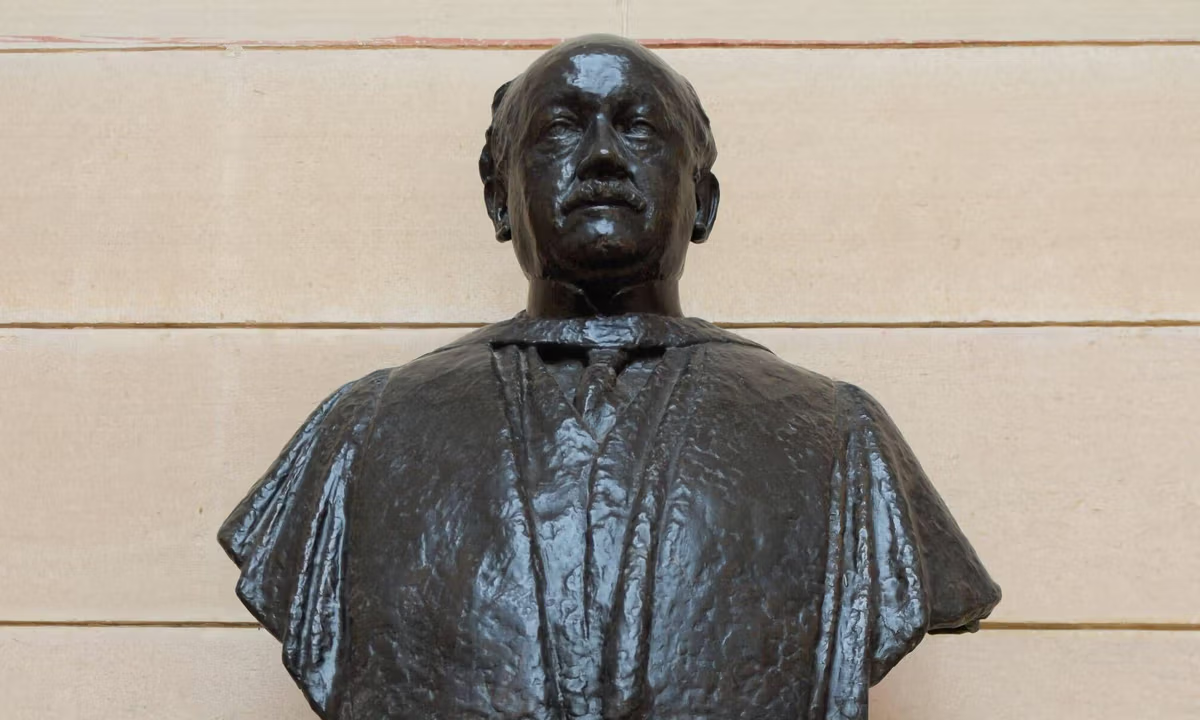
A bust of the British architect Edwin Lutyens has been removed from the Rashtrapati Bhavan, the official residence of the Indian president. The bust, made in 1929 by William Reid-Dick, was replaced this week by a statue of Chakravarti Rajagopalachari, the last governor-general of India, and the first Indian to hold that post. Droupadi Murmu, the current president of India, described it as a step towards “shedding the vestiges of colonial mindset and embracing, with pride, the richness of India’s culture”.
The move forms part of a long-standing desire on behalf of the Indian prime minister Narendra Modi’s ruling Bharatiya Janata Party (BJP) to remake India’s long-standing secular political identity, which the BJP links with the legacy of British rule. In recent years, the BJP government has overseen extensive construction to replace Delhi’s old civic centre, designed by Lutyens in the early 20th century, which they associate with the country’s old, English-speaking elite.
Edwin Lutyens was one of the most prominent architects of the Edwardian era, devising a modern, restrained neo-classical style, seen in projects such as the Cenotaph in London’s Whitehall. He also designed much of modern Delhi, including monuments like the India Gate and the Rashtrapati Bhavan. He travelled to India regularly between the 1920s and 1940s—a fertile period of archaeological rediscovery in the subcontinent—and incorporated Indian motifs into his work.
But he was also overtly racist towards Indians, stating in a letter to his wife Emily: “The very low intellect of the natives spoils much. I do not think it possible for Indians and whites to mix freely; mixed marriage is filthy and beastly and they ought to get the sanitary office to interfere.” His views were reflected in his commentary on Indian culture: he referred to to Mughal architecture as “piffle” and hybrid Indian-inspired Victorian architecture as “half-caste”.
Modi, India’s prime minister since 2014, characterised the move as liberating India from “the mentality of slavery”, referring to continued reverence from some segments of India’s society towards the country’s colonial legacy. Modi, who does not give interviews, made the comments during his monthly solo broadcast to the nation: “Unfortunately, even after independence, statues of British administrators were allowed to remain in Rashtrapati Bhavan, but those of the nation’s greatest sons were denied space.”
Lutyens’s great-grandson, the British journalist and member of the UK’s House of Lords Matt Ridley, said on X that the removal was “sad”, and made the case for Lutyens’s sympathetic architectural engagement with India. In a separate post, Ridley called the Rashtrapati Bhavan “a more ingenious and imaginative building than Buckingham Palace, the White House, the [Quai] D’Orsay, the Kremlin or the presidential palace in Beijing.” He continued: “It carefully incorporates Buddhist, Hindu, Jain and Muslim architectural themes.”
The Rashtrapati Bhavan is certainly larger than those buildings: at 200,000 sq ft on a plot of 320 acres, it is the second-largest head of state’s residence in the world after the Quirinal Palace in Rome. Its construction turned the principal contractor Sobha Singh into one of India’s richest men. It was designed by Lutyens and Herbert Baker as the “Viceroy’s House”, and construction began in 1912—a year after the British moved the capital of India from Calcutta (today Kolkata), to Delhi, the historic capital of Mughal India.
Much of Delhi’s grandiose Islamic architecture had been destroyed in the British response to the “Indian Mutiny” of 1857, so Lutyens was given the task of innovating a new architectural idiom appropriate for the seat of government of the world’s largest and most powerful empire. The empire at the time stretched from the Andaman Sea to Abu Dhabi, and was administered from Delhi.
For decades after the end of British rule, colonial monuments like the Gateway of India in Mumbai or the Indian Museum in Kolkata were treasured by many as symbols of India’s national identity. In recent years, however, such architectural vestiges of the British era have come to be seen with suspicion by a government keen to remake the architecture of power in India.
It has employed Bimal Patel—dubbed by the Indian magazine Caravan as “Modi’s architect”—to construct a new parliament, processional pathway and administrative complex. In 2020, the sculptor Anish Kapoor condemned a lack of “due process” in Bimal’s commission. “The destruction of Lutyens’ Delhi is deeply misguided and comes out of Modi’s political fanaticism,” he wrote in the Guardian. “This is not the redesign of buildings, it is instead Modi’s way of placing himself at the centre and cementing his legacy as the maker of a new Hindu India.”
Lutyens’s architecture may have engendered considerable controversy, but it remains a highly sought-after commodity: in February, the Maharaja of Tehri Garhwal, Manujendra Shah, reportedly put his Lutyens-designed bungalow on the market for more than £80m. The Maharaja’s wife is a member of parliament for the BJP.
