


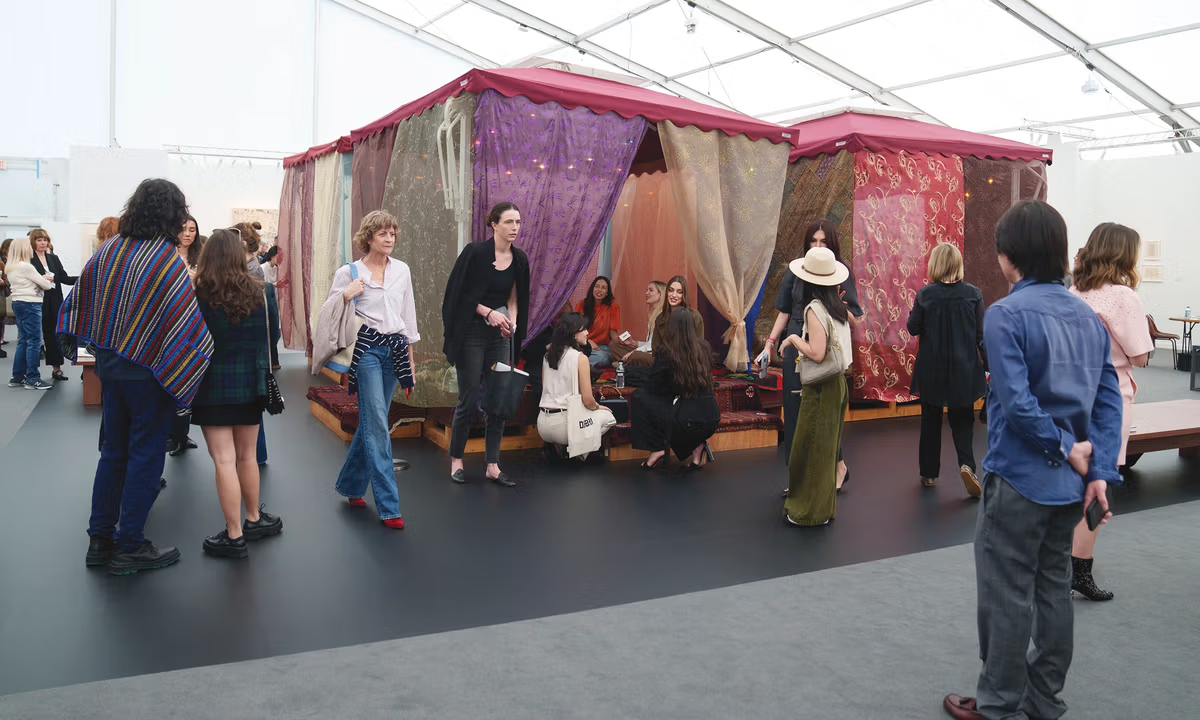
Although the clamouring for bold artistic statements remains loud, one place in the art industry that has become less likely to answer it in 2026 is the art-fair stand. The waning adventurousness in these spaces speaks to important shifts in the trade over the past two decades—and there is no better time to consider them than this month, as the fairs have stretched from Zona Maco in Mexico City and the first-ever Art Basel Qatar in early February to the latest Frieze Los Angeles.
“Statement stands”, for want of a better term, used to be the talk of the fair sector in the 2000s and 2010s. Sometimes their distinguishing trait was immersiveness, as when Jeffrey Deitch reimagined the early 20th-century Manhattan studio of the late artist and salon organiser Florine Stettheimer (1871-1944) at the 2017 Armory Show in New York. Other times it was fearlessness, as when Gavin Brown devoted his stand to a single spinning cigarette pack by Urs Fischer at Art Basel Miami Beach in 2006.
Readers struggling to conjure post-pandemic corollaries are far from alone. Multiple sources I spoke to strained to do the same. The prevailing sentiment is that the larger forces in the fair sector have reduced the statement stand to an endangered species.
The cost of curation
Although almost every aspect of running a commercial gallery has become (much) pricier since 2020, data and anecdotes have pegged art-fair participation among the worst offenders. Dealers surveyed in last year’s Art Basel and UBS Global Art Market Report, for instance, ranked fairs as the third most concerning cost. If even the simplest stand is becoming prohibitively expensive, fewer dealers can afford to gamble on costlier build-outs or daring curation.
“Fairs are a business. Galleries are there to make money, to recoup their costs, to sell art,” says the New York-based adviser Candace Worth. “They are, I’m sure, weighing the upside of the marketing buzz a booth can provide versus the upside of selling work by ten or 20 artists.”
Paradoxically, she notes, the galleries with the most resources to present statement stands also rarely do so anymore. This is partly because they have the luxury of mounting attention-grabbing solo exhibitions in their numerous permanent spaces around the world. Some of these are proximate enough to the major fairs to give top dealers the best of both worlds: a programme-spanning group display inside the convention centre (or tent) and a focused show of force in their gallery nearby.
Víctor Hugo Pérez’s colourful works on Proyectos Monclova’s stand at Frieze Los Angeles 2025 Photo: Casey Kelbaugh/CKA
The proliferation of fairs over the past two decades has contributed to the fade of the statement stand, too. Executing an ambitious display when a dealer only showed at one or two of the 68 annual fairs operating in 2005 was one thing; it is entirely another proposition now that there are hundreds of fairs per year—and the pressure to do several more of them than 20 years ago.
“I find that the whole calendar has gotten overwhelming, and it feels as though there’s no real discerning factor between fairs other than location, when the galleries are mainly submitting group selections of their artists,” says one collector.
New ways to make a mark
One counter-argument is that some of the energy of statement stands has been channelled in new directions. “Many of today’s strongest statements operate through duration or conceptual density rather than provocation,” says Christine Messineo, the director of Frieze New York and Los Angeles. “They reward time and attention rather than demanding it instantly, which can make them feel less conspicuous, but not less ambitious.”
Messineo cites Edel Assanti’s presentation at Frieze London in 2024 as one recent example of the move away from spectacle and towards experience. Anchoring the stand was Jenkin van Zyl’s Sweat Carousel (2024), a functioning sauna that “collapsed film, architecture and performance into a single embodied environment”.
It is arguable, too, that narrower remits of fairs’ curated sections have provided fresh ways of making a mark. Think solo presentations of emerging artists, as in Frieze Los Angeles’s Focus section, or the monumental works making up Art Basel Unlimited. “There are now multiple contexts within the fair where different kinds of ambition can thrive,” Messineo says, adding that Frieze’s special sections “give galleries permission—and the structural support—to take risks that might previously have felt harder to justify”.
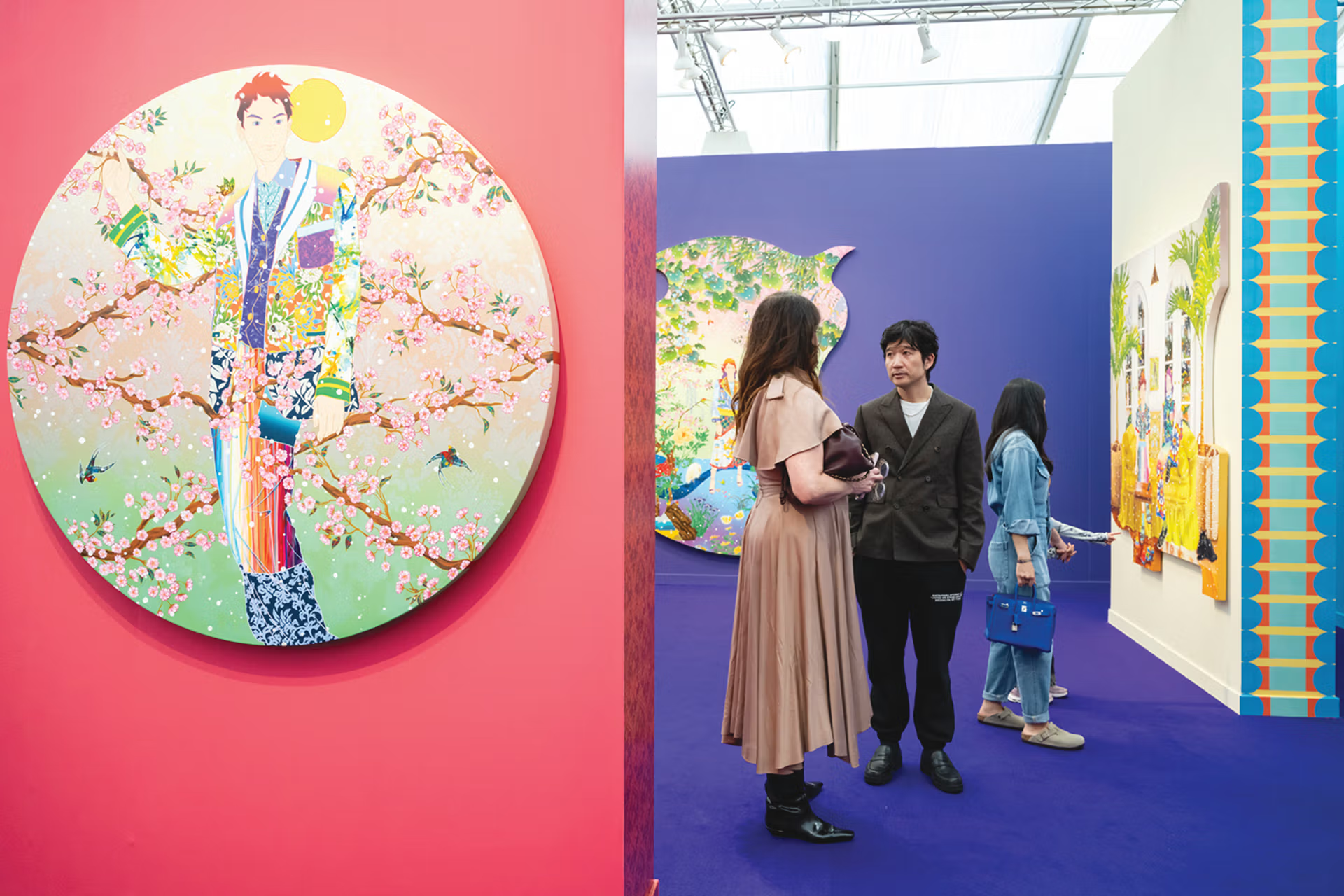
A solo presentation of Tomokazu Matsuyama’s work at Almine Rech’s stand Photo: Casey Kelbaugh/CKA
More holistic alternatives have also emerged. Some excitement has shifted towards boutique fairs in nontraditional environments, like Post-Fair (26-28 February) in a former Santa Monica post office. The inaugural Art Basel Qatar consisted of nothing but single-artist presentations guided by the artist and curator Wael Shawky. Vincenzo de Bellis, Art Basel’s chief artistic officer and global director of fairs, says that this format “is itself the defining gesture” of the event.
De Bellis acknowledges that it would be “disingenuous” to ignore the rising costs facing any dealer organising a fair stand in 2026. Still, he says, “the willingness to invest in artists, ideas and presentations remains very much intact. Galleries are making very conscious decisions about where to place emphasis and how to align their presentations with longer-term strategies.”
Opening eyes (and wallets)
Shifts in collectors’ behaviour also complicate the calculus of any fair presentation. As art fairs and their influence have expanded this century, foot traffic to commercial galleries has subsided in lockstep. Reasonable people can debate whether these phenomena represent direct cause and effect, but industry veterans tend to see more than coincidence at play.
Worth, for one, believes that the average buyer based outside an art hub like New York increasingly looks to fair visits as replacements for the gallery-going that used to be the bedrock of collecting. “It’s kind of depressing, but it is what it is: they spend three or four hours at a fair, do some business and go home,” she says.
This change suggests that statement stands—by whatever definition one chooses—are becoming higher stakes in both risk and reward, at least for the out-of-town dealers whose fair displays are their one opportunity to entice buyers in a different locale.
So, it is noteworthy that immersive presentations still crop up outside the major international expos, too. This year’s edition of the Winter Show, which closed at Manhattan’s Park Avenue Armory on 1 February, included Study of a Young Collector, a faux domestic interior hung with a cross-category mix of classical and contemporary works in dialogue. The stand, sourced from 11 young dealers, was “a literal study but also a character study of an imaginary person through the lens of the objects they collect”, says its co-curator Patrick Monahan. The goal was to give inexperienced visitors a taste of living with art of all types. “We wanted to remind people, especially new audiences, that you can come in and be a part of it,” he adds. “What’s really going to happen with these events if you don’t make room for new people?”
