


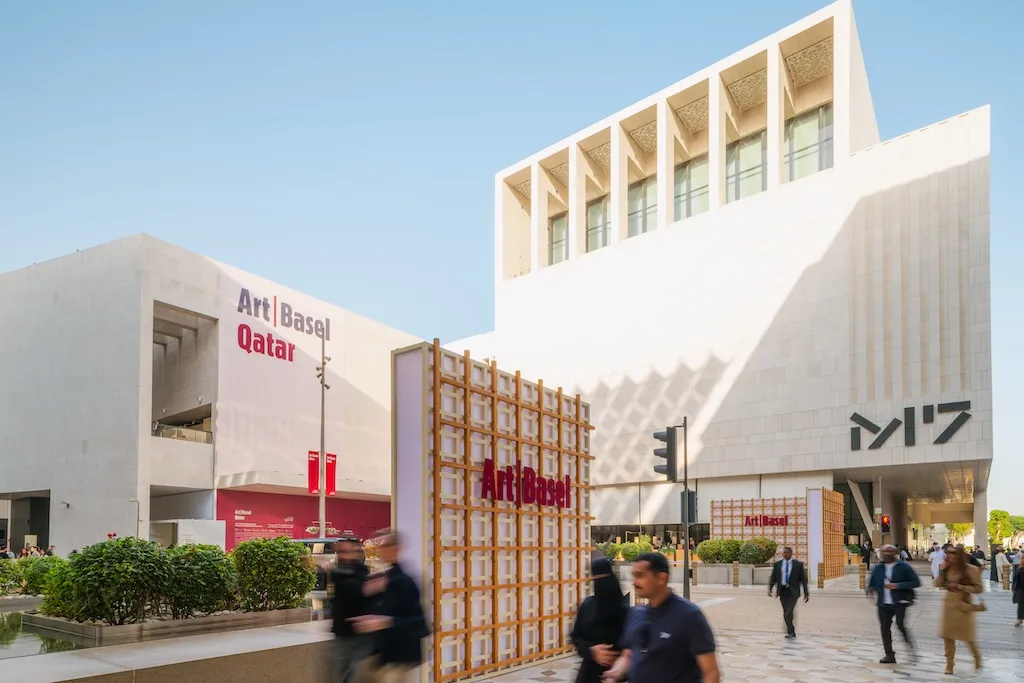
Art Basel’s first edition in Doha opened this week with a noticeably different rhythm from the fair’s established outposts in Basel, Paris, Hong Kong, or Miami Beach. The Qatari fair’s format focused on fewer galleries, solo presentations, and a layout that encourages visitors to move slowly. The change was significant and widely praised on the floor by dealers and visitors. Disparate booths were suddenly in conversation with each other yet there was room for both the art, and the visitors, to breathe deeply.
Sales, however, were more selective. Many dealers described the opening days less as a rush to transact than as a period of positioning and discovery.
The atmosphere felt closer to an introduction than a full-scale commercial test. That was by design as, leading up to the big event, Basel executives waxed lyrical about how the iteration of the fair was equal parts meditation and commercial endeavor. ARTnews was told that many visitors, including collectors from the region, were attending an art fair for the first time, and the scaled-down format made the whole enterprise more easily digestible, both for veterans and the newly initiated.
“It’s thoughtfully composed,” said Amar A. Zahr, a partner at the Dubai- and Berlin-based AAZ Art Advisory who works primarily with Middle Eastern collectors. “Art fairs are overwhelming. Here, you can actually look.” Zahr described the opening day as a chance to observe how a market in Doha might take shape. Collectors in the region here have access to Middle Eastern and North African artists that might not have been on their radar before, Zahr added.
Installation view of Lehmann Maupin’s presentation of works by Nari Ward.
Andrea Rossetti
Few galleries reported sales during the opening day, which put the fair in a type of holding pattern. Multiple dealers said a significant number of works across the fair were placed on reserve following a private walkthrough on Monday by members of the Qatari royal family, who were granted right of first refusal. Galleries said they expect to learn whether those holds convert into purchases tomorrow, a dynamic that helped explain why some dealers, including Sadie Coles, ATHR, Almine Rech, Gladstone, Pace, Lisson, Lehmann Maupin, and Gray, reported strong interest but held back on confirmed sales figures.
Art Basel leadership has been careful not to frame Doha’s debut purely in terms of early sales figures. Vincenzo de Bellis, the fair’s chief artistic officer, told ARTnews that the commercial side of the fair remains essential, but that success would be measured by several additional metrics, including new relationships formed, regional participation, and longer-term collector development.
De Bellis said the solo-artist format, while seemingly a riskier prospect for galleries, was a deliberate attempt to slow the speed of viewing and encouraging deeper engagement. Still, he said the fair’s model may evolve over time and that the event was always planned as a long-term commitment rather than a one-off experiment.

Installation view of ATHR’s presentation of works by Ahmed Mater.
Ismail Noor
The solo-presentation format also left little room for contingency, a reality underscored by an unexpected change on the floor involving Stephen Friedman Gallery. The gallery had been slated to present a solo booth of work by the late Huguette Caland, and Friedman’s name remains listed on fair maps. The fair’s booth was promoted by the gallery as recently as last week on Instagram. Caland’s work is indeed on view in Doha, but it is now being presented by the Huguette Caland Estate, not Friedman. Sources told ARTnews that Lisson Gallery underwrote the presentation after Stephen Friedman withdrew from the fair at the last minute. Art Basel declined to comment on the specific reasons for the change, citing its standard policy regarding exhibitor participation.
A look at Stephen Friedman Gallery’s UK filings adds context. Public records show the gallery lost about £1.7 million in 2023, and that its auditors warned that the business was relying on outside financing to cover day-to-day costs, raising questions about how easily it could meet its short-term obligations, or even stay afloat. ARTnews tried several times to reach the gallery, without success.
“We are first and foremost a commercial enterprise,” de Bellis said, noting that galleries need to sell. At the same time, he pointed to encounters between international galleries and regional collectors, some of whom are new to buying art , as an equally important early indicator or sales figure.
Among dealers and advisers, expectations for immediate results were modest. A handful of dealers said they’d made sales ahead of the fair, but most dealers were curious enough to hold back on the pre-sales in order to understand the context, the scale, and the seriousness of the Doha project.
For collectors based in the region, the fair functioned more as a discovery platform, particularly for artists from the Middle East and North Africa. The truth is that clients who are interested in blue-chip international names are the same collectors who could already acquire those works in Basel, Paris, or London, making regional artists a more natural focus in Doha for some collectors.
Installation view of works by Mohamed Monaiseer at Gypsum Gallery’s booth
Intstagram @karendexterphoto
There was an interesting dynamic with some of those galleries who brought emerging regional artists to the Art Basel Qatar. Aleya Hamza, director of the Cairo-based gallery Gypsum, which featured an outstanding salon-style hang of textile works by the Egyptian artist Mohamed Monaiseer, described the difficulty of pricing works for an international fair without disrupting local markets. Prices that appear modest in the context of Art Basel, she said, can already represent significant steps for artists whose careers are still anchored in their home countries, especially when a dealer tries to scale up prices after selling out shows and successful fairs.
“The DNA of the galleries to work with younger artists and to you know produce work for them and do international shows and nurture their careers. And so we have to be very careful.” Hamza said. Still, the gallery nearly sold out the booth, mainly to collectors from Dubai, Saudi Arabia, and Abu Dhbi, with prices ranging from a few hundred euros to roughly €14,500.
When looking back years from now, it’s not hard to imagine the first edition of Art Basel Qatar as early investment rather than a guaranteed commercial opportunity. Iwan Wirth of Hauser & Wirth said the fair felt “real” and well-constructed, even if sales were not immediate. Wirth was fully aware, he said, that some visitors were encountering an art fair—and the idea of buying art at one—for the first time. “Still, Doha has the potential to become the center of gravity in this region, which of course is exciting.”
Wirth and others pointed to institutional interest and the presence of museum groups as encouraging signs, while admitting that it was too early to draw firm conclusions. “It’s the magic mix,” Wirth said, referring to the unpredictable combination of people, place, and timing that allows a fair to become both established and commercially successful.
The main question is whether Art Basel and the Qatari’s can “reverse engineer” an art market by introducing a major international fair before a dense commercial gallery infrastructure exists locally. Whether that strategy succeeds will depend less on first-week sales than on whether galleries return and whether collectors come back with greater confidence next year. But for now, at least, Art Basel Doha appears to be doing what it set out to do.
