


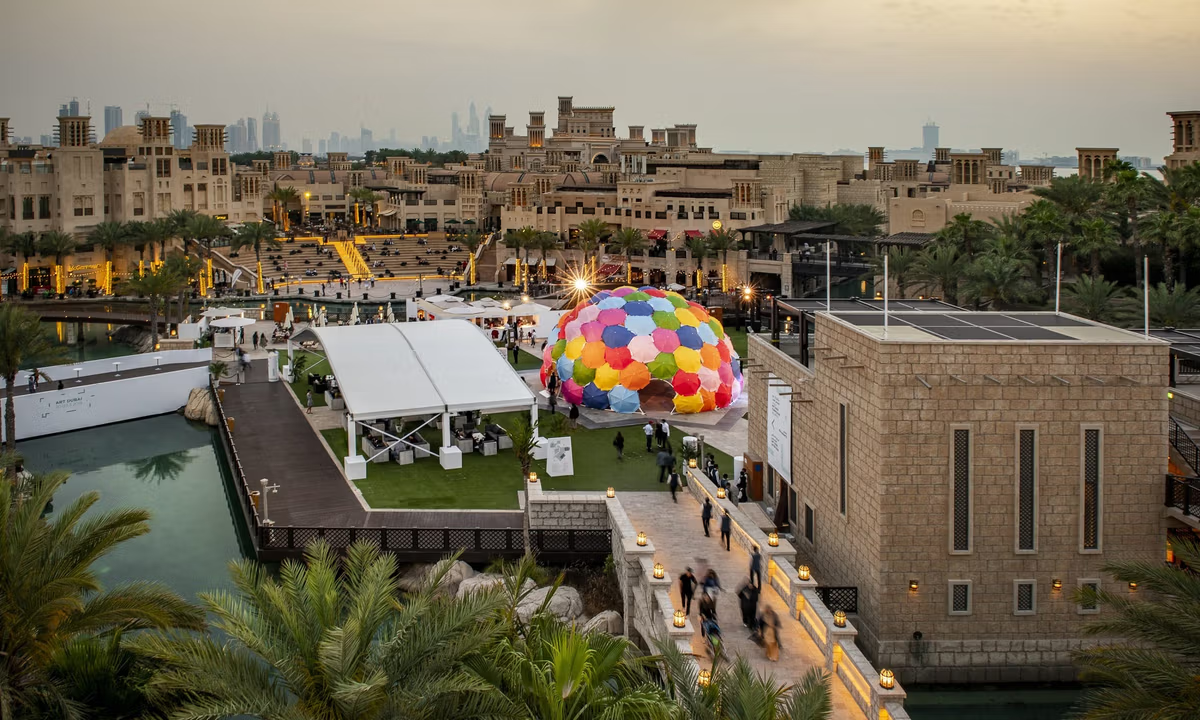
Art Dubai has announced further details of its 2026 edition, which it postponed by a month due to the US-Israel war in Iran. The fair, which will take place from 15 to 17 May in its usual venue of the Madinat Jumeirah, will include 50 regional and international galleries in its sales section, as well as a number of new partnerships in its non-commercial programme.
The fair is offering a revised fee structure to galleries, waiving stand costs and instead charging a percentage of the sales made, capped at the stand fee equivalent. Virtually all major UAE galleries are showing, including The Third Line and Gallery Isabell, plus international galleries such as Ab-Anbar and John Martin from London, Lilia Ben Salah and Galerie Frank Elbaz from Paris, and Galleria Franco Noero from Turin. Many galleries from the Arab region are also attending, such as Athr and Hafez Gallery from Jeddah, Saleh Barakat from Beirut, and Gallery One from Ramallah.
Still, around 75 galleries that had been due to exhibit in the April edition have dropped out, both from the fair’s main section and its digital and emerging platforms. The fair’s director Benedetta Ghione says a variety of factors were in play—chief among them the fact that by “shifting the timeline, we’ve basically created a new slot in the calendar for ourselves”.
Notable galleries to not make the revised fair are O Gallery and Dastan Gallery, both from Tehran, and Western outfits such as Almine Rech, ChertLüdde, Galerie Peter Kilchmann, and Vigo Gallery. None of the sizeable cohort of Indian galleries meant to exhibit at the fair—Experimenter, Jhaveri Contemporary and Chemould Prescott Road, among others—will attend, despite some of them having reported success at Art Dubai in the last few years.
“There is a constituency of galleries for whom the fair didn’t make sense, for a number of reasons—timing, logistics or the specific projects that they were planning to bring,” Ghione says. She adds that nearly all the galleries reconsidered what they were bringing to the fair, but that ultimately the gallery presentations remained broadly similar to what was originally planned. Some of the presentations had already been crated and shipped, and the fair appointed specialist shippers to help other work in. In some instances, galleries commissioned new works from artists from the UAE.
“Surprisingly, I would say, the majority of the galleries were able to maintain, if not the core, then the spirit of the roster of artists they were wanting to show,” Ghione says. “And we have pretty much a similar makeup as we tend to have within Art Dubai—about 60% drawn from the region, 40% international.
Institutions step up
A significant revision to edition is its non-commercial partnerships, with major local art entities, such as the Sharjah Art Foundation, the Barjeel Art Foundation, Alserkal Avenue, and Art Jameel, all taking part. While some of these projects were in place for the original fair, which had already amplified its programming in order to celebrate the fair’s 20th anniversary, others have been put in place over just the past three weeks.
The Barjeel Art Foundation, for example, currently has an exhibition at Dubai’s Etihad Museum and since the postponement, worked to organise an exhibition of Modern works from its collection to be held at the fair. The arts district Alserkal Avenue, in Dubai, had been co-organising commissions with Art Dubai and is now developing a moving-image programme.
“There is an undercurrent of the resilience of the city,” Ghione says about the numerous partnerships that sprung into shape. “It is a feeling of coming together as a community, and of the importance of each piece of the puzzle.”
Since the outbreak of the war in late February, the Arab Gulf states had sought to project a sense of normalcy, despite the almost daily drone attacks and missile strikeson—most of which were intercepted before causing serious damage.
In the UAE capital, the Guggenheim Abu Dhabi is still set to open by the end of the year, and in Riyadh, the well-received third edition of the Diriyah Contemporary Art Biennale is continuing to hold events.
The Iranian attacks have dropped off substantially since the 8 April ceasefire, which is set to expire on 21 April, though the current negotiations between the US and Iran suggest that that date may be extended. Should military action resumes, the fair will need to re-examine its plans once again. An Art Dubai spokesperson said in that case, they will continue to follow the most up-to-date government advice regarding the staging of events.
