


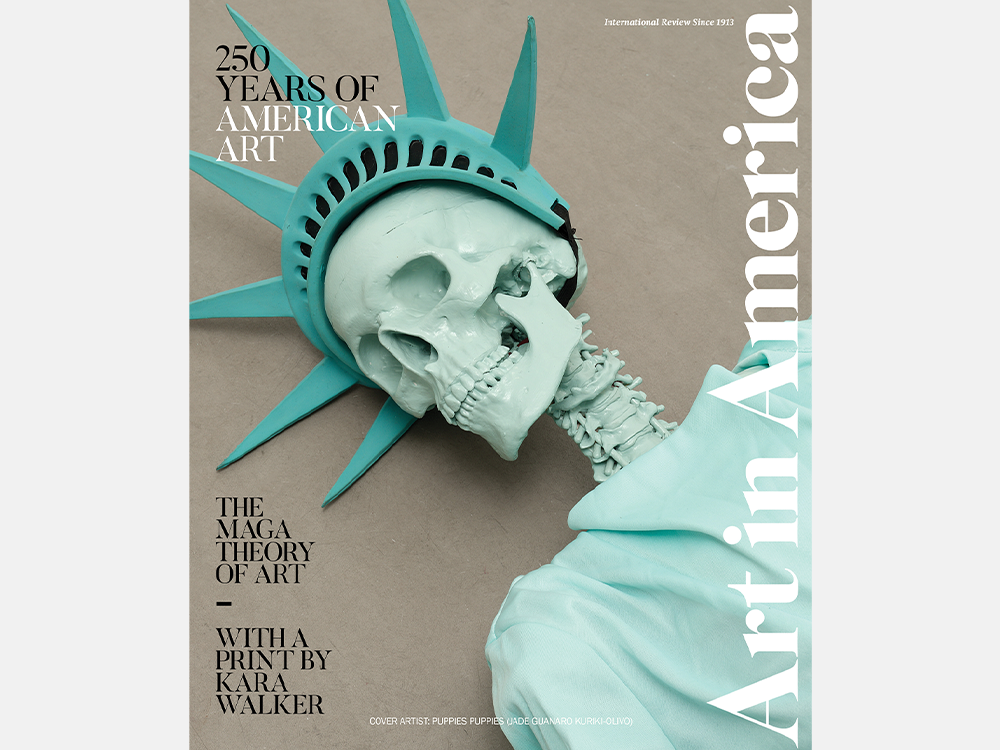
As we put to bed this issue about the 250th anniversary of the United States, I am feeling deeply uncertain. About the fate of the country itself, in the midst of ICE killings and protests in Minneapolis, I am certainly uncertain. But I am also uncertain about something at once much more specific and highly symbolic: the fate of the murals in the Cohen Building, slated for sale or possible demolition by the Trump administration. As I write this, artists like Joyce Kozloff and Martha Rosler have just called on the Jewish Museum in New York to support them in saving these artworks by artists such as Ben Shahn and Philip Guston.
The Cohen Building murals were commissioned by this country in the 1930s as part of the New Deal’s numerous art programs, which, as art historian John P. Murphy writes in this issue, stand today as a model “for the principle that art by the people, for the people, is vital to a healthy democracy.” As much as the murals in the Cohen Building are worth saving for their own sake, they are also worth saving because they represent the goal of the program “to weave art into the fabric of a pluralistic society,” Murphy explains.
It is right, on this anniversary, that we—Art in America, after all—celebrate our country’s artistic achievements; it is also right that we acknowledge its shortfalls, as we do in these pages, whether that means pointing to its history of colonialism or to its racism and xenophobia. At the moment, my greatest fear is that the bombastic efforts of the current administration to make America loom large will have the effect of diminishing it. Literally, making it small, and provincial. The opposite of a shining city on a hill, more of a backwater.
In January, when the A.i.A. staff was discussing the Statue of Liberty artwork by Puppies Puppies (Jade Guanaro Kuriki-Olivo) on the cover of this issue, I recalled viewing the piece from a balcony at Art Basel Paris, where the sculpture debuted back in October. I remember how deflated Lady Liberty looked down there on the floor, resting on her sarcophagal plinth. In 1886, she was a gift from France to the US, and became a beacon of hope to millions of immigrants; in 2026, our president is, heedlessly and nonsensically and arbitrarily, threatening France with tariffs and, just as heedlessly and nonsensically and arbitrarily, rounding up immigrants. The artwork is, sadly, perfectly apt.
Close-up of S. P. Dinsmoor’s installation The Garden of Eden, 1907–32, in Lucas, Kansas; featured in American Art A to Z.
Photo Erika Nelson/Courtesy Friends of S.P. Dinsmoor’s Garden of Eden
FEATURES
American Art from A to Z
A 250-year art history narrated alphabetically by 26 different writers.
The MAGA Theory of Art
At the movies, the Third Reich and the Republican Party seem to converge if you squint.
by Becca Rothfeld
Worker with a Brush
How the New Deal treated art as essential to democracy.
by John P. Murphy

The Playboy Bunny character from Pat Oleszko’s performance series “New Yuck Womun,” 1971.
Photo Neil Selkirk
DEPARTMENTS
Datebook
A highly discerning list of things to experience over the next three months.
by the Editors of A.i.A.
Hard Truths
An artist second-guesses firing his gallery, and a formerly formidable figure frets about his power ranking. Plus, an interactive quiz.
by Chen & Lampert
Sightlines
Artist and author Fab 5 Freddy tells us what he likes.
by Andy Battaglia
Inquiry
A Q&A with Pat Oleszko about fighting and flirting with absurdity.
by Nicole Kaack
Revelations
A beloved novelist singles out Rose Salane’s 60 Detected Rings.
by Ben Lerner
Battle Royale
Pop vs. Minimalism—two American art movements go head-to-head.
by the Editors of A.i.A.
New Talent
Maia Chao finds humor in banal bureaucracies.
by Simon Wu
Syllabus
A reading list for a crash course on Marcel Duchamp.
by Ara H. Merjian
Appreciation
A tribute to Napoleon Jones-Henderson, a textile artist who imbued art and life with exuberant energy.
by Jeffrey De Blois
Critical Eye
A distinctly Nordic sensibility ignites a quiet craze.
by Emily Cox
Spotlight
Raphael was a prolific painter who died before reaching age 40. A retrospective prompts a leading expert to wonder: What if he had lived?
by Christian K. Kleinbub
Book Review
A reading of Daniel Spaulding’s Joseph Beuys and History.
by Emily Watlington
Cover Artist
Puppies Puppies (Jade Guanaro Kuriki-Olivo) talks about her artwork on the cover of A.i.A.
View of the exhibition “Echo Delay Reverb: American Art, Francophone Thought,” 2025–26.
Photo Aurélien Mole "
REVIEWS
Phoenix
Phoenix Diary
by Jackson Arn
Aspen
Jaquline Humphries
by Barry Schwabsky
Brussels
Nairy Baghramian
by Emily Watlington
New York
Gabriele Münter
by Kelly Presutti
Paris
“Echo Delay Reverb”
by Eugenie Brinkema
Washington, D.C.
“State Fairs”
by Julia Silverman
