


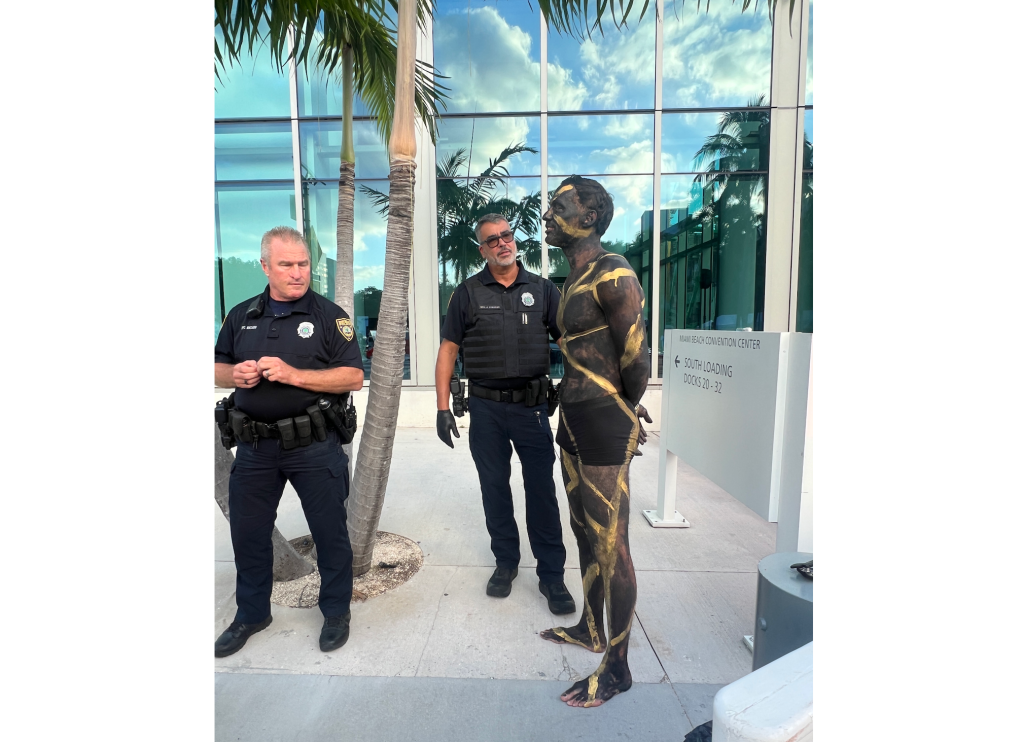
A performance artist from Luxembourg managed to turn a few scrawled lines of washable spray chalk into a night in jail during Art Basel Miami Beach—an outcome he claims was both unexpected and meaningful.
Thomas Iser was arrested last week after spray-painting the words “Sorry to disturb, art in progress,” in exaggerated graffiti-style lettering, on a window of the Miami Beach Convention Center during the United States’ largest art fair. He then invited his three-year-old daughter to add her own marks with a chalk pen. Police charged Iser with criminal mischief, a misdemeanor.
Iser later told the Miami New Times that he knew an arrest was likely, though he said he was surprised officers “handcuffed [him] immediately,” and did so in front of his daughter. He has staged similar interventions around the world and has been detained for them before, which makes his stated assumption—that American police would wait for a more convenient or decorous moment—more than a little curious. In a video posted to Instagram, Iser said the child’s mother was filming the performance “a few meters away,” though when questioned, he told police he was alone with the child.
On Instagram, Iser framed the episode as “a performance about tenderness, freedom, and the invisible borders we carry.” He described the chalk writing as “a small act of love, courage, and playfulness,” emphasized that “nothing was damaged,” and presented the intervention as a gift to his daughter. “In a world where access to art often depends on privilege,” he wrote, “I wanted to give her her own place—even at the price of my own freedom.”
“I saw this man, body painted head to toe in black with gold streaks across his body and a little black speedo—he was surrounded by cops who were calmly looking at him,” Miami-based artist Jillian Mayer, who happened upon the scene outside the convention center, told ARTnews. “I asked if I could take his photo and he said, ‘Yes, of course! It’s art!’”
The encounter was serendipitous: Mayer knows a thing or two about body paint. In 2013, she posted a YouTube video titled “Make Up Tutorial, How to Hide from Cameras,” which gained enough traction to be picked up by comedian John Oliver and featured on Last Week Tonight in a segment about facial recognition software.
“I asked the cops if, when they arrest someone in full makeup, they get photographed in that makeup?” Mayer said. (As it turns out, when someone is arrested in disguise, police photograph them both with and without the get-up.)
Iser’s account of what followed was less whimsical. He described the Miami jail as “a real descent into hell,” citing cold cells, poor food, and guards shining flashlights in detainees’ faces throughout the night. He was released after posting $600 bail and now faces a court date.
Since then, Iser has recast the police response as an unwitting extension of the work. The decision to handcuff him before determining whether he was responsible for the child, he wrote, was “a mechanical reflex applied to a moment that was profoundly human,” one that “became part of the performance.” His phrasing can’t help but conjure the old adage that a man’s freedom to swing his fist ends at another man’s nose—perhaps one that hasn’t quite made it to Luxembourg.
Iser says he may now be barred from returning to the United States, which he described as “an increasingly authoritarian country in many ways”—a characterization that seems an outsize response to a harmless, if poorly thought-out, artistic intervention. Still, he said, he would repeat the performance “without hesitation.”
