


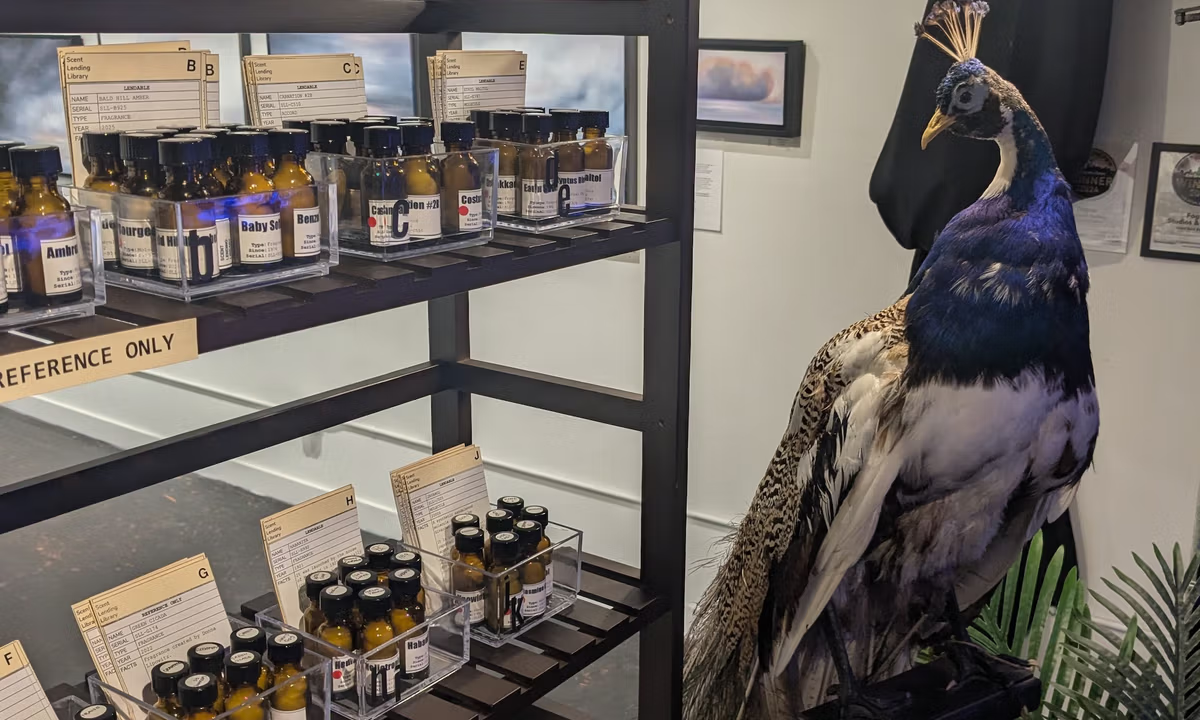
The artist Donna Lipowitz says she had the idea for her scent library while in the forest next to her house. “It’s kind of crazy, but I just get ideas all the time,” the Australia-born multisensory artist said one afternoon at her home in West Seattle, handmade curtains shading her vast collection of perfume bottles against the sun. “I genuinely thought: wouldn’t it be cool if you could borrow scents like books? And would that work? Would people do it? Would they just think it was stupid?”
So far, no one seems to think it is stupid. Lipowitz debuted the first incarnation of her Scent Lending Library in a converted supply closet in New York in April 2025, at the Olfactory Art Keller in Chinatown, drawing a crowd and a line despite rainy weather. In November 2025, the exhibition opened in the front windows of Fogue Gallery in Seattle’s Georgetown neighbourhood. It has been so popular there that in April, it will move upstairs into a permanent installation space.
What is in the library? Chanel No. 5, but also Bermuda Triangle. Bounce brand “Outdoor Fresh” dryer sheets. Eau Sauvage, created in 1966 by the perfumer Edmond Roudnitska as a masculine scent for Dior. Essential oils like frankincense and eucalyptus. The smell of space (developed in 2008 by the chemist Steve Pearce for the National Aeronautics and Space Administration to help train astronauts) and of Cheerios (featuring actual cereal).
Some items are concept scents that Lipowitz herself created, like the aforementioned Bermuda Triangle and It’ll Be OK, blended in 2020 using aromas often thought to be uplifting. Her Green Cicada was created for Olfactory Art Keller’s 2022 Portraits in Scent show and is meant as a self-portrait of the artist, age five, barefoot in the Australian rainforest.
Fittingly, Teen Spirit deodorant is among the bottled scents at the Scent Lending Library in Seattle Photo: Bess Lovejoy
There are two parts to the library: a reference section (more than 140 scents) and a lending section (84 scents and counting). The scents come in small amber bottles with just a trace of fragrance on cotton or blotter paper—enough to smell, not to wear—and each borrowed smell includes an old-fashioned check-out slip stamped with its return date. (One bottle, labelled “Nothing”, is entirely empty.)
Part of the idea behind the library, Lipowitz says, is developing our scent literacy—training our noses as we train our muscles, brains or taste buds. But it is not so much about being able to detect specific odours, bloodhound-like, as it is developing an ability to notice and appreciate scent in a world dominated by sight and sound. Lipowitz says one visitor to the library, a boy about seven years old, smelled a package of tennis balls near the scent vials (there are select scent props around) and said, astonished: “So does everything have a smell?” She could almost see the gears turning and the windows opening in his mind.
Lipowitz also appreciates how the scent library has functioned (both in New York and Seattle) as a third space. People bring friends or make new ones there, and sometimes they have emotional experiences brought on by scent’s ability to conjure memories. One woman, who smelled the whole library, said she had both laughed and cried while doing so. “It’s like a miniseries,” Lipowitz says. A Scottish man who smelled Home Garage—a scent Lipowitz created with assistance from Fogue’s owner Kerry Gates—was also brought to tears, having made contact with the ghosts of woodworking projects past.
Scent memory
For my own library experience, I borrowed two items, Clearwood and Iso E Super. Both are perfumery molecules: building blocks of scent that are often synthetic. Clearwood reminded me of patchouli, and Lipowitz said it had been synthesised in a Swiss lab to capture the more appealing aspects of patchouli while avoiding the funkier parts that turn some people off. Iso E Super, meanwhile, is one of the most famous perfumery molecules and was created by International Flavors & Fragrances in 1973. I was fascinated by its ability to smell like the entirety of a men’s cologne in just one molecule.
I asked Lipowitz how to get to know my new scents, and she advised me to smell them at different times of day while taking notes. As I did so, I was surprised at how the aromas changed. I had always found the interaction of skin and scent interesting, but this showed me how mercurial scent could be even when skin is taken out of the equation.
Sometimes, Iso E Super smelled magnetic and delicious; sometimes, it smelled only like a man who wanted to smell expensive (and thus it smelled kind of cheap). In the beginning, I found Clearwood nicer to smell, although I missed the earthier undertow of real patchouli, or imagined I did. Midday, on a cold and cloudy Monday, Clearwood opened up into warmth, while at other times it seemed sharper and more chemical. Lipowitz told me that our sense of smell works best in the morning, and while my own concept of “morning” is erratic, both scents smelled best to me around 1:30am—fuller, more pleasant, less hollow than earlier in the day.
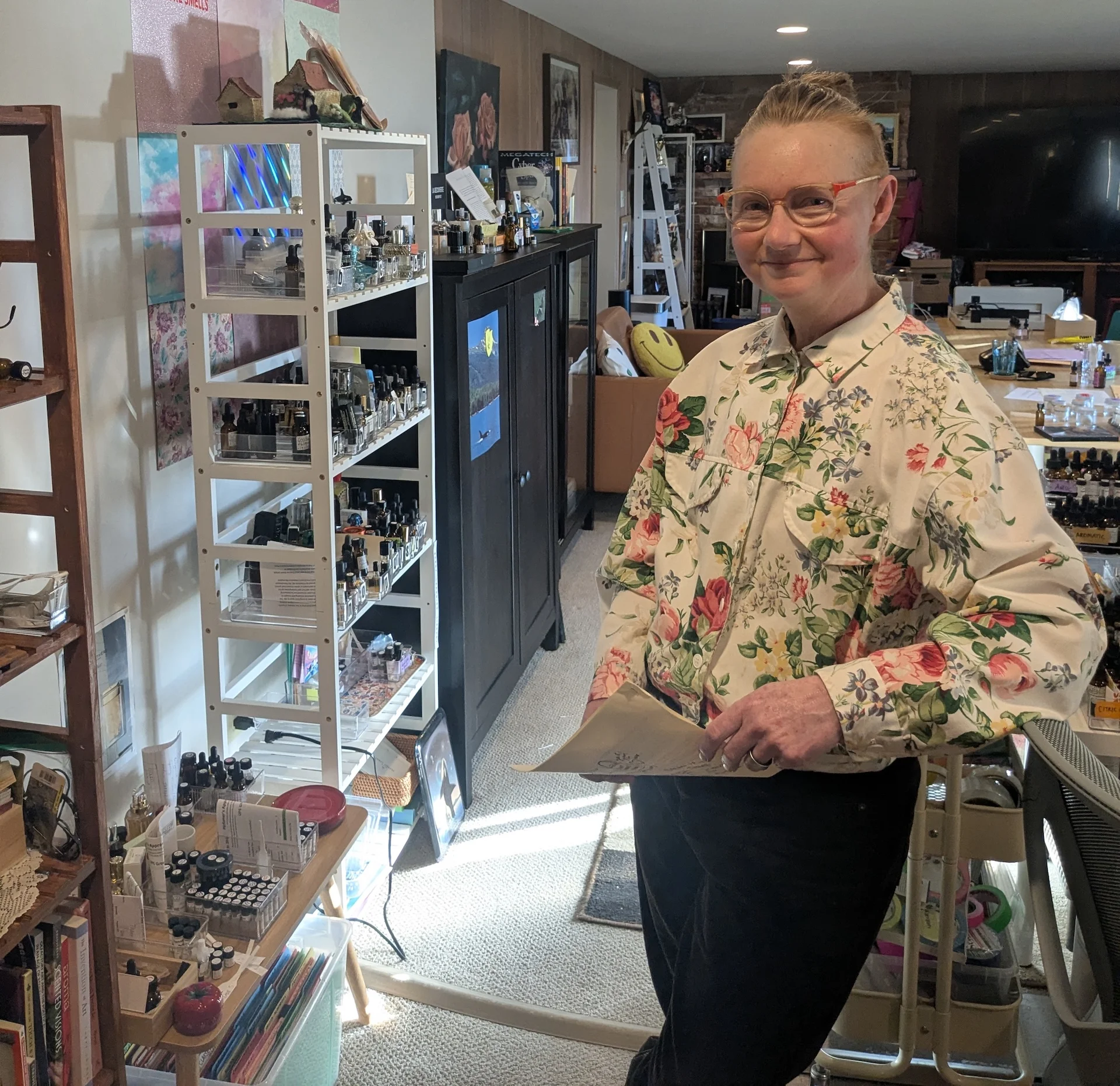
The artist Donna Lipowitz at home Photo: Bess Lovejoy
After visiting both the library and Lipowitz’s home, I asked the artist what makes scent art. She mentioned a book she had been reading by the philosopher Larry Shiner, Art Scents: Exploring the Aesthetics of Smell and the Olfactory Arts (2020), which describes how olfactory art intentionally uses odours to create aesthetic experiences. But unlike fragrances sold in a store, these need not be pleasant. Instead, they are meant, according to Lipowitz, to “challenge our perceptions, express complex concepts and engage the audience both physically and intellectually”.
It is easy to think about scent, at least in US culture, mostly as something to avoid (consider the negative connotation of the word “smelly”) or as something colonised by luxury brands. But the experience need not be confined to those two extremes. As I thought about the library’s appeal, I considered how this cultural neglect also means there is room left for the adventurous to play and create subtle manoeuvres. The ephemerality of scent, its unpredictability (as my own borrowings showed me), can feel exciting. It also feels like a way of reinforcing the embodied human, of carving out space for deeply private and subjective worlds—ones that we then do our best to try to discuss and share, whether the prompt is the smell of space, Cheerios or walking around the Australian rainforest at age five.
“Honestly, it’s been quite overwhelming how popular the library has been. It feels like the general public needs this,” Lipowitz says. Once the library has moved upstairs at Fogue, she hopes to expand into collaborative events with other artists, and perhaps eventually into other cities. “I get excited when people come in who aren’t perfumers,” she says. “Or who aren’t scent people. I want everyone to be able to have a go.”
- Donna Lipowitz: Scent Lending Library, Fogue Studios and Gallery, Seattle
