


The South African artist Gabrielle Goliath’s urgent application to overturn the cancellation of her planned Venice Biennale pavilion has been dismissed by the country’s high court. Goliath and the curator Ingrid Masondo, who submitted the application with her, will be challenging the decision. The judge, Mamoloko Kubushi, has, meanwhile, ordered them to pay court costs to the respondents, including Gayton McKenzie, the country’s sport, arts and culture minister.
Goliath and Masondo were selected to represent South Africa at the 2026 Venice Biennale on 6 December last year, by a five-person selection committee composed of imminent members of the country’s art community. The pair were to present a new iteration of Elegy—Goliath’s decade-long project that has centred on femicide and the murder of LGBTQI+ people in South Africa. The version in Venice was also due to address the Ovaherero and Nama genocide in Namibia in the early part of the 20th century, as well as the death of Hiba Abu Nada, a Palestinian poet who was killed in an Israeli airstrike in October 2023.
On 22 December, McKenzie—the leader of the right-wing Patriotic Alliance party who has been vocal in his support for Israel in recent years—wrote a letter to the organising committee in which he described the Abu Nada-related suite as “highly divisive in nature” and said it “relates to an ongoing international conflict that is widely polarising”. McKenzie called for the section to be changed, and when the artist refused the minister pulled the plug on the work, in early January. Goliath then took legal action against him.
The hearing took place online last Wednesday (11 February), with Goliath’s advocate, Adila Hassim, arguing to have Goliath’s pavilion reinstated as a matter of urgency.
Reacting to the judge’s decision, Goliath tells The Art Newspaper: “We will be appealing the court’s decision. This is crucial, not just for our chances of presenting Elegy as the 2026 South African pavilion exhibition, but on account of the dangerous precedent we believe this ruling sets for the broader arts community in South Africa.”
The attempt to overturn the decision comes, however, with significant time pressures, given the biennial’s final deadline for South Africa to submit it plans for the event passed on 18 February.
Judge Kubushi gave no reasons for her ruling. The judgment, delivered electronically, simply stated: “Having read the papers filed of record, heard counsel and considered the matter, it is ordered that: the application is dismissed.”
“Our legal team will need to request [an explanation]—which is just another time-consuming hurdle for us in an already pressured situation,” Goliath says. “As the selected artist-curator team, we are profoundly disappointed by Justice Kubushi’s ruling. The judge dismissed the application in two sentences, and a full week after hearing the argument.”
Goliath and Masondo have also contacted Nosipho Jezile, South Africa’s ambassador in Italy, who is the official commissioner of the South African pavilion, requesting that she contact the biennial to ask whether it would consider granting Goliath’s team a further extension.
“Should they do so, we would have grounds to lodge an urgent appeal. If not, we will need to explore other pathways,” Goliath says. “This is all to say that we will appeal this ruling, irrespective of whether we are able to realise the exhibition as planned.”
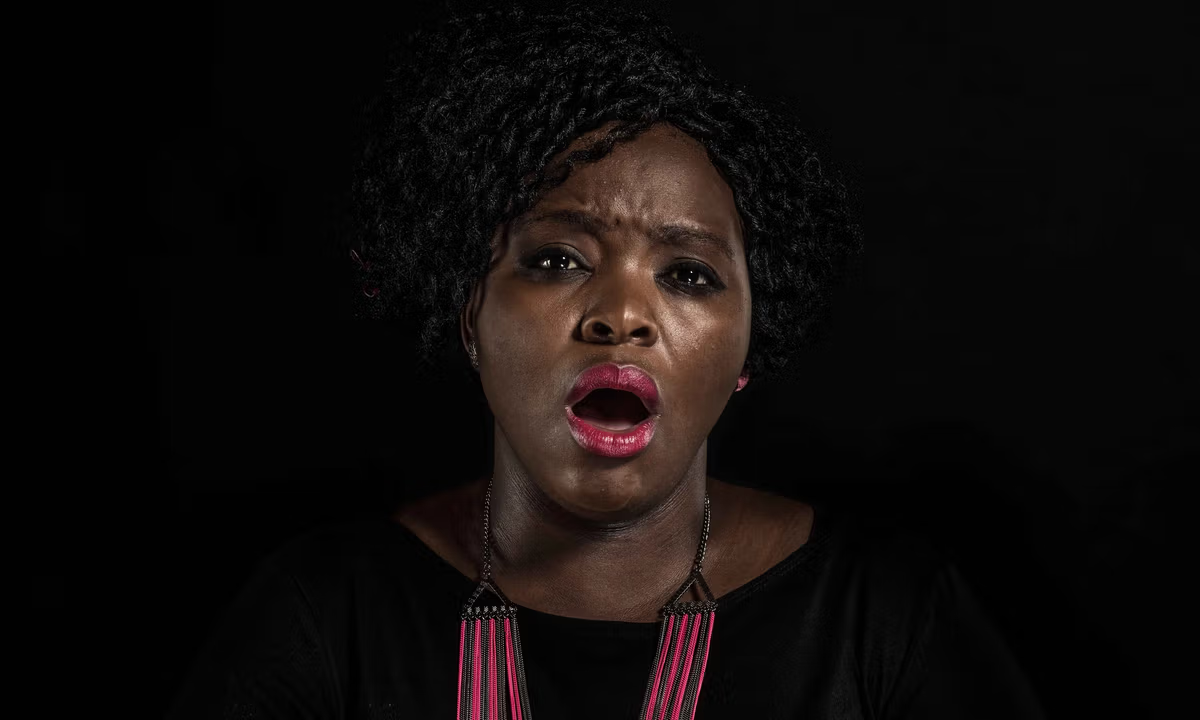
Gabrielle Goliath and Ingrid Masondo
Photo by ZUNIS_1
Goliath criticised the judge’s order for her and Masondo to pay costs of the application. “These are punitive measures, enacted against those the Department of Sport, Arts and Culture (DSAC) is mandated to support, and could certainly discourage others in the arts community from attempting to defend their constitutional rights in court,” she says.
The DSAC said in a statement that it welcomed the ruling. Asked whether the ruling might inhibit artists from defending themselves, spokesperson Stacey-Lee Khojane told The Art Newspaper: “It might be worth waiting for the full judgment to be released before engaging in speculation around the legal implications. There has never been any intention to inhibit art or artists.”
Goliath remains focused on trying to get Elegy to Venice. She says that if the biennial were to grant them even a short extension, she and Masondo would be in a position to lodge an urgent appeal, “in the hope of reclaiming the pavilion”.
“We have been working towards the various deadlines, frustrated by this process of cancellation, and are ready to submit any requested materials and plans,” she continues.
She and Masondo do not believe the deadlines are insurmountable.“At this stage it hinges on how the Biennale chooses to respond. If they grant us a window, there may be an exhibition this year in the South African Pavilion. If not, Minister McKenzie will have his way and the space will stand empty.”
Khojane confirmed that there would not be a South African-government-backed exhibition in the space.
