


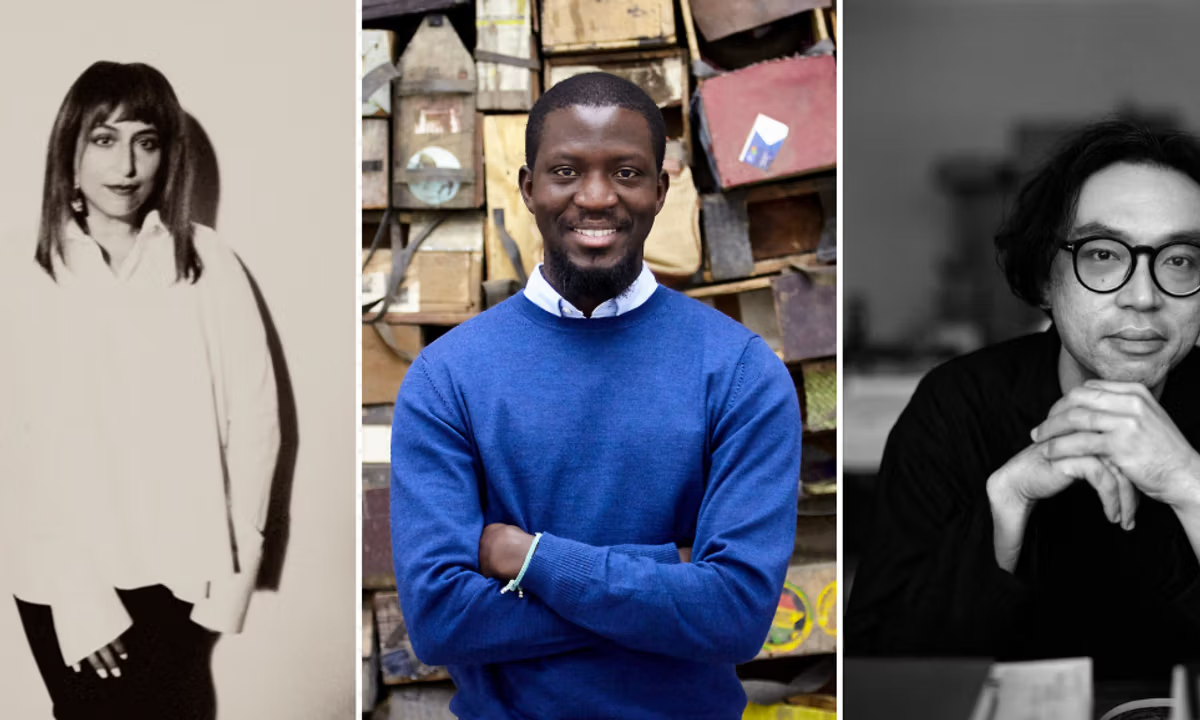
The publication ArtReview has announced its Power 100 list for 2025, naming the art world’s most influential people over the past 12 months. The 24th annual ranking, this year’s list reflects what an ArtReview statement describes as “shifts” in the ways artists and institutions now operate, highlighting the struggles of “older models of museums and galleries” and “old art-power centres”.
As in recent years, artists dominate the list, taking seven of the top ten spots. The artists chosen are highlighted, in particular, for their work in “creating their own infrastructure, reflecting a desire to bring artmaking closer to artworld-making”, according to an ArtReview press statement.
In first place is the Ghanaian artist Ibrahim Mahama, who has used the profits from the sale of his works—which address issues around labour and exploitation—to establish art institutions and community spaces in his home vity of Tamale, Ghana. “Mahama is emblematic of the way in which many artists today are taking control of the means of production as well as the means of distribution,” a statement says.
Other artists in the top ten include Wael Shawky (fourth place, sixth last year); Ho Tzu Nyen (fifth, 72nd last year), Amy Sherald (sixth, 23rd last year), Kerry James Marshall (seventh, eighth last year), the collective Forensic Architecture (ninth, fifth last year), and Wolfgang Tillmans (tenth, a re-entry who was last on the list in sixth place in 2022).
It has been a big year for art in the Arabian Gulf, with the announcement and opening of new art fairs, museums, auctions and galleries, and unsurprisingly two of the region’s art leaders appear in the list’s top ten. Sheikha Al-Mayassa bint Hamad bin Khalifa Al-Thani, who takes the second spot (21st last year), is the sister of the current emir of Qatar and is chair of Qatar Museums, a collection of over a dozen institutions and heritage sites in the country. In third place is the curator Sheikha Hoor Al Qasimi (first last year), who is the youngest daughter of the ruler of Sharjah and the president and director of Sharjah Art Foundation.
Further down the list, in 21st place (41st last year), is Badr bin Abdullah Al Saud, the Saudi prince who serves as the country’s minister of culture. “With culture wars and austerity raging in old art-power centres such as the US, Germany and the UK, the Arab world is increasingly becoming a platform from which artists and curators can expand their work,” an ArtReview press statement says.
Apart from artists and Gulfi royalty, there is one so-called “thinker” on the list. The American academic and writer Saidiya Hartman (eighth place, third last year) is celebrated for her work to redress “gaps in the archive of slavery (particularly women’s testimonies) by melding historical research, theory and fictional narratives” set against “a backdrop of revanchist white supremacism and capitalism-driven ecological catastrophe“.
According to ArtReview, the Power 100 list is chosen by an international panel of around 30 people from different parts of the art world. The criteria for inclusion on the list are that each person has had an influence on the art being made and shown now; that they have been active in the last 12 months; and that their presence stretches beyond their local scene.
“What emerges is a means of capturing an art world that is not purely an economic system, or an aesthetic one, but a complex social system,” an ArtReview press statement says. “Through this list, ArtReview gives a portrait of the network of relationships that shaped the art of 2025.”
