


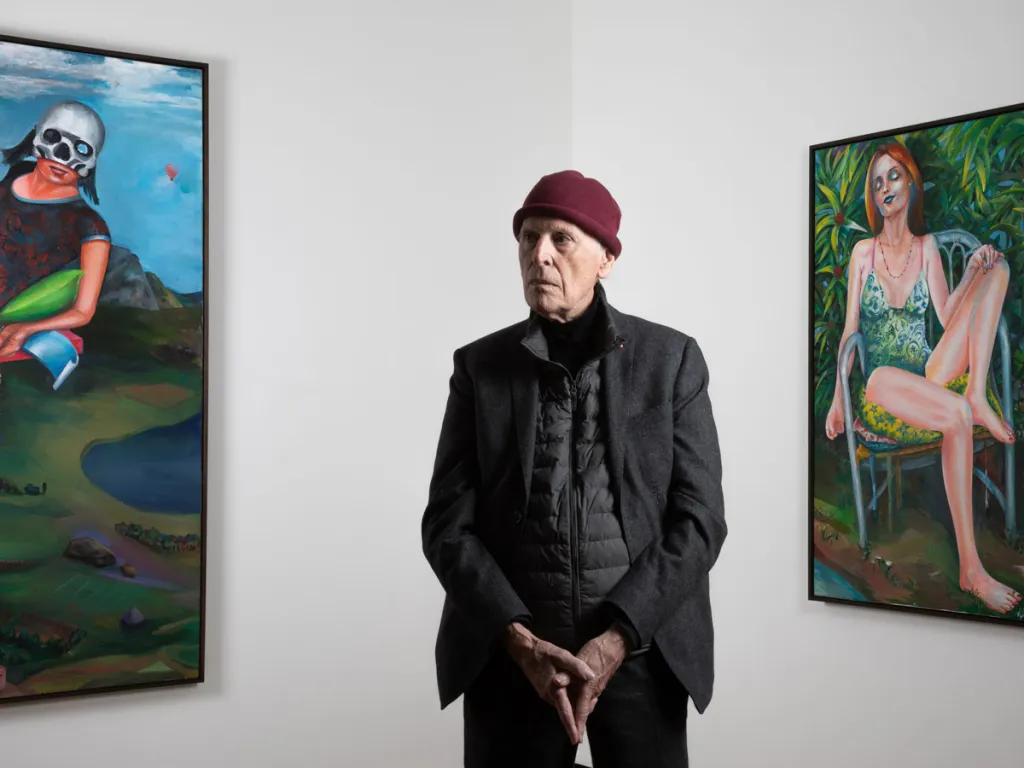
When you get to the chance to meet a giant of the art world, it’s an opportunity you don’t pass up. Martial Raysse, 89, is one of those giants. The reclusive artist seldom grants interviews, but he welcomed me into his home, just outside Bordeaux, shortly before the opening of his exhibition at Galerie Templon in Paris earlier this month. The exhibition marks the artist’s debut with the gallery, which is showing 30 of Raysse’s recent paintings and sculptures—narrowed down from more than 50 works when we spoke. Founder Daniel Templon, Raysse recalled, “sent me a handwritten letter at a time when I was looking for a place to show my latest large canvases. It really was that simple.” That matter-of-factness set the tone for our hours-long conversation about art, literature, and life.
In France, Raysse, one of the most influential—and most unclassifiable—figures in postwar French painting, needs little introduction. But the restlessly experimental artist’s latest work might come as a surprise to even those who have followed his work closely over the years. On the walls of Raysse’s Dordogne house hang paintings from various points in his career, as well as by his wife Brigitte Aubignac, a painter equally committed to figurative art, and friends of the family. In one corner, Raysse has decorated an ivory lampshade with a tiny butterfly. One of his canvases, begun a year ago, rests on an easel. All around are books upon books, including John Steinbeck’s 1937 classic Of Mice and Men, which he was reading at the time. Our conversation later moved to Raysse’s vast studio, a strikingly orderly space in a nearby structure. Nothing lies on the floor except a few cardboard sheets protecting it from splashes of color.
Above all, Raysse sees himself as a poet—working in paint. “I became a painter because painting requires no translation. It is a universal language,” he said. Figurative painting, he clarified, adding that “abstraction is pointless. If I wanted to speak abstractly, you wouldn’t understand a thing.” If Raysse views his canvases as poems, he also writes. “I favor the sonnet, which requires language carved like a sapphire. Free verse, because it has no limits, bores me.”
In Raysse’s work, both his new canvases and those from decades ago, art and literature are deeply intertwined. Since the late ’80s, he has drawn inspiration from mythology, as once did generations of French academic painters, who Raysse’s work pastiched earlier in his career. “Myths offer archetypes that reappear in everyday life,” he said.
Martial Raysse, La Peur (Fear), 2023.
Photo Laurent Edeline/Courtesy the artist and Templon, Paris – Brussels – New York
Several works on view at Galerie Templon support this idea. His bronze sculpture Actéonne (2019) revisits the tragic fate of Actaeon, the hunter transformed into a stag and torn apart by his own dogs after catching the Roman goddess Diana bathing. But Raysse has also done a transformation of his own, making Actaeon into a female figure, whose position in the scene is now unclear: is she the voyeur who dared disturb Diana at her bath? Or is she the watched rather than the watcher? Raysse leaves it open to interpretation open, stating plainly “To be understood, let those who wish to understand.”
Actéonne shares her posture of terror with the figures in La Peur (Fear), a large-scale painting completed in 2023. Dominated by dark, gray, leaden tones that evoke the tragic atmosphere of Goya’s Black Paintings, the work also serves as a memory of the tragic day in Raysse’s youth when the Gestapo came to arrest his father, a member of the Resistance. To bring it into the present, Raysse has also dedicated the work to the atrocities of the war in Ukraine. All the figures are attuned to a single emotion: fear, clearly legible on their faces as they confront death. Among them, a man, wearing a T-shirt with a Raphael-inspired putto, raises his arms as if imploring mercy.
Hanging on an opposite wall is La Peur’s counterpart, an equally monumental 2023 painting titled La Paix (Peace). The vividly colored painting—unveiled last fall at Art Basel Paris—reads as a message of hope. The composition brings together a variety of thought-out motifs and details which Raysse refers to as “hieroglyphs”: le Tricolore, an amphibian, colored balloons, a paper sailboat, a small Buddha statuette, the latter possibly a nod to his decades-long Zen lifestyle. In a twist, Raysse has even included a self-portrait, seated on the right-hand side, a fishing line extending from his cane and tracing the words: “Once, never again.”
As he put it: “I mostly speak about emotional problems I experience myself, which are tied to the state of the world I live in.”

Martial Raysse, La Paix (Peace), 2023.
Photo Laurent Edeline/Courtesy the artist and Templon, Paris – Brussels – New York
Raysse was born in 1936 in Golfe-Juan on the French Riviera into a family of ceramic artisans. In his early 20s, he formed close ties with other artists from the French Riviera, like Yves Klein, Arman, and César. Together with critic Pierre Restany, they would form, in 1960, the Nouveaux Réalistes, who broke with postwar abstraction by incorporating everyday objects (detergent boxes, tin cans, toys) into their work. In 1963, Raysse traveled to New York and Los Angeles, where he gravitated toward Pop Art and its wry interrogation of consumer society through images drawn from advertising, comics, photography, film, and video. “When you’re young, you think that taking the opposite stance from what already exists automatically makes you more interesting,” he said, reflecting on that period. “That’s not entirely false, but it’s a form of mannerism.”
Raysse has consistently embraced classicism. “That’s the royal road. When you look at the great masters—Delacroix or Millet—you immediately see your own shortcomings. That’s when a long process of self-improvement begins.” He sees his commitment to tradition as one of “strict obedience.” His 1964 reinterpretation of Ingres’s Grande Odalisque (1814)—painted in green against a red background and punctuated by a plastic fly glued to the surface—belongs to a series of deliberate and respectful pastiches. Now in the collection of the Centre Pompidou, Made in Japan – La grande odalisque is Raysse’s most famous painting and one of the most iconic of the era.
Installation view of “Martial Raysse: Recent Works,” 2026, at Galerie Templon, Paris.
Photo Laurent Edeline/Courtesy the artist and Templon, Paris – Brussels – New York
After returning to France in 1968, he turned to filmmaking. His only feature-length film Le Grand Départ (The Great Departure), shot in Paris and Morocco, was released in 1972. When asked why he distanced himself from Pop Art, Raysse replied, “Artists must avoid falling into a rhetoric; doing something else is a way of transcending the problem.”
He would do so again and again that decade. Throughout the ’70s, he produced a series of bric-à-brac sculptures known as “CocoMato”; revisited drawing in a psychotropic vein filled with grotesque figures; started the “Spelunca” series, a group of seven paintings inspired by Renaissance monk Francesco Colonna’s Dream of Poliphilus; and moved to Ussy-sur-Marne, in the eastern Paris region, to escape the capital’s art scene. “To focus, you have to stay away from distractions,” he said of his change in surroundings.
In 1978, Raysse relocated further south, into three abandoned houses in the Dordogne region, where he has remained ever since. “At the time, I couldn’t afford to repair the roofs,” he said. “For two years, I lived with tarps over my head.” A turning point came in 1992, when mega-collector and luxury goods magnate François Pinault acquired Le Carnaval de Périgueux (1992), a large procession of masked and costumed figures. Major exhibitions followed in Paris, Venice, and Sète, and Raysse’s market value rose sharply. In 2011, when L’Année dernière à Capri (1962) sold for £4.8 million ($6.4 million) at a London auction, he was named the most expensive living French artist. Three years later, the Centre Pompidou devoted a major retrospective to his work.
Martial Raysse, Ciel Blue Mili Blue, 2014.
Photo Laurent Edeline/Courtesy the artist and Templon, Paris – Brussels – New York
For the past 40 years, Raysse has meditated every day for at least 45 minutes, starting at 4 in the morning. “That’s why I walk on water,” he said, with a laugh. But as an artist, he is less regimented: “I’m not a unionized painter!” Striking a more serious note, he explained that his relationship to art is driven by desire. “An artist has an almost physical need to express himself, but there’s no set hour for falling in love.” He is still quite prolific but only heads to the studio if he feels like it.
For the past half decade, it would seem Raysse has been especially in the mood. He favors acrylic, which can be diluted with water and dries quickly, like mural paint. Tubes of paint, glue pots, and brushes are arranged, orderly of course, on a large table. “I prefer lean to fat,” he said of his choice of material. “I know how to paint in oil, but it’s not part of my story. I’ve always dreamed of painting frescoes; acrylic reminds me of that technique.”
The studio is also home to much of Raysse’s oeuvre. Most of the canvases are stacked one behind the other, while three large-scale works stand fully on display. One depicts a man in a suit stabbing an anthropomorphic creature: Georges et le Dragon (1990), one of Martial Raysse’s earliest mythological paintings. Another, Diane des terrains vagues (1989), portrays the Roman goddess of the hunt, modeled on his daughter Alexandra. These two paintings belong to the artist’s personal collection—and are not for sale.
Martial Raysse at work in his studio earlier this year.
Photo Sarah Belmont for ARTnews.
Leaning against a third wall is an allegorical canvas in progress, referencing a French nursey rhyme. “It’s the story of the ferret [who] snatches a girl’s scarf and dashes away, leaving her alone with a fragment of fabric, a fragment of their love.” The female figure is hidden beneath a white sheet, while the ferret—or the “little rogue” as the artist put it—is already visible, clad in red shorts and a blue T-shirt. The painting, however, is not in Raysse’s Templon show, as he refuses to show unfinished work. “Many artists exhibit pieces before they are done—that’s fraud!”
Taking stock of the in-progress painting, Raysse said, “I’m fascinated by the candle that’s about to go out. At my age, time weighs heavily. In front of each painting, I wonder whether I’ll manage to finish it.” Does he think he’s achieved his goals, I ask. “I never set any, but when I think about it, I’ve done quite a lot.” Over the course of nearly seven decades, he’s made more than 2,000 works, to be precise, he notes.
