





By my count, there are at least three flying people included in Pittsburgh’s recently opened Carnegie International. One can be found in Khalil Rabah’s video Critical Interrogations: Renewed Belief (1997), in which one man is launched by another over an olive tree, a symbol of resilience in the artist’s native Palestine. Another can be found—sort of—in Shala Miller’s video installation Flight (2026), a murky abstraction projected onto sinuous screens hung from the ceiling. That video is inspired by Toni Morrison’s novel Song of Solomon, whose titular character is an enslaved man who flew back to Africa.
The third flying person appears in archival footage projected during Be Holding, a performance Brooke O’Harra conceived with the poet Ross Gay, the composer Tyshawn Sorey, and the musical quartet Yarn/Wire. Staged at a YMCA gym during the exhibition’s opening weekend, the performance centered on a 1976 slam dunk by Julius Erving, who appeared to defy gravity when he leapt above his opponents’ heads and rammed a basketball through a hoop in mid-air. Be Holding starred grown men and adolescents who danced and spoke their way toward understanding Erving’s feat. Eventually, the performers came to realize that Dr. J’s dunk was less the result of one person’s might than the product of good old teamwork—“holding each other, which is a practice,” as the performers at one point repeated.
It takes a lot to soar, and we cannot do it alone. That is the message to be gained from this year’s lush and quietly astonishing edition of the Carnegie International, a recurring exhibition run by the Carnegie Museum of Art that is almost as old as the Venice Biennale. As if to underscore the communal nature of the endeavor, the curators—Ryan Inouye and Liz Park, of the Carnegie Museum, and Danielle A. Jackson, of New York’s Artists Space—included the first-person plural in their exhibition title, “If the word we,” a quotation from a Haytham el-Wardany essay about the impossibility of “being individual without being collective at the same time,” as the writer put it.
The 61 artists in the show run the gamut from a Filipino online radio station to a Japanese ikebana foundation, though most participants are artists with traditional studio practices. (Roughly half are based outside the US and Europe, reflecting a demographical shift that began with last edition, in 2022. The Carnegie International prior to that, in 2018, wasn’t really so international: just a quarter of its artists worked in locales beyond the US and Europe, which is more than could be said of many Carnegie Internationals before that one.) Even though most of the artists in the show work solo, many have found creative ways of dissolving their individual authorship.
Photorealistic paintings of hands held across chests figure in a section of the Carnegie International devoted to Khalil Rabah’s work.
©Carnegie Museum of Art, Pittsburgh/Photo Zachary Riggleman
Near the museum’s entrance, a trio of Sámi artists—Hans Ragnar Mathisen, Joar Nango, and Elle Márjá Eira—banded together for a presentation that begins in the lobby and spills outside into a courtyard. Their installation, titled Buolvvaiguin (With Generations), revolves around the life story of Mathisen, whose watercolors depict the artists’ shared homeland of Sápmi, a land under siege from developers in Norway, Sweden, Finland, and Russia. Mathisen’s paintings are draped over structures created by Nango, whose arcing wood elements mirror those seen in Sámi fishing villages, and a film by Eira in which Mathisen plays the Sámi anthem on the piano.
At the Mattress Factory, one of three other venues beyond the Carnegie Museum, an entire three-story building is given over to the married Peruvian artists Claudia Martinez Garay and Artur Kameya, whose sprawling installation La ceniza ya no recuerda qué causó el incendio. / The ash no longer remembers what caused the fire., dated 2026, includes greyish paintings, textiles showing people breaking free from chains, a room filled mostly with rubble, a jerky machine, and altar-like niches with barred windows. It’s not possible to tell which elements were contributed by Garay and which were lent by Kameya, and this gripping piece impresses less for its ability to unfurl a story—it ostensibly tells the tale of Túpac Amaru II, an Indigenous leader who led a rebellion against Spanish colonizers in Peru, though the events are too hard to follow—than for its maximalist mind meld.


At the Mattress Factory, Claudia Martinez Garay and Artur Kameya joined forces for an installation so sprawling that it’s tough to tell who contributed which elements.
©Carnegie Museum of Art, Pittsburgh/Photo Zachary Riggleman
Work of this kind is about collectivity as a means of fighting the man—an especially relevant topic as any during continued conflicts in Palestine, Iran, Ukraine, Sudan, and the Democratic Republic of Congo, all of which haunt the Carnegie International. But the curators also show, if only somewhat convincingly, that this kind of community-led defiance is not a new artistic tradition.

Firman Ichsan, an Indonesian fashion photographer, is the subject of a historical mini-presentation at the Carnegie. Depicted here is the model Okky Asokawaty.
Photo Firman Ichsan
Alongside a host of new commissions, the show includes several mini-exhibitions of historical artists with an anti-authoritarian streak. One focuses on the fashion photographer Firman Ichsan, whose studio became a gathering place for chicly dressed Indonesians in the 1970s during the time of the Suharto dictatorship. But these presentations lapse into academicism, with an eat-your-veggies approach to un-canonized areas of art history that conflicts with the ultra-current sensibility of the rest of the show. (And besides, why not just give these artists proper retrospectives outside the Carnegie International?)
More successful are displays of other artists’ artworks organized by contemporary artists. G. Peter Jemison, a member of the Heron Clan of the Seneca Nation, returned to a survey of Native American artists of the Haudenosaunee confederacy that he curated in 1975 and revised it anew, presenting works by Jay Carrier, Tom Huff, himself, and others in a fresh setting. (Back then, Jemison transported the show’s contents using a van in 1975; he pays homage to that mode of transport with a newly purchased Chevrolet that will remain parked outside the Carnegie through the end of the exhibition’s run in January.) Meanwhile, Karuk/Yurok artist Miller Robinson pulled baskets from Indigenous communities out of the Carnegie Museum of Natural History’s storage and arranged them in vitrines, adding to them little butterflies and plastic hearts.

Georges Adéagbo’s Le Socialisme Africaine (2001–4) is newly revisited for the Carnegie, with a new Pittsburgh-specific focus.
©Carnegie Museum of Art, Pittsburgh/Photo Zachary Riggleman
Elsewhere in the museum, Beninois artist Georges Adéagbo revisited his remarkable 2001 installation Le Socialisme Africain, which he initially created for a survey of African contemporary art organized by Okwui Enwezor. Cascading across a full gallery of its own, the installation contains T-shirts, posters, masks, posters, books, vinyl records, carpets, and more, all of them bearing some connection to decolonization in Africa. There are also some new additions that have a Pittsburgh-specific context. In between an image of enslaved people being marched through a field and a picture of François Tombalbaye, the Chadian president who liberated his nation from French rule in the 1960s, I spotted a sign for the United Steelworkers, a union headquartered in Pittsburgh. In bold blue letters, the sign spells out a rousing word that rang through my mind throughout this exhibition: “SOLIDARITY.”

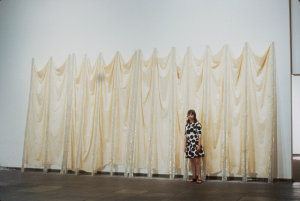
Hong Lee Hyunsook made her 35-foot-tall frottage What You’re Touching Now—Insubong in 2025 by ascending a mountain in South Korea.
Courtesy the artist
It takes a lot to soar, and we cannot do it alone. This is also the message of Hong Lee Hyunsook’s What You’re Touching Now—Insubong in 2025 (2025), whose title refers to the mountain the Korean artist scaled to create this frottage. To do so, she donned a harness, then ascended high off the ground. Suspended over the park below, she attached a 35-foot-long stretch of gwangmok fabric to the peak and methodically ran a crayon along the mountain’s rough surface, an act only possible because there were other climbers there to help her.
Speckled with pops of black and crimson, Hong Lee’s frottage is hung near the parking lot, making it one of the first things many viewers will see in the Carnegie International. It’s a smart curatorial choice, since this edition posits that abstraction is undergoing a worldwide renaissance, continuing an emphasis also found in the show’s 2022 edition.
Abstraction is a mode of art-making that can be a stumbling block for biennial curators, who often can’t quite figure out what to do with it. But at this Carnegie International, abstraction fits right in. Here, it’s not the sort of artmaking practiced by lone, tortured geniuses in their studio. Instead, it’s an understated kind of art that needs other people to come to fruition.
This type of abstraction is exemplified by the painter Zhao Yao, whose works are composed of the shells of eggs that he purchases online from across China. Unlike spare paintings of the postwar era created by artists like Agnes Martin, who famously worked solo, Zhao’s require assistance from supply chains and shipping companies to become complete. In a different way, RJ Messineo’s abstractions are also about networks, since they also foreground connective forces. Messineo’s paintings are technically groupings of little canvases, only some of which are brightly hued monochromes; these mini-pictures are held together through magnets attached to wood boards behind them. Arranged like misaligned Tetris pieces, Messineo’s paintings look as though they might fall apart if one were to remove any of their disparate elements.

Zhao Yao’s abstractions are made by rigorously lining up eggshells in rows.
©Zhao Yao/Photo Zhang Hong/Courtesy Ota Fine Arts
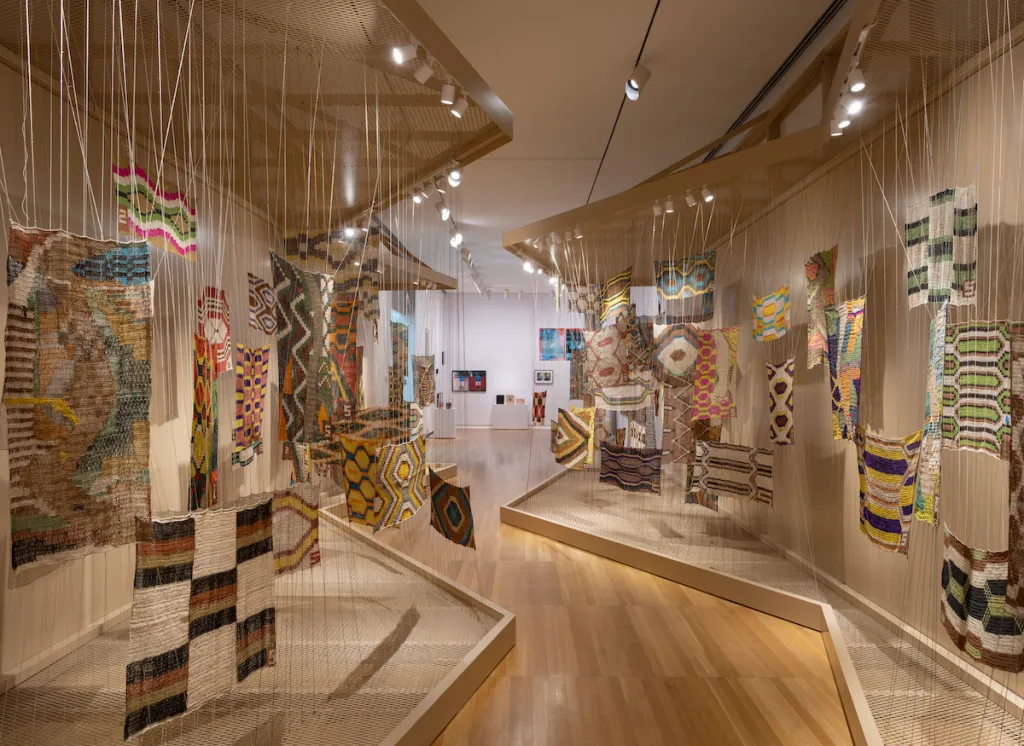
In the case of Silät, an all-female collective of Wichí weavers based in a remote part of Argentina, abstraction is a community endeavor. Led by artist Claudia Alarcón and curator Andrei Fernández, the collective is presenting Tewok: the river we weave (2026), in which a thicket of 102 weavings—roughly one for each Silät member—covers both sides of a corridor. It becomes difficult to tell where each textiles ends, so tightly bound are they to one another.
Last year, Alarcón told me that Silät’s weavings are about “showcasing our knowledge.” In a way, so too are paintings in the Carnegie by d harding and their cousin Jordan Upkett, both of whom are of Bidjara, Ghungalu, and Garingbal heritage. Their Untitled (Private Painting J1), from 2019, is as long as Hong Lee’s frottage is tall—35 feet, to be exact—and has an underlayer that’s composed of dry pigment and gum from robusta trees, which are native to eastern Australia. That underlayer records their grandfather’s memories of the Country, or the land as seen from an Aboriginal perspective. But the pigment and gum are largely invisible, because harding and Upkett smeared them white paint used by the Carnegie Museum to cover its walls. Still, the brownish underlayer refuses to entirely disappear. As that old protest chant goes, the people united will never be defeated.


