


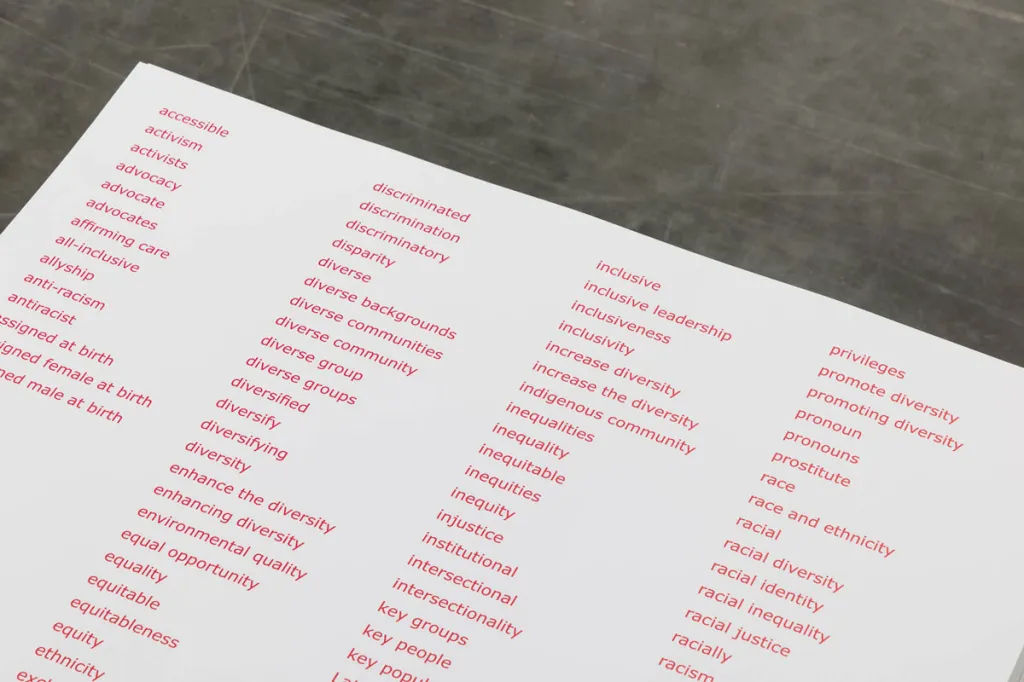
At Art Basel Miami Beach this week, you might notice a stack of posters (glossy white paper, with red text) on the floor of Commonwealth and Council’s booth. The Los Angeles–based gallery is encouraging visitors to take them home with them.
Upon close inspection, the work’s text is a list of words that have seemingly been banned by the Trump administration that first appeared in the New York Times in March, which has been adapted as Andrea Fraser’s latest project, titled Lexicon. The majority of these words revolve around the term “diversity, equity, and inclusion” (DEI) and related terms, like “racial diversity,” “activism,” “discrimination,” confirmation bias,” “women,” “cultural heritage,” “underserved,” “pregnant person,” “they/them”—the list goes on.
Fraser is best known for her institutional critique work, like Museum Highlights: A Gallery Talk (1989), in which she acts as a museum docent named Jane Castleton who gives a tour of the Philadelphia Museum of Art as a way to interrogate how museums display their work, as well as the power institutions hold over the objects the own and the people who come to see them. More recently, she published 2016: In Museums, Money, and Politics, which provided data on museum boards across the country and the political donations during the 2016 presidential election.
Fraser said she sees Lexicon as being related to her Museums, Money, and Politics project. (She is currently developing one on the 2024 election.) “In some ways, it’s less a work of critique than an affirmation of the role art, art venues, and art audiences can play in fighting censorship,” she said.
To learn more about the project, ARTnews interviewed Fraser, who is currently the Philip Guston Rome Prize fellow at the American Academy in Rome, by email.
This interview has been lightly edited.
Andrea Fraser, Lexicon, 2025, installation view, at Commonwealth and Council’s booth at Art Basel Miami Beach 2025.
Photo Mark Blower/Courtesy the artist, Commonwealth and Council, and Marian Goodman Gallery
ARTnews: When did you first get the idea to make Lexicon?
Andrea Fraser: I started thinking about developing a work with words censored under the Trump administration back in February 2025. One of Trump’s first executive orders on inauguration day was to terminate DEI-related programs, grants, and contracts, and to bar consideration of DEI in federal government operations. Almost immediately, words associated with DEI were scrubbed from government websites as well as the websites of entities reliant on federal grants. Lists of “words to avoid” started to circulate. The White House has denied prohibiting any specific words. In many cases, lists were generated internally by administrators in acts of preemptive censorship to avoid the loss of funding. They include terms that will automatically trigger program reviews and extra scrutiny of grant applications. Of course, it’s not only words that have disappeared but also resources, research, and programs serving marginalized groups and focusing social, environmental, and health justice.
Were there any words in the list you formed that surprised you when you began compiling? Are there any other banned words that have been left out? If so, why?
Actually, I did not compile the list myself. The list that I reproduce in Lexicon was published in the New York Times in March 2025. It has about 200 terms. Since then, other organizations have published expended lists. The most recent list I’ve seen has almost 400 terms—so maybe that will be Lexicon II. What surprises and really disturbs me about these list are the variations of words and phrases. There are five terms with “bias,” six with “culture,” ten with “diversity.” It reflects a kind of paranoid bureaucracy that is one of the hallmarks of totalitarianism.
Why did you choose the form of Lexicon to be a paper stack that people can take away?
The Trump administration is trying to make these words disappear. One way to counter that is to keep them in circulation in every way we can. I want everyone who goes to an art fair or a museum to be walking around with these words, to put them up in their homes and offices, to play a role in keeping them from being repressed.
What do you make of the context of presenting this work at an art fair, especially a fair in Florida, whose politicians have been at the forefront of creating and enacting much of Trump’s worst policies?
Like I said above, and especially at an art fair in Florida! DeSantis started banning DEI in Florida even before Trump’s executive order.

Andrea Fraser, Lexicon, 2025, installation view, at Commonwealth and Council’s booth at Art Basel Miami Beach 2025.
Photo Mark Blower/Courtesy the artist, Commonwealth and Council, and Marian Goodman Gallery
Your book 2016: In Museums, Money, and Politics was revelatory. It brought to light the political affiliations and monetary donations from the country’s top art patrons and donors. Many of them supported Trump or his Super PACs in 2016 (and likely in the subsequent two elections). How do you think this context will impact the work’s reception and presentation at the US’s largest art fair?
I’ve started working on 2024 in Museums, Money, and Politics. In 2016 I noted that the partisan lean of the boards did not correspond to the partisan lean of the states in which the museums were located so much as to their financial scale. The boards of small museums in deep red states were often well to the left of the boards of big museums in deep blue states. In 2024, there seems to be more correspondence between the partisan lean of the boards and the states they are in. It looks like the boards of the big museums in Florida and Texas and other red states have gotten more Republican and those in California and New York have gotten more Democrat. I don’t imagine any of that will impact the reception of Lexicon but I guess we will see.
You’ve previously made paper stacks, but those have focused on wealth inequality and the relationship between wealth and the art market. Can you discuss your decision to create a work that was in direct response to the current presidential administration? Do you see these two bodies of work (beyond their form/medium/realization) as being related? If so, how?
I think Lexicon is related more to my Museums, Money, and Politics projects than my two previous stack works. It holds my love of classic conceptual art and, of course, of Felix Gonzalez-Torres’s work. In some ways, it’s less a work of critique than an affirmation of the role art, art venues, and art audiences can play in fighting censorship. But I hope it’s still institutional critique as I have defined it, that is, as a defense of the field of art as an institution of critique. That can be generalized as a defense of the independence of all cultural fields, including educational and scientific fields, so they can serve a critical function in democratic society. This is what the radical right is trying to destroy.
