


When I happened upon Friedman Benda’s booth at Design Miami, artist Nicole Cherubini was holding court in front of one of her monumental ceramic sculptures with the fair’s curatorial director, Glenn Adamson, and collector Abigail Spector. Cherubini, who has her first solo show coming up at the gallery next month, is known for subverting the inherent classism of decorative forms—in this case, a baroque pitcher. Her philosophical approach is similar to that of Molly Hatch, whose wall installation of 288 ceramic plates at Todd Merrill’s booth transforms the ornamentation of 19th century British designer Christopher Dresser. Their work encapsulates Adamson’s theme for the fair, “Make.Believe”—or, as he told ARTNews, a combination of “craft and conviction.”
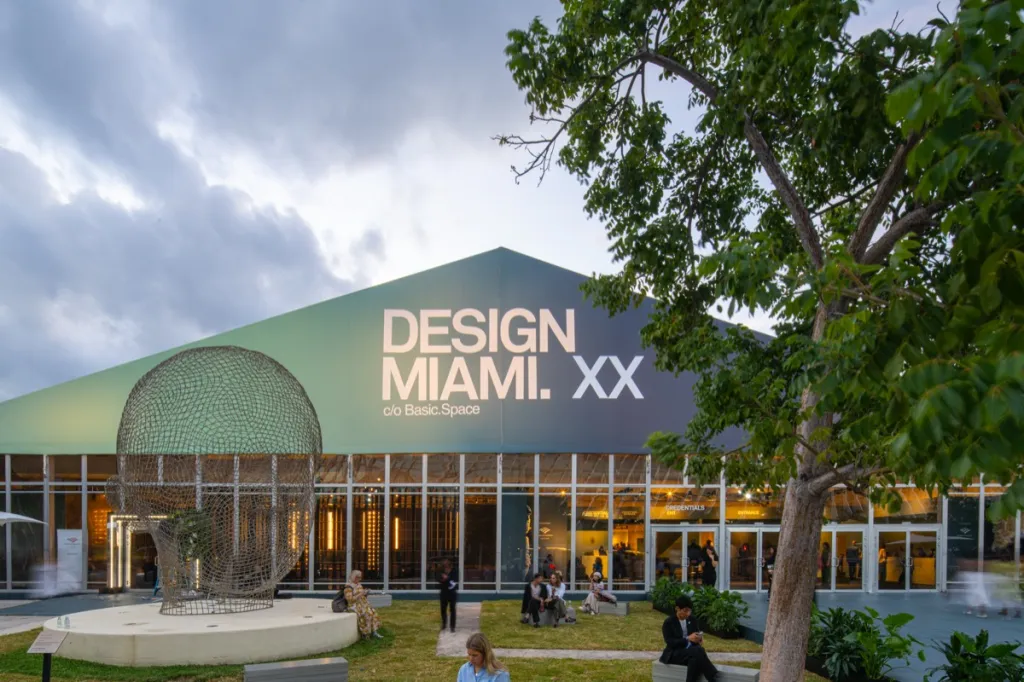
This year’s edition of Design Miami comes at an inflection point in the collectible design market. For overseas dealers, President Trump’s tariffs have increased the cost of exhibiting in the U.S.—for example, there’s now a 50 percent tariff on products containing steel and aluminum—and for collectors, many are choosing the more novel Paris edition in October over Miami. The result is that 15 previous exhibitors did not return this year, leaving room for younger, emerging talent. Altogether, there were eight more booths than last year’s fair (not counting the preponderance of commercial booths by the likes of Kohler, Fendi and Perrier-Jouët, which one attendee dubbed “Rodeo Drive”). But, within that, there were five fewer large gallery booths and 13 more “Curio” presentations and “Special Projects.” As advisor Simon Andrews summed up, “There were a lot of interesting people bringing interesting ideas.”
The fair was dominated by contemporary design dealers who showed organic forms in organic materials, which fits the general design trend of the past three or four years but also plays into the Miami style. The fair felt effervescent and lively, with lots of pastels and blobby, easygoing shapes, and less cerebral, historic design on display. “It’s like the Darwinian evolution of a species altering to adapt to the environment,” Andrews told ARTnews. Mindy Salomon painted her booth like a sunset. Both Tuleste Factory and Sten Studio transformed their Curio presentations into garden-like environments. Si Vis Pacem had a pair of overtuned Nike Air Jordans in the corner, as if someone had just come home and kicked them off before settling onto the couch.
Among the more established galleries that did not return to the fair this year were Donzello, from New York; Patrick Seguin, from Paris; Sarah Myerscough, from London, whose attention (and dollars) was probably spent opening her new gallery in a former schoolhouse in Mayfair. Cape Town-based gallery Southern Guild moved across the street to Art Basel Miami Beach to show photography and paintings, as it prepares to open a new space in Tribeca. First-time exhibitors included Arte y Ritual, from Madrid, and Mass Modern Design, from the Netherlands. (Gagosian was also there, partnering on a “Special Project” with Casa Malaparte, but mostly their presence was just confusing, especially when Peter Marino climbed on the glass-topped desk he consigned to the booth for a photo.)
An installation view of Friedman Benda’s presentation at Design Miami 2025.
Jeanne Canto/Design Miami
Coincidentally, on the third day of the fair, Pantone announced its color of the year for 2026: Cloud Dancer, which is, essentially, white. The brand explained in a statement that the color is “a symbol of calming influence in a society rediscovering the value of quiet reflection.” That sentiment was very much on display at Design Miami. Dubai studio Roham Shamekh brought his new Roots collection, made from his signature hand-carved epoxy resin mixed with ceramic, and invited attendees in his design statement to “reconnect with the timeless emotions and shared consciousness within you.” Likewise Merida Studio described its booth, featuring the white textiles of Sylvie Johnson, as a “place for quiet reflection”—the exact phrase used by Pantone.
Standing apart from that pack was Galerie Signé, founded in Paris just four years ago by 41-year-old dealer Maxime Bouzidi who was showing in the U.S. for the first time. “It’s important right now to present work to the American public,” he told me. He represents a small stable of designers with industrial backgrounds who incorporate handcraft into their work, like the duo Marie Cornil and Alexandre Willaume whose colorful ceramic lamps, priced at $10,000 to $15,000 each, are reminiscent of the Memphis Group but allow for slight imperfections.
Whereas many art world denizens think of art, craft, and design, at best, as three overlapping circles of a Venn diagram, or, at worst, a hierarchy, Adamson said he thinks of “craft” more in terms of process than product—essentially, craft is inherent to everything that’s made by hand in some way. The hierarchy of these mediums comes out of a 19th century mindset around classism and race, and “we have to get out of all that,” he said. In other words, “craft is not intrinsic to the material, and Design Miami is a great place for understanding all that.”
One of the standout exhibitors with a historical focus was Arte y Ritual, specialists in tribal art for the past 35 years. About five years ago proprietors Ana and Antonio Casanovas started buying 20th century design for themselves, realized what a beautiful blend it was with tribal art, and decided to start exhibiting and selling it as such. The arresting results include a Pomo basket and a 16th century fossilized wood figure from Mali, which once belonged to dealer Pierre Loeb, displayed atop a 1969 Ettore Sottsass grey fiberglass wardrobe. A Dan mask, formerly in the collection of René Rasmussen, and a Shōji Hamada vase adorn a Charlotte Perriand dining table. And, the pièce de résistance, is a Cameroonian royal throne with carvings of mothers holding infants encircling the base. It was first exhibited in the seminal 1935 MoMA exhibition, “African Negro Art.” The gallery’s combinations reflect today’s taste for decorating in a more eclectic style and buying the very best across categories.

An installation view of Arte y Ritual’s presentation at Design Miami 2025.
Jeanne Canto/Design Miami
Mass Modern, led by 30-something proprietor Etienne Feijns, came from the southern Dutch town of Roosendaal. He opened his first gallery space right out of high school in 2007. He told me he had waited to participate in Design Miami until he felt like he had something really special enough to meet the moment. He curated his booth around the theme of “Art Meets Furniture” in the literal sense. A ceramic painting by Carlo Zauli serves as the surface of a unique, midcentury wooden bar ledge by studio Permanente Cantù, available for $66,000. He’s already sold a midcentury ash wood desk by Renato Angeli, adorned with painted glass panels by Claudio Olivieri, and a sculptural tête-à-tête birch chair, from 1983, by American-born, Germany-based master woodworker David Delthony.
Charles Burnand Gallery, who was making its third appearance at the fair, brought a selection of works by contemporary designers who blend materiality and form, with a focus on Korean makers. “We really found our niche,” director Michael Totten told ARTnews. Jungin Lee crafts furniture from hundreds of layers of traditional Korean paper and flour paste. Kyeok Kim crochets cocoon-like pendants out of copper then coats them in lacquer and sawdust. Deglan’s cloud-shaped tables are made from lime plaster mixed with resin. Peter Lane, who is based in New York, makes custom ceramic walls—the ones at Design Miami look like burnt, or fossilized, wood.
As Adamson told me, “The whole point of Miami is discovering things.”
