


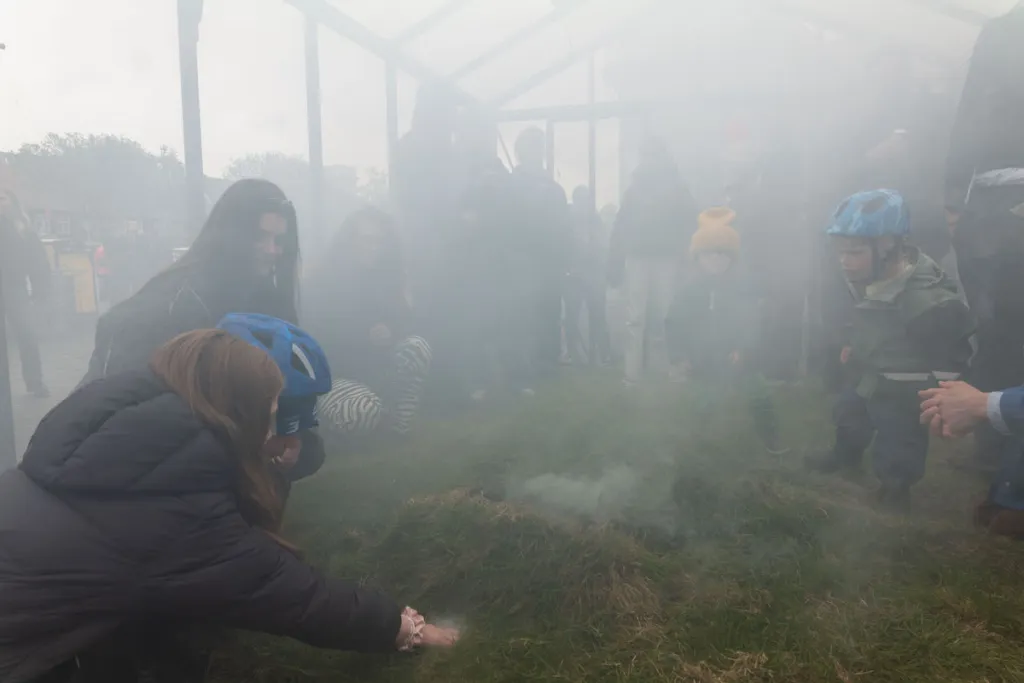
All arts festivals abound in sights and sounds, but the Reykjavík Arts Festival invested in a sense seldom given its due: smell. And not just any smell but, suggestively, the scent of “freshly cut grass resting by a fence post, chervil spilling across a sun-warmed sidewalk, a lawnmower shredding dandelions and sorrel, the echo of a distant party, blackcurrants dropping one by one from bare branches.”
Those are some of the poetic notes appended to a special scent created for the Reykjavík Arts Festival by Fischersund, a family enterprise led by Jónsi, the lead singer of the Icelandic rock band Sigur Rós, and his artist sisters Lilja, Ingibjörg, and Sigurrós Birgisdóttir. The scent emanated from an installation in a greenhouse in the center of the city, filled with hay and senses-scrambling atmosphere from a fog machine. It also featured in the Fischersund shop/studio nearby, where products—perfumes, candles, incense, and so on—are for sale in a dreamily designed environment painted a cinematic shade of black and decorated with curios, including Jónsi’s “perfume organ” in the basement. (Picture dozens of little vials and bottles aligned on a desk with shelves, organized by how much they synesthetically evoke impressions of bass or treble notes.) A different fragrance figured in a live Fischersund scent concert at a downtown music venue, which involved sprays from sample bottles handed to the audience. Some notes for that one, known as Faux Flora No. 1: “White porcelain mountain milk flows from watery lips. Pearlescent pale seedlings burst through dry concrete. Out from cotton cloud curtains a beam of light breaks…”
The Reykjavík Arts Festival is quintessentially Icelandic, which is to say it’s ethereal, surreal, and in a million different ways invitingly and perplexingly strange. The festival proper centered on performances and openings from May 30 through June 14, but many of its offerings—including installations and exhibitions at institutions in town and elsewhere around Iceland—extend throughout the summer and into the fall.
Two of those are exhibitions for Björk and James Merry at the National Gallery of Iceland. The Björk show features installations designed to incubate the experience of living inside three songs, two already released and the third new. A room devoted to “Sorrowful Soil,” from her 2022 album Fossora, features 30 speakers in a ring, inspired by Janet Cardiff’s canonical sound-art piece Forty Part Motet, and a momentous projection of the video for the song, with Björk singing her heart (and entrails) out in front of a volcano’s lava flow. “Ancestress,” from the same album, is presented in a similar but smaller-scale way in a room lined in blood red. The new song, “Nerve Bloom (Remix),” blares alongside antic projections featuring new works by the Polish painter Natalia Kleszczewska, brought to life through animation by Natalie Viv. Imagery of horses and humanoid figures predominates, many of them fusing and conjoined. (More on this exhibition, which runs through September 19, will follow in a separate review to come.)
Björk, Nerve Bloom (remix), 2026.
Photo Sigurður Gunnarsson/Courtesy Reykjavik Arts Festival
The James Merry exhibition accompanies the Björk show with many of the phantasmagorical masks he made for the singer to wear and transform into different kinds of life-forces. During a walkthrough, Merry spoke of inspiration from things like pagan fertility figures, Celtic iconography, and Icelandic plants. Much of the work in the show was made in service of Björk’s high-style kind of world-building, but some of it relates to other collaborations with icons including Tilda Swinton and Iris van Herpen.
Another exhibition under the aegis of the festival is a survey of work by Karin Sander, a German conceptualist who started visiting Iceland in 1993 and has spent significant time there since. Visitors to the Reykjavík Art Museum can leave their coats, bags, and other belongings in viewable vitrines near the entrance, to serve as something like memorials for those taking in the show. Meanwhile, a large wall-work catalogs adjectives from Sander’s Wikipedia entry (“institutional,” “legible,” “reflective,” “translinguistic,” and so on). The most ambitious work is an array of machines that stands ready to scan bodily images of whoever steps inside and then create 3D-printed models in plaster to be put on display. The end result, Sander said, will be a collective portrait of Reykjavík in 2026.

3D-printed figures of Karin Sander.
Courtesy Reykjavik Arts Festival
The Living Art Museum, an artist-run institution in a building next to fishing boats in the city’s old harbor, is playing home to a show by Open Group, a Ukrainian collective whose video work Repeat After Me II was presented in the Polish Pavilion of the 2024 Venice Biennale. Like that iteration of the work, the one in Reykjavík features close-up portraits of Ukrainians mimicking the sounds of war (bombs, helicopters, etc.) in what exhibition materials describe as a sort of riff on “apocalyptic karaoke.” For a newly commissioned work, Aurora Borealis, Open Group boarded up the museum’s windows with wood, blocking the view of the otherwise placid surroundings. The title of the show, “Ode to Joy,” alludes to the official anthem of the European Union—a timely reference in Iceland, which is currently considering whether or not to reopen negotiations related to possibly joining the European Union a few years after a previous round of talks were suspended.
Drawing by Sólon Íslandus, a.k.a. Sölvi Helgason.
Courtesy Reykjavik Arts Festival
One of the Reykjavík Arts Festival’s homegrown highlights is a jewel-box exhibition at the National Museum of Iceland related to Sólon Íslandus (a.k.a. Sölvi Helgason), a 19th-century folk artist who reads like an eccentric character from a Halldór Laxness novel. At a time when it was illegal to wander the country without a fixed address, he forged a travel pass whose extravagant claims got him in trouble with the law. “He exceeds most craftsmen, and is superior in mind and body,” read the document, which went on to praise his many other qualities, including diligence, creative imagination, beauty, and “manliness, strength and wrestling, energy and agility, gait and fortitude, swimming and walking on his hands.” To accompany delicate, sometimes fantastical drawings Íslandus made during his time on the run or in jail, the Icelandic band Mógil made an album of songs devoted to him.
Music was integral to the Reykjavík Arts Festival—including three concerts by the festival’s artist-in-residence Hildur Guðnadóttir, who has become a classical-music star by way of recent soundtrack work for the films Tár and Joker as well as the TV series Chernobyl. Two performances took place in Harpa, a large concert hall whose light-splicing façade was designed by artist Olafur Eliasson, and another featured compositions for choir and the enormous organ in the breathtaking modernist church known as Hallgrímskirkja. The two Harpa shows were especially spellbinding, especially an ensemble performance of music from her recent album Where to From, bathed in otherworldly illumination by lighting designer Theresa Baumgartner.
Hildur Guðnadóttir’s ensemble performs Where to From.
Courtesy Reykjavik Arts Festival
Another musical high point was Venutian Wetland by viibra, a flute septet founded to support an album and subsequent tours by Björk in 2016. The group coaxed tones and notes out of instruments that sounded less like flutes and more like mouthpieces in transmission with other kinds of language. Of the musicians, who moved together as a chaotic yet tightly choreographed chorus line, the show notes read: “Invisible flows of matter weave between them—thick, unstoppable—becoming the driving forces that reshape form, function, and being.”
Even farther out than that was Arnbjörg Maria Danielsen’s Love Love, a sort of sustained hallucination about tennis (among many other things) set to music and movement in a way that conjured Robert Wilson blocking out a stage show for a psychedelic sports club. Dancers in tennis skirts twirled around with rackets while breaking to move plants and shovel dirt. Near the end, an automatic volley machine shot out pink tennis balls that bounced onto stray drum cymbals spilled around the room.
Arnbjörg Maria Danielsen’s Love Love, 2026.
Photo Gunnhildur Helga Katrínardóttir/Courtesy marvaða
A humble personal favorite of the Reykjavík Arts Festival is an exhibition at the most remote art museum I’ve ever visited—by far. Located a six-hour drive from Reykjavík in the region known as the Westfjords, the Samuel Jonsson Art Museum preserves the legacy of a self-taught artist born in 1884 and active through his death in 1969. He never really left the isolated area he called home, and it wasn’t until he was 65 that he had enough money (still barely any at all) to make the art he most wanted to make.
Working from pictures he’d seen, Jonsson created incarnations of the Fountain of the Lions in Alhambra, Spain, and St. Peter’s Basilica in Rome, as well as paintings of the landscape and sculptures of walruses. When an altarpiece he’d painted was rejected by a local church, he built a church building of his own with cement paid for by his pension. (Materials were so scarce that, as a caretaker of the museum noted, a large piece of iron on the grounds came from a shore-wrecked fishing trawler that Jonsson salvaged and carried over a mountain to bring to his land.)
For an exhibition titled “Resonance,” open through September 1, the Reykjavík Arts Festival added sculptures and paintings to Jonsson’s world by artists working in Listvinnzlan, a studio in the city devoted to artists with disabilities. Dragons and zebras joined the lions and walruses, as did a robot and a totem built with prosthetic legs. All of the art is heartening—and very much at home.
A work in “Resonance” at the Samuel Jonsson Art Museum.
Courtesy Reykjavik Arts Festival
