


Editor’s Note: This story originally appeared in On Balance, the ARTnews newsletter about the art market and beyond. Sign up here to receive it every Wednesday.
Before this week, the last time more than $1 billion worth of art ripped through an auction house in one night was back in 2022, when Christie’s New York unloaded the Paul G. Allen collection. The sale brought in a staggering $1.5 billion, still one of the biggest single-night hauls the market has ever seen, and marked the peak of the euphoric, post-pandemic art market. (All prices include fees unless otherwise noted.)
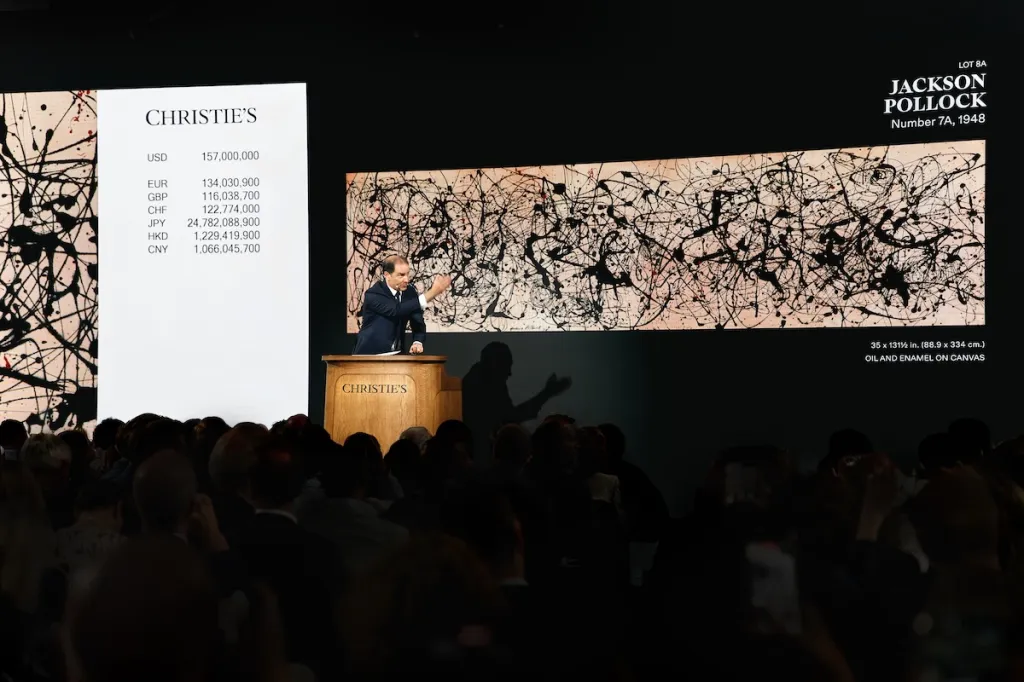
Anyone who’s seen the headlines or watched the Instagram clips of Christie’s hammering down Jackson Pollock’s Number 7A, 1948 (1948) for $181.2 million to a room erupting in applause, alongside the flurry of other records smashed on Monday night, could be forgiven for thinking that frothy market is back with a vengeance. After a few sluggish years, strong results in New York’s marquee sales last November and the London evening sales in March have raised hopes that we are in full-on recovery mode. And, while Christie’s $1.1 billion double-header this week was welcome news, it’s worth keeping a couple of things in mind before getting carried away.
The art market runs on multiple tracks simultaneously; the auction game is just one. The extraordinary totals on Monday reflect only the market’s champagne-soaked apex, an ultra-thin sliver occupied by a baby’s fistful of big spenders. Money is no object to this stratum of buyers. By contrast, the market’s other tracks—its bulk—are moving at a more grounded pace, so it’s vital to look beyond the irresistible headlines.
“The reality of what I’d call the real middle market—maybe $100,000 to $1 million—is that things are still a bit sticky,” Candace Worth, founder of the New York–based Worth Art Advisory, told me on Tuesday. “There’s definitely more energy than there was a year ago, and more things are selling, but advisers and gallerists will still tell you it’s not easy. Buyers are taking longer to make decisions.”
Worth added: “The art market needs to be defined much more broadly than just these super high-end blue-chip works that transact publicly. There’s the gallery market, private sales, advisory businesses, younger galleries, and smaller fairs—all different strands.”
The Baer Faxt echoed her sentiment. “The major auctions at Christie’s, Sotheby’s, and Phillips this week drew outsized media attention relative to the percentage of people directly implicated,” the publication wrote on LinkedIn. “So, why should the rest of us—we, the humble majority—care about such jaw-dropping results?”
One prominent art adviser who was in the salesroom Monday night told me that it was dominated by three buyers, one of whom was the dealer Jeffrey Deitch, who apparently snapped up four works: Pablo Picasso’s La femme enceinte, 1er état (1953) for $22.5 million, Francis Bacon’s Study for a Portrait 1 (1955) for $5.9 million, Jasper Johns’s Alley Oop (1958) for $5.8 million, and Andy Warhol’s Do It Yourself (Violin), from 1962, for $25.9 million.
That being said, New York–based art adviser Megan Fox Kelly told me there may well have been more buyers participating than was immediately apparent. Two Christie’s staffers placed an outsized number of bids on Monday: Maria Los, deputy chairman and head of client advisory Americas, and Alex Rotter, global president. They “could each have been speaking to multiple collectors throughout the night,” Fox Kelly noted.
The top end of the auction market has always depended on a narrow band of buyers. Yet on Monday night, as records tumbled like dominoes, that band appeared narrower still, distilling a view of the market at a time when its participants hope its recovery continues. For the first time in two years, the global art market reported growth in 2025, though it was just 4 percent to $59.6 billion, well below the 2022 peak. That recovery was heavily concentrated at the top end, with auction sales above $10 million jumping 30 percent last year, while sales below $50,000 actually declined by 2 percent, according to the UBS and Art Basel report.
Zoom out and Christie’s sale was more revealing at the $10 million to $20 million mark, which is the auction business’s “middle market,” though not the middle band of the entire art market, which is much lower. Bidding showed a depth and spontaneity largely absent from the tightly managed, overestimated auctions of recent years.
Auctioneer Henry Highley sells Andy Warhol’s “Sixteen Jackies,” from 1964.
Courtesy Phillips
The consensus among the art advisers I spoke to was clear: works of this caliber, namely those from the collection of the late media mogul S. I. Newhouse sold by Christie’s on Monday, will fetch top prices whenever they appear, whatever the state of the market.
Fox Kelly, however, cautioned that Christie’s blockbuster results risked masking a weaker broader market. “It’s not smoke and mirrors so much as how people interpret the data. If you’re not looking at the market from the inside, there’s a tendency to assume that when the top end rises, everything rises with it. That’s not necessarily the case,” she said. “When collectors see extraordinary works making extraordinary prices, they assume the market is up for everything. They think the value of their own collections has necessarily risen because a major Pollock or Rothko sold for an enormous number. But those sales don’t automatically lift the value of everything else.”
As for whether collectors are increasingly buying with conviction, or more cynically deploying capital in a thin market, Jussi Pylkkänen, Christie’s former global president, who now runs Pylkkänen Art Advisory, offered another interpretation.
“There are many collectors in the market who are actively engaging with advisors to build collections, not just buying opportunistically,” he said. “What’s interesting is how broad tastes have become. Collectors are now building more diverse collections, combining different periods and disciplines. Many are also buying design objects and so-called ‘great maker’ works, which has strengthened the design market.”
All 16 works from the Newhouse sale carried irrevocable bids. As for the guarantees, which are increasingly used by the houses, Pylkkänen told me they “provide structured support, however, they’re part of a process of returning to a more orderly market—a market that isn’t artificially supported.” He added that, given Sotheby’s and Christie’s are always fighting to land the top estates, if one doesn’t offer guarantees, the other will. “That has created a ‘race to the top,’ especially for objects above $50 million,” he said. “Now there’s a need to rebalance pricing discipline, particularly in the $20 million–$50 million range, where professional advisers should be more influential. Simply demanding the highest estimate or guarantee doesn’t necessarily result in the highest sale price.”
When you throw Sotheby’s and Phillips’ modern and contemporary evening sales on Tuesday into the mix, it’s fair to say that while there’s obviously more liquidity, the outlook isn’t so sunny. Sotheby’s took $303.9 million against its $320.2 million high estimate, and Phillips achieved $115.2 million against an estimate of $84.2 million (its highest presale estimate since 2022). Solid, but not ecstatic results.
Worth noting are a couple of interesting results from the Phillips sale. Andy Warhol’s Four Colored Marilyns (Reversal Series), from 1979–86, sold for $5.63 million, setting a new auction record for the series and marking a sharp increase from historical pricing levels. The last comparable work from the series to sell publicly was acquired by Masterworks in 2017 for roughly $3.5 million, according to data from ARTDAI.

Pablo Picasso, Arlequin (Buste), 1909.
Also of note was the nearly $1 million result for an Anna Weyant painting, her strongest auction performance since her explosive rise in 2022. Weyant’s ascent has frequently been cited as emblematic of the ultra-contemporary boom of the Covid-era art market, as well as its excess.
At Sotheby’s Breuer Building, Arlequin (Buste) by Pablo Picasso set the tone early on Tuesday, selling for $42.6 million after restrained two-bidder bidding. The night’s only real flash of intensity came with La Chaise lorraine by Henri Matisse, which leapt to $48.4 million after a 10-minute battle—remarkable largely because the rest of the evening felt so measured. La Moisson en Provence by Vincent van Gogh brought $29.4 million with little resistance, while La Clairière by Alberto Giacometti sold for $23.1 million in steady three-way bidding. Another major Matisse, La Séance du matin, landed squarely on estimate at $20 million, reinforcing the evening’s prevailing mood: selective, disciplined, and short on frenzy, unlike Monday night.
Pylkkänen described the sale as “tidy but lacking competition, which was a reflection of the quality of the material and strong estimates.”
“Only the Matisse surprised with four bidders but was priced to generate competition,” he said.
Sotheby’s day sales last week also showed a split picture. Strong headline results were countered by a subdued mood in the evening auctions. In-room bidding was reportedly thin, with much of the top material already well circulated. By contrast, the day sales were robust, with a 93 percent sell-through rate and strong demand for fresh-to-market works. Many lots beat estimates, pointing to selective but solid demand for quality at the right price. Overall, it appears that the market remains active, but increasingly price-sensitive.
“When I walked through Sotheby’s day sale, it looked like what a day sale is supposed to look like—a lot of second-tier material selling at lower prices,” Worth told me. “That, to me, is actually more representative of the market.”
