



Christie’s has announced the consignment of the American Western art collection belonging to the energy billionaire Bill Koch, which the auction house says is the most valuable tranche of the genre to ever appear at auction. The collection is estimated to sell for at least $50m, which would more than double the existing record. The two sales, scheduled for 20 and 21 January, are expected to bring national attention to a small but growing sector of the art market.
Western art in the US is characterised largely by its straightforward depictions—or artists’ interpretations—of life in the country’s western states. Common subjects include cowboys and horses, scenic prairie landscapes and Native Americans, often shaped by the bigoted baggage of the US history of genocide and mass displacement of North America’s Indigenous inhabitants, and the period in which the works were produced.
The sale at Christie’s features works by some of Western art’s most commercially valuable artists, like Frederic Remington. His painting Coming to the Call (around 1905) leads the sale, with a $6m to $8m estimate. The work—depicting a moose staring out on the water under a sky glowing green, yellow and orange at sunset as a hunter on a canoe aims nearby—first appeared in 1905 as a double-page spread in Collier’s Weekly. It was quickly considered one of the artist’s finest paintings, according to Christie’s.
The sale will also include two versions of Remington’s important sculptural work Broncho Buster, showing a cowboy breaking in a rearing horse. Other Remingtons from Koch’s collection include Argument with the Town Marshall (around 1905), his bronze Coming Through the Rye (modeled in 1902, cast by 1916)—both with a $4m to $6m estimate—and the only one of three The Horse Thief (1907) casts to remain in private hands, carrying a $3m to $5m estimate.
Frederic Remington’s Broncho Buster. Courtesy Christie’s
Other notable Western artists in the sale include Charles Marion Russell, whose paintings The Sun Worshippers (1910) and Dust (1925) carry estimates of $4m to $6m and $5m to $7m, respectively. Also represented are the artists Alfred Jacob Miller, G. Harvey and Wyeth family patriarch N.C. Wyeth.
While Western art has largely been sold through regional auction houses and galleries based in western US states such as Texas, Arizona, Nevada and New Mexico, the category has recently shown stronger results at major international houses. In January 2024, Christie’s annual auction of 19th-century American and Western art totaled more than $13.1m (with fees), a record total for the sale, which was first held three years earlier.
“We have seen growth in the numbers of Western art auctions around the country, total annual sales, as well as in the performance of individual artists and objects,” Tylee Abbott, the head of the American art department at Christie’s, told The Art Newspaper in a statement, adding that Western art “played a significant role in the year-over-year growth of historic American Art sales in January by four times over the last four years”.
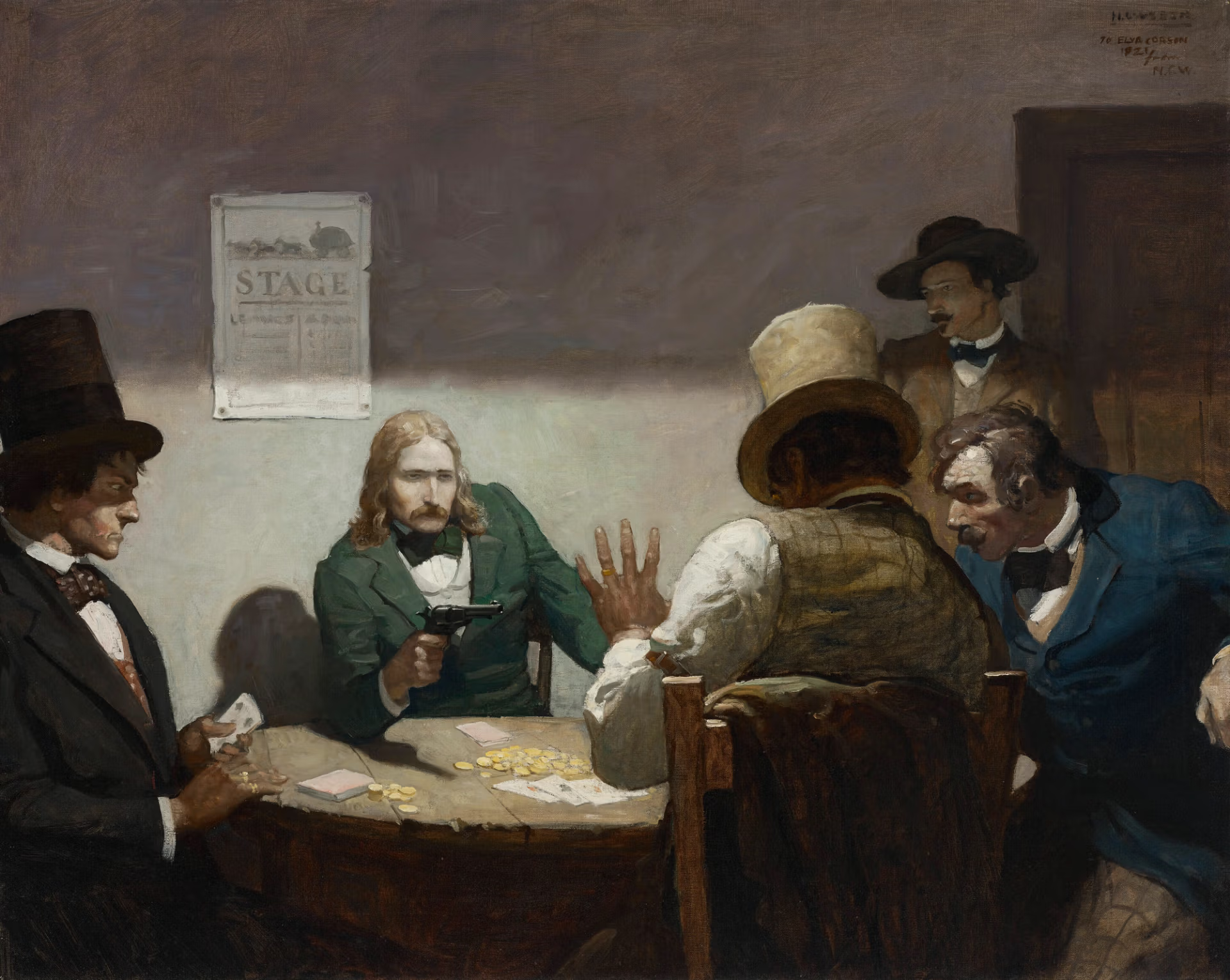
Wild Bill Hickok at the Cards (1916) by N.C. Wyeth. Courtesy Christie’s
Specialised dealers also report growth in the market for Western work. Jinger Richardson owns Legacy Gallery, with locations in Santa Fe, New Mexico and Scottsdale, Arizona. A second-generation Western art dealer, Richardson is also a co-founder of the Scottsdale Art Auction, among the largest fine art auction houses in the southwestern US. The Christie’s sale—and any record it sets—could help bring attention to the category, Richardson says. She adds that while her gallery sold work to Koch, he would not be considered an influential collector of Western art compared with some of the field’s major buyers.
“My client base is growing. I think the internet helps that,” Richardson says, adding that more recent Western art than the material Koch collected is becoming more popular. Other factors include more people moving to the Sun Belt states since the Covid-19 pandemic and wanting to outfit their homes with art inspired by the surrounding culture, along with a proliferation of cowboy-themed media in recent years.
“There is Yellowstone, and a lot of Westerns on TV right now,” Richardson says. “Hallelujah, that always really helps us.”
