


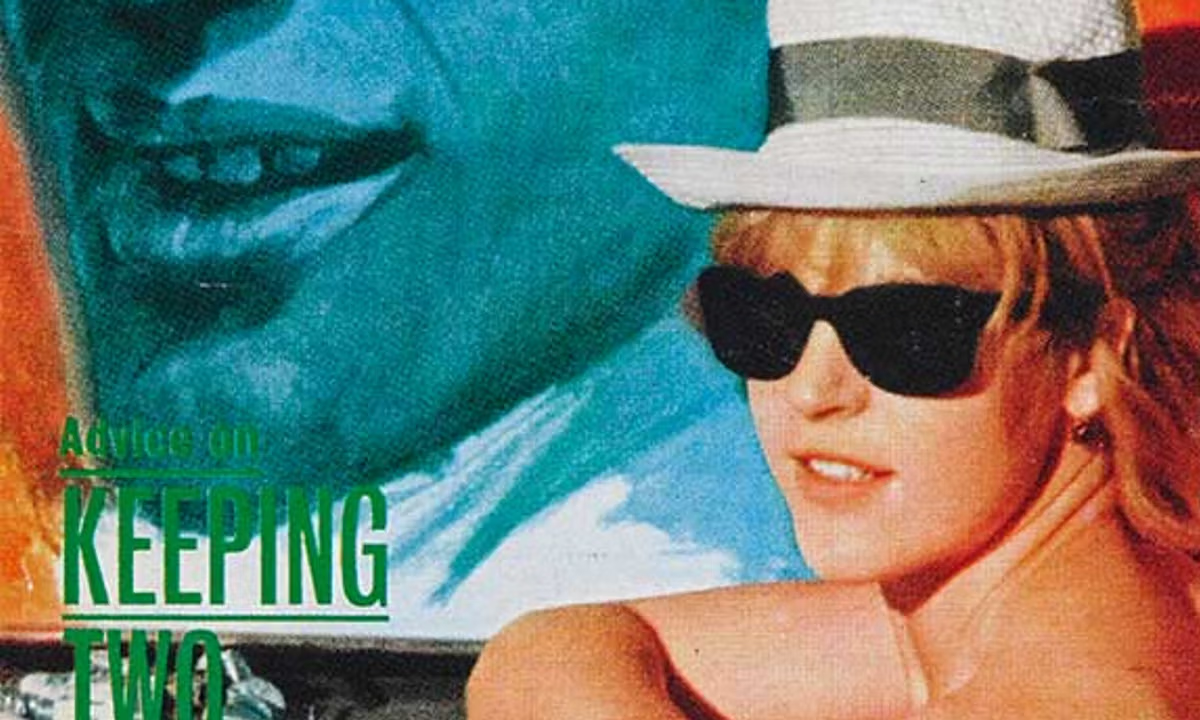
Following on from her 2023 Paul Mellon Lectures of the same name, Lynda Nead, a professor of art history at London’s Courtauld Institute of Art, gives a rich and original account of the culture in post-war Britain as explored through the image of the “British Blonde”. The stories of Diana Dors (1931-84), Ruth Ellis (1926-55), Barbara Windsor (1937-2020) and Pauline Boty (1938-66) act as anchors for this far-reaching account of social and cultural change in the 25 years following the Second World War. Yet how can the fates of these four women expose the role of class, social ambition and desire in reforming the cultural atmosphere of the 1950s and 1960s? And how did complexities of gender roles and visual culture become more convoluted still?
The book begins with the 1967 album cover image of Sgt. Pepper’s Lonely Hearts Club Band by Jann Haworth and Peter Blake. Within the colourful crowd scene, Nead picks out the figures of Hollywood blondes Mae West and Marilyn Monroe and her first British blonde, Diana Dors. Hidden in plain sight is the diagonal line between these three figures that tells the story of the post-war passage of American glamour to Britain. This is central to how blondeness was encouraged commercially, with the promotion of hair dye playing to the politics of identity and selling the dream of a perfect lifestyle.
Blonde became British, Nead argues, when Dors, the British troops’ pin-up girl during the Suez Crisis of 1956, was dubbed the British Marilyn. The perception was that Dors flirted with respectability while revealing a degree of vulgarity in her demeanour, and her glamorous image soon began to detract from her status as a serious actress and performer. Her marriage to Dennis Hamilton in 1951 heralded, through his mismanagement of her finances, a period of bankruptcy and legal cases that affected the rest of her life. If Dors was portrayed as a contemporary British woman with her own agency, she was also painted as ostentatious and sexual. It was this that the press latched onto, and what unnerved the British public.
Ruth Ellis was what Nead calls a “Blonde Noir”. Found guilty of the murder of her lover David Blakely, Ellis was executed at London’s Holloway prison on 13 July 1955, the last woman to be hanged in Britain. Marked as a femme fatale, she worked as a model and nightclub hostess. With her peroxide blonde hair, her choices were widely judged as excessively ambitious and morally ambiguous. Despite the evidence of Blakely’s physical violence, somehow everything paled into insignificance in the face of Ellis’s perceived deviancy and immorality.
Nead’s next blonde, Barbara Windsor, is remembered for her roles in the Carry On films, a series of 31 British comedies that ran from 1958 to 1992. Drawing on the tradition of music hall and lewd seaside postcards, the films relied heavily on sexual innuendo and double entendre. The dyed-blonde Windsor, who appeared in just nine of them, perfected a blend of false innocence and blatant sexuality in her comedic roles. Sadly she was often the butt of the joke. As with Dors and Ellis, Windsor fell into risky personal relationships, notably with her first husband Ronnie Knight and notorious gangsters the Kray twins.
Finally, we arrive at “Sixties Blonde”, where Nead examines the imagery by and of the British pop artist Pauline Boty as representing a type of female perfection that masks the inherent strains in British society. While immigration and the end of empire impacted racial, social and cultural conditions, the fantasy of the Sixties Blonde—natural, lively, reckless and self-sufficient—was under threat. Boty exposed the fantasy for what it was, by embracing contemporary themes such as desire, sex and whiteness in her works, for example The Only Blonde in the World (1963). Posing for photographs, often with her own work in the background, Boty performed bold blonde femininity.
Nead’s undoubtedly original and compelling study concludes in the late 1960s and early 1970s when second wave feminism and the Women’s Liberation Movement supported political action and collective protest. This provided a systematic way of understanding women, desire and the image. No longer judged by archaic standards, the British Blonde was finally cut loose and allowed to flourish on her own terms.
• Lynda Nead, British Blonde: Women, Desire and the Image in Post-War Britain, Paul Mellon Centre, 240pp, 143 colour and b/w illustrations, £30 (hb), published 9 September 2025
• Beth Williamson is an art historian and writer. Her book A Cultural Biography of William Johnstone: The Making of British Modern Art, will be published by Edinburgh University Press in February 2026
