


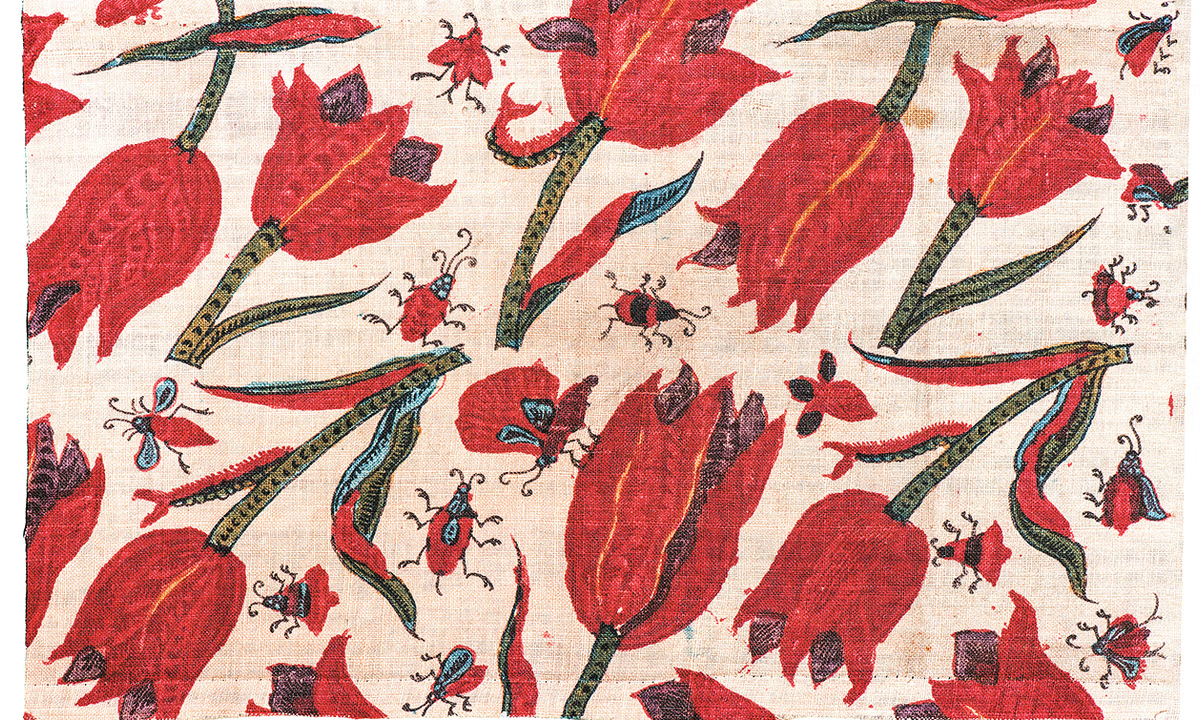
This handsomely illustrated book, based on one of the world’s largest textile collections, sheds light on a little-understood category of global art: the intricate, astonishingly varied block-printed cloths that were designed in pre-modern India and sent out for over a thousand years on maritime trade routes to Japan, Indonesia, France and Britain.
Today, we may be tempted to associate “chintz” with cushions, curtains and chairs, but Chintz: Indian Cotton Textiles from the Karun Thakar Collection tells a story of indigenous artistry, trade and cultural exchange that contains within it a potted history of pre-modern global connectivity. Through the collected essays of 12 leading scholars of Asian textiles, we learn of the extraordinary diversity underlying an ancient export industry that has cast a long shadow on global fashion.
The book uncovers a rich and disappearing history, since textiles—
particularly those designed for specific, everyday use—do not tend to last more than a few generations, putting their inception and historical development out of reach. As they are the products of predominantly oral societies, we also know next to nothing of the unnamed, enigmatic makers who introduced boundless, minute variation to highly formulaic traditional patterns.
These problems are particularly pronounced in the case of chintz, whose very definition remains malleable. “The word ‘Chintz’ in Hindi denotes ‘spray’ and a ‘splattered’ or ‘speckled’ effect,” writes Thakar as he excavates little-appreciated Indian views of Indian textiles. Perhaps the most common application of the word is to lengths of ivory-coloured fabric, usually cotton, dyed or painted with pigments of red and indigo. In this guise, in the 17th and 18th centuries, chintz palampores—a word derived from the Hindi for bed-cover—“decorated homes on every continent, making Indian chintz makers among the most influential in art and design history”, writes Avalon Fotheringham, the curator of Indian textiles at the Victoria and Albert Museum, London.
As early as the 13th century, we learn, Indian cotton textiles were being traded as far as Indonesia on trade routes that long pre-dated European colonialism. Pigments and motifs flowed into India by land and sea, while the finished, highly prized products were sent back in return. For example, from the 15th century, pieces of chintz—known in Japanese as sarasa—were sent to Japan, where they sparked a craze. Market pressures and chintz design books adapted Indian artists’ productions to Japanese tastes, while, we are told, the most valuable kind remained the old Indian variety, called kowatari sarasa. Elsewhere, John Guy of the Metropolitan Museum in New York shows us a jacket made for the Thai king’s guards, made in the 18th century from Indian chintz, that was designed to “precise patterns provided by the court to the agents commissioning these jackets, to be shared with the … cloth painters and dyers on the Coromandel Coast of southeast India”.
Another beguiling piece of chintz is The Flower Picker, depicting a figure whose smooth red body is punctuated only by piercing white paisley-shaped eyes. Richly adorned with jewellery, he is bending forward in profile, amid stalks of foliage, depicted in bold shades of red. Who is this figure and what is he doing? Found in south India, he is thought to be a reference to the work of the ninth-century Tamil poet Manikkavacakar, but visual clues and resonances are all we have to go on, as the textile is the only surviving example of its kind. As Guy points out: “Its exceptional quality lies in the sensitivity of the painted line and the subtle integration of figure and setting … in a simple madder-
red mordant technique.” It is also a reminder of the mysterious sophistication of a branch of art often derided as folk or ritualistic.
In time, the mercantile vanguard of European colonialism brought in pattern-
books and prints, creating in the process a new hybrid visual language born of the European encounter with the East. What had been an astonishingly diverse agglomeration of relationships became a more uniform export-oriented industry, snuffed out in the end by technological advances that enabled European manufacturers to imitate and exceed their Indian models. The industry in India is now almost gone but, as Fotheringham argues here, its “impact on global art and design history leaves a legacy that can never be erased”.
• Cyrus Naji is a freelance writer and journalist
Karun Thakar, with essays by Avalon Fotheringham, John Guy etc, Chintz: Indian Cotton Textiles from the Karun Thakar Collection, ACC Art Books, 400pp, 300 colour illustrations, £60 (hb), published 28 November 2025
