






As the British government prepares to lay out its agenda for the coming year in tomorrow’s (12 May’s) State Opening of Parliament, one critical debate that has yet to be tabled is the future of the Palace of Westminster. After a decade of warnings over the state of the building, in February, the Restoration and Renewal (R&R) joint parliamentary committee submitted two costed proposals for fixing up the parliamentary estate and bringing it into the 21st century.
The first, dubbed Full Decant, would see the site fully emptied, with the Lords and the Commons moving to new premises for most of the works. The second, Enhanced Maintenance and Improvement Plus (EMI+), would see only the House of Lords move out for part of the project and construction otherwise undertaken around MPs’ daily work. According to these proposals, the latter have until 2030 to choose which option to go for. During that time, companies will bid for construction contracts, the palace will seek planning consent, and a phase of early, preparatory works will begin.
However, at a talk on the future of R&R at the Institute for Government yesterday (11 May), Jack Pringle, the chair of the board of trustees at the Royal Institute of British Architects, emphasised the urgency of the situation. To his mind, the choice between the two options was a “no-brainer”: “The decant saves between £10-24bn and 30 years,” he said. “I would suggest that it’s a no-brainer that a full decant is needed.” And, he added, “I don’t think it’s satisfactory to take that decision in 2030, because what all projects need is certainty.”
Fellow speaker Nick Smith MP, who chairs the House of Commons Administration Committee, said the Commons would be debating these costed proposals “in the coming weeks”.
Taxpayers currently foot a £1.5m weekly bill simply to maintain and repair the building reactively
The cost for the full programme of works ranges from £11.5bn to £18.7bn, and timeframes from 24 to 61 years. Should EMI+, the slower and more expensive option, be picked, works would be completed by 2086, the report shows. Even Sam Carling, the 24-year-old member for North West Cambridgeshire, the so-called Baby of the House, would be long retired from public service. The Conservative leader Kemi Badenoch has duly called for a comprehensive rethink, saying the project was “out of control”.
What really appears out of control is the palace’s service infrastructure. Taxpayers currently foot a £1.5m weekly bill to simply maintain and repair, reactively. The committee estimates that delaying R&R delivery could cost £70m per year.
Built on reclaimed land
In 1840 the Victorian architect Charles Barry started building the Palace of Westminster around three extant Medieval buildings, including the 929-year-old Westminster Hall, on land reclaimed from the Thames; in the Middle Ages visitors arrived at the hall by boat. The R&R committee has commissioned extensive survey work, including dropping 14 bore holes across the site and another 15 or so in the river. Archaeological trial digs have shown human activity at the site from 6,000 years ago.
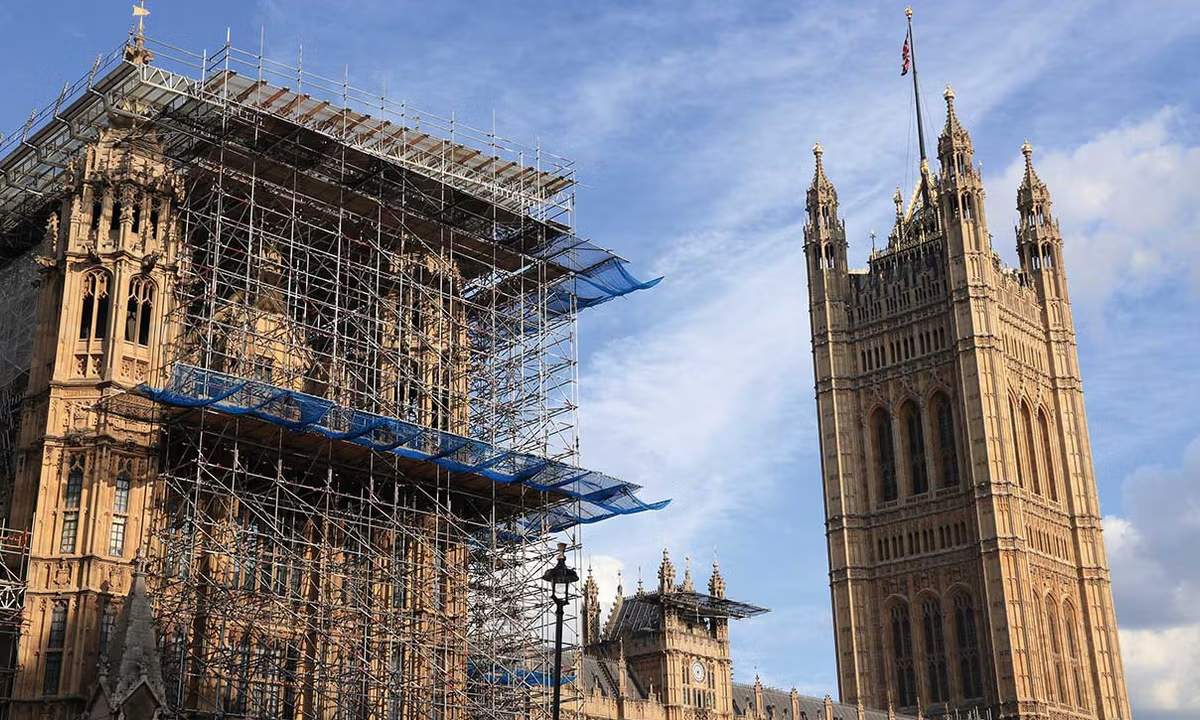
The surveys have revealed no subsidence: the concrete foundation slab Barry laid (16 football pitches in size and between 8ft and 11ft thick) is remarkably stable and intact. So too, the iconic neo-Gothic pile that rises above it, with its three towers: the Victoria Tower, the Central Tower and the Elizabeth Tower (known as Big Ben).
As with any historical landmark, extensive conservation work is required. The £3.3bn allocated to what the report terms “Other Parliamentary projects which support R&R” includes external works on Victoria Tower and the Lords chamber roof, as well as addressing crumbling stonework in the Medieval Cloister Court, Cromwell Green and the Colonnade. Part of the benefit of the R&R programme, the report highlights, is how it will foster skills and employment, in the way the Notre-Dame de Paris reconstruction revived ancient craftsmanship in wood and stone.
But unlike Notre-Dame, this project is not a reconstruction, nor is the palace a ruin. Rather, it is a massively complex effort to avert a disaster.
What is known as the Spine Road is the only route running in and out of the palace. Deep gouges on the Victorian arches under which it travels remind visitors that it was designed for horse-drawn carts, not delivery trucks. Today, food, rubbish and construction material, as well as MPs and the 500-odd schoolchildren who visit the site each week in hi-vis vests, all travel down this one road. R&R has factored in building a jetty on the Thames for materials delivery and rubble removal by boat or barge.
Elsewhere, there is limited disability access, with only 12% of the floor area being step-free. There is asbestos and reinforced autoclaved aerated concrete that needs removing. Sewerage is a constant headache. The House of Lords is unheatable. Overall, in fire safety terms, the building is certified for life safety (people can be evacuated), not building safety. Much of this has to do with infrastructural redundancy. The original cabling and pipework that was installed to power and heat the palace is still in place, running through the underground corridors and vertical ventilation shafts that Barry designed.
Repairs to the building’s interior Photo: Simon Leigh/Alamy Stock Photo
There are 20,000-volt electric cables wrapped around the steam heating system; the high-pressure mist system recently installed as a fire safety improvement measure runs alongside the gas mains; telecoms and fibre optic cables weave in and out of all of it. And that is just the top layer. Successive generations of pipes and cables have been installed around or in front of the old, running almost a metre deep. This means corridor space is now reduced to not much more than a person’s width and height. Several years ago, the site’s engineers had to come up with a way to avoid water pipes leaking on to an electrical board the size of a laundry room. They installed a drip tray with a pipe down the side that empties on to the floor, which means anyone walking down the corridor can see when it is wet: a clever solution, but not a permanent fix.
New visitor routes
Pundits have criticised proposals for new visitor routes and a reception area beneath Central Lobby for what one critic has labelled an unnecessary intrusion into the Gothic building. But a spokesperson says that the columned space that the reception area would be inserted into is simply an area that would become available once the cabling and pipework that is currently clogging it is removed. Further, these parts of the proposals account for less than 3% of the total costs.
Most non-expert responses to the eyewatering sums and timelines start with “Can’t they just…” But there appears to be no “just” in this case. Any decant involves construction work to prepare temporary accommodation for working Lords and MPs, not to mention, as the journalist Tom Lowe put it in the Building Design publication, reimagining the ceremonial functions of the building: the state opening of Parliament, the King’s lying-in-state, which, the average UK life expectancy suggests, will certainly happen before the project is completed, regardless of which option is picked.
“We have a collective duty as custodians of this historic building to protect it for generations to come,” the committee states. “We believe that the recommendations set out in this report will enable us to deliver on those responsibilities and safeguard the Palace of Westminster as the home of the UK Parliament, as a national asset and enduring symbol of democracy, for the future.” It is truly the task of a lifetime.


