


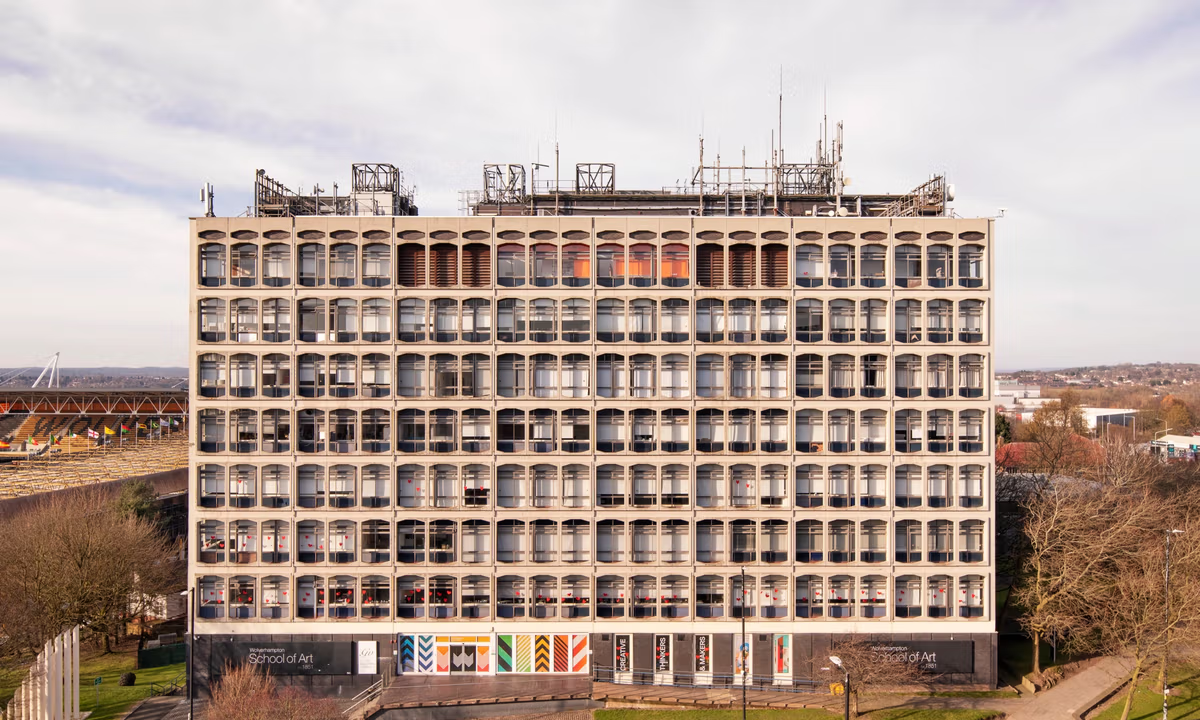
A building often considered to be the home of the Black British arts movement has been saved from demolition after being granted new protection by the Department for Culture, Media and Sport (DCMS).
The University of Wolverhampton’s School of Art building—an eight-storey Brutalist landmark completed in 1969—was awarded Grade II listed status by the UK government department following advice from Historic England. In October 1982, the school hosted the first National Black Art Convention, now widely recognised as a formative moment in the emergence of the British Black arts movement.
Historic England’s Midlands regional director, Deborah Williams, said the building “holds a prominent place in the centre of the city, and in the hearts of many locals”, adding that its design and social history “meet the high bar for post-war listing”.
The decision comes following a campaign to save the art school from University of Wolverhampton plans to demolish the building, redevelop the site and move the art school to another location. A petition set up by a former student has reached 6,655 signatures.
Wolverhampton School of Art is closely associated with the Blk Art Group, formed in 1979 and originally known as the Pan-Afrikan Connection. Many founding members were students at the polytechnic, including Keith Piper, Marlene Smith and Claudette Johnson, nominated for the Turner Prize in 2024.
Largely children of Caribbean migrants raised in the industrial West Midlands, the group sought to challenge the marginalisation of Black artists within British institutions. Their first exhibition, Black Art An’ Done, was held at Wolverhampton Art Gallery in 1981.
Designed by Diamond Redfern and Partners, the building—also known as the MK Building—rose during a period of institutional change, coinciding with the merger of the College of Art and the College of Technology to form Wolverhampton Polytechnic. Its exoskeleton of pre-cast modular concrete panels, hung from a concrete frame, produces a striking, sculptural façade whose repeated patterning reflects the influence of Pop Art on architecture in the 1960s.
The building’s listing, which was originally applied for by the 20th Century Society, recognises not only architectural distinction but an outsized cultural legacy. Visible across the city, it has become a defining feature of Wolverhampton’s skyline.
