


Henry Darger left behind one of the strangest imaginative monuments of the twentieth century: a vast private cosmos teeming with angelic child armies, sadistic empires, blizzards, tornadoes, serpentine sky-beasts, and wars fought over the fate of enslaved children. After his death, the whole sprawling kingdom surfaced at once, like an inheritance no one knew to claim. Critics, encountering the hoard, have naturally reached for labels. “Outsider artist” is the one that tends to get slapped on him; others follow close behind—visionary, naïf, crank, madman. Each explains something and misses more. Henry Darger repels labels the way condensation repels paper on a soda bottle: the harder you press, the quicker it lifts.
The perennial temptation is to treat him as a puzzle to be solved. How did a menial worker in Chicago, working in near-total obscurity, produce a 15,145-page epic and hundreds of sweeping, panoramic paintings? What species of solitude allowed him to incubate armies of child rebels? Biography, as a form, tends to flail here. It inventories facts—born 1892, a childhood punctured by institutionalization, decades cleaning hospital floors—but sheds little light on the compulsive, burrowing labor that produced the work.
Yet it is biographical facts that structure Bughouse, a new play about the artist running at Vineyard Theater in New York through April 5. John Kelly stars as Darger in this one-man play, portraying him as a puttering, vaporous presence. His voice rarely rises above a murmur as he reels off facts about his life, sourced from his 5,000-page autobiography (The History of My Life). His early years were marked by rupture: his mother died shortly after he was born, in 1892; his father became ill and, increasingly unable to manage him, placed him in Catholic institutions, including an asylum for “feeble-minded” children in Illinois.
At the asylum, Darger was subjected to a regime of discipline that he chafed against. He ran away several times, once legging it for miles along rail lines in a stubborn bid for self-determination, before eventually making his way to Chicago, where he would spend the remainder of his life isolated in rented rooms. Unfortunately, in playwright Beth Henley’s rendition, Darger is confined to a room that feels smaller than his imagination ever did.
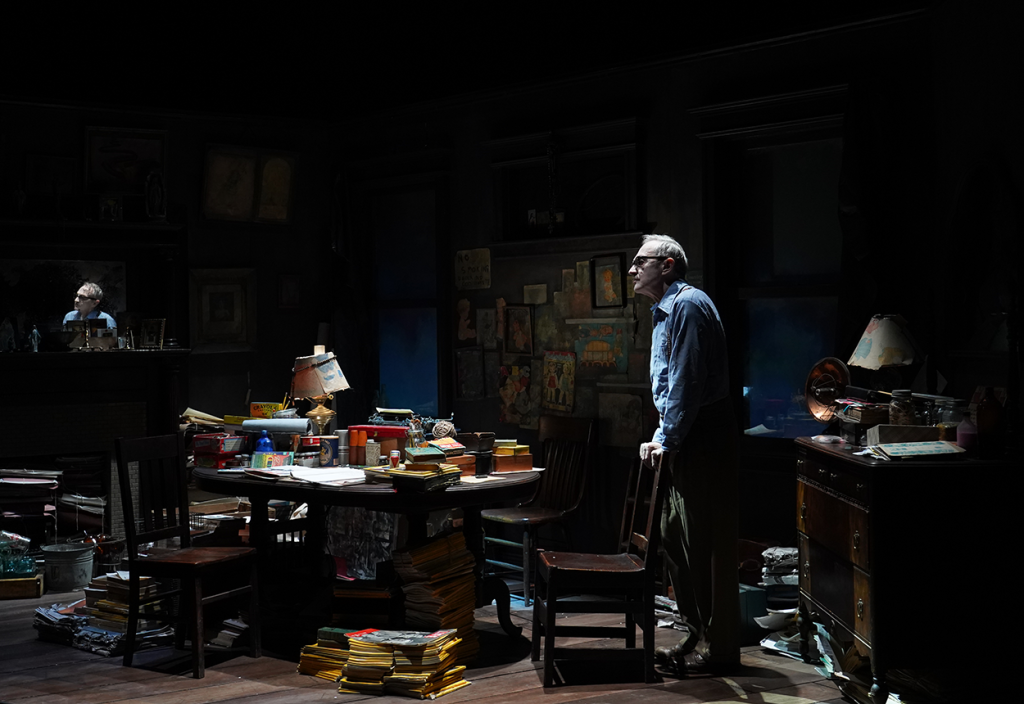
The stage is an obstacle course of towering stacks of books and newspapers, the residue of a lifetime’s compulsive accumulation. The walls are an exhausted shade of purple. A pride of miniature religious icons stands stiffly on the mantel above a defunct fireplace, as if awaiting orders. Two grimy windows look out onto a gray nowhere. The building appears one code violation away from being condemned.
John Kelly as Henry Darger in Bughouse, 2026.
Photo Carol Rosegg
Under Martha Clarke’s no-frills direction, the play gestures toward the social forces that can drive a person inward—poverty, trauma, religious fervor—but these remain backdrops rather than meaningful antagonists or accelerants. Projections supply the evening’s strongest images. Darger’s drawings bloom across the windows and the large mirror that dominates the room, their saturated colors intermittently electrifying the drab interior. The Vivian Girls—those virtuous heroines of Darger’s collaged epic that he worked on from 1910 through 1927—flicker into existence there, ghostly emissaries from his inner kingdom.
Annie Aronburg, an ally of the Vivians, receives particular emphasis. Scholars have noted that the fictional girl seems to have been inspired by a real tragedy: the kidnapping and murder of a Chicago child, Elsie Paroubek, whose photograph circulated in newspapers before her body was discovered. Darger reportedly clipped that image and later misplaced it; the loss affected him. In Bughouse, she appears variously as a commander and a martyr—always haloed with a specialness the script somewhat monotonously insists upon.
Occasionally, the Vivian Girls speak back to their creator. The conceit has promise but limited payoff. Their appearances function less as dramatic encounters than as decorative interruptions. We never get the sense that Darger’s vivid imaginings rearrange reality. Maybe that was never the intent. Carl Watson has observed that Darger’s writing “develops no climax, no conclusion, nor any real insight or dramatic tension, but seems to exist only to perpetuate itself in an ongoing metaphysic of wreckage and sublime turbulence.” Bughouse similarly lacks a climax and dramatic tension, but for the more deflating reason that it traffics in Wiki-facts.
For a play whose title evokes chaos and disorder, the show is sober to a fault, presenting us with a man without qualities droning for 65 minutes with the dull persistence of a dot-matrix printer. Darger’s Chicago remains a brumal abstraction beyond the grimy windows and strangely, there’s no mention of his landlords, who assisted him in sundry ways throughout his life and recognized the merit of the work he left behind. Henley’s dutiful script rarely ventures beyond what one might glean from a documentary like Jessica Yu’s 2004 In the Realms of the Unreal, which covers much of the same ground in roughly the same running time, or from Michael Bonesteel’s much more comprehensive book on the artist. (Bonesteel is listed as the show’s Art Historian Consultant.)
A more adventurous director and playwright might have leaned into the logorrheic qualities of Darger’s writing or shown us more of the art—given us a fuller chance to feel as Darger felt when he fictionalized himself as a General and wrote “The heart aches at the sight the inconvenience and strange mystery of it all.” Watching the play, I wondered what Beckett might have done with such material. In hermit-haunted works like Krapp’s Last Tape and A Piece of Monologue, he wrought drama from the bare fact of a solitary mind communing with itself in a small space. Bughouse regrettably brings the curtain down on Darger’s vast imaginative machinery before it’s had a chance to whirr to life.
