


A pair of Claude Monet series paintings from 1894; a 1st-century AD Egyptian granite vase commissioned by the Emperor Nero; a 14th-century navigational map of Europe, the earliest left in private hands; a unique 17th-century Mughal elephant automaton that flaps its ears.
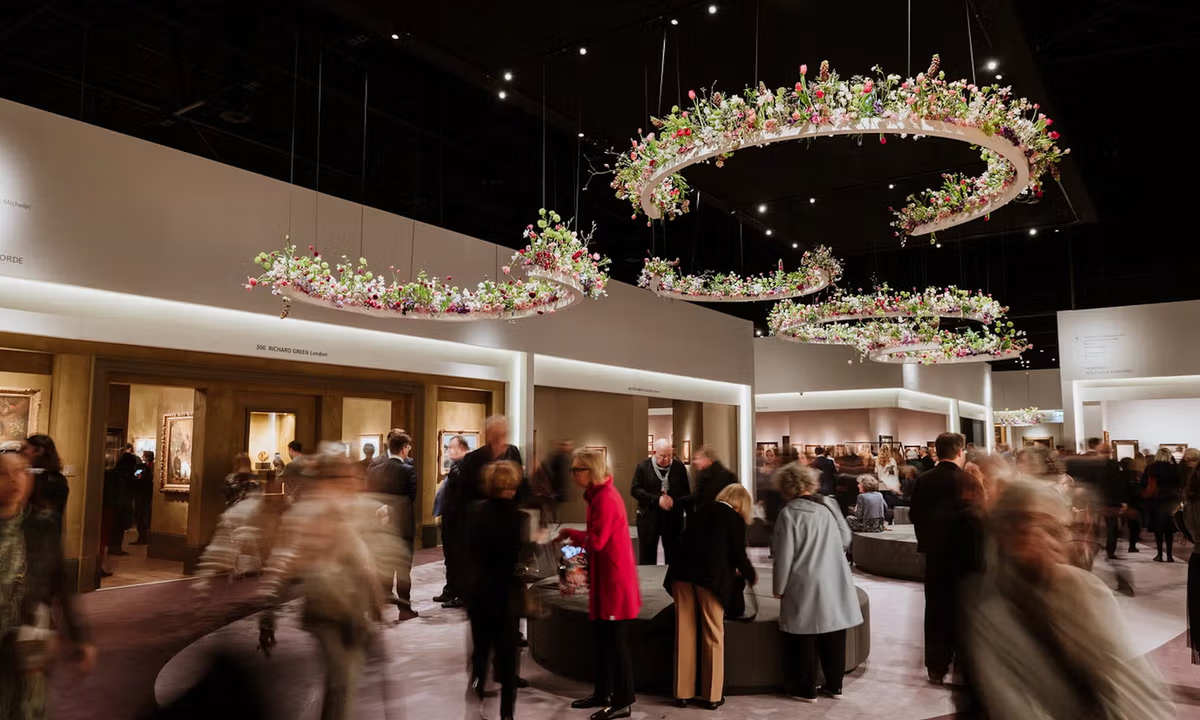
The 39th edition of the Tefaf Maastricht fair, which opened to invited visitors in the Netherlands on 12 March, and runs until 19 March, certainly lived up to its long-held reputation for being a treasure house of museum-quality objects. But as a predominantly male, middle-aged, besuited crowd filed into the fair to browse the booths of 276 exhibitors, an existential question continues to hang over the last of the grand international fairs primarily devoted to pre-20th century art and antiques. To what extent does the past still have a future in today’s ever more amnesiac art world?
On the one hand, the recently released 2026 Art Basel & UBS Art Market Report reveals that just 3% of the world’s art dealers now specialise in Old Masters, the traditional mainstay of Tefaf, which shuttered its New York fair devoted to older art and objects in 2021 (its spring fair in New York remains). On the other, Artprice.com reports that the value of auction sales of works by contemporary artists under 40 have halved for the last three successive years.
“Looking at old art gives me a sense of craftsmanship, of what can be achieved with paint,” said Luc Haenen, a seasoned Belgian collector of ultra-contemporary art, at the preview of the fair. Haenen is a part of a seemingly increasing, if unquantifiable cohort of contemporary art collectors who visit the fair. “There is nothing comparable with Tefaf. The atmosphere of quality is unmatched,” added Haenen, speaking on the booth of Sofie Van de Velde, an Antwerp-based debut exhibitor. Van de Velde sold seven canvases by the young Brussels-based artist Felix De Clerq that were subtly redolent of works by older masters. They were priced up to around €20,000.
The trade-based foundation that organises this Dutch fair has a tricky balancing act to stay relevant by presenting a credible contemporary art offering without weakening Tefaf’s core strength of pre-20th century material. This latest edition featured 67 dealers specialising in Modern and contemporary art, versus 56 showing 19th-century art and Old Masters. It is this older material that inspires annual pilgrimages from the curators of major American institutions and their patrons. This year, groups from the Metropolitan Museum, New York, the MFA Boston, the Getty, Los Angeles and the Cleveland Museum were all in evidence.
A late 14th-century marble sculpture of a kneeling donor was bought by the Metropolitan Museum of Art for €1.5m from the stand of Tomasso
Courtesy of Tomasso
“Everyone is here from the United States. It’s like a conclave of museum directors,” said Gerhard Lutz, curator of medieval art at the Cleveland Museum. “I get the chance to talk to colleagues and the dealers bring their best things, so I also get a sense of what’s happening in the market.”
With their generous endowments, stretching back to the era of the Robber Barons, American museums are also in a position to buy. A late 14th-century marble sculpture of a kneeling donor, bought by the Met for €1.5m from London- and Leeds-based dealership Tomasso, was one of the several purchases made by American museums at the two-day preview. Tefaf’s organisers said that representatives from 450 institutions attended. The Van Gogh Museum in Amsterdam was also among those doing some buying. It gave a price between $500,000 and $1m at the Texas-based 19th Century Gallery for the monumental 1889 Paris Salon painting of a fisherman’s wife and child, L’homme est en mer, by Virginie Demont, which was copied by Van Gogh. Nero’s equally monumental granite vase was another museum purchase, acquired by an undisclosed institution for £1.8m from the London dealer Stuart Lochhead.
Accurately assessing the “success” of a fair like Tefaf at its preview is an impossible task. Sales of important objects, particularly to museums, can take time. A war was raging in the Middle East. Belgian railway workers were on strike. But Marcel Nies, the founder of Antwerp-based Nies Oriental Art, a specialist in South East Asian sculpture, who has been showing at Tefaf Maastricht for 38 years, was one of the several exhibitors who was upbeat.
“For the first time in a while we’ve been continually meeting good people who are asking good questions,” said Nies, who sold three sculptures and took several more reserves on the first day. His pieces were priced up to €850,000. Nies was one of the many Tefaf exhibitors specialising in non-European objects adversely affected by the EU’s new regulations for importing cultural objects into the bloc. He, like others, complained that dealing in his field had become about the quality of the provenance, not the object. “It will affect the whole trade. It’s not helping,” Nies added.
The quality of exhibited objects remains key to the future of Tefaf. This year’s edition didn’t disappoint. Visitors couldn’t remember the last time two Monet series paintings had been shown on a stand at a commercial fair. The London dealer Alon Zakaim had bought Monet’s 1894 painting Église de Vernon Soleil for $7.1m at auction last year and had managed to pair it up with Église de Vernon, temps gris. These superbly atmospheric canvases had been part of a series of eight paintings of Vernon church in different conditions exhibited by Monet in Paris in 1895. Zakaim was asking $20m for the pair.
The fellow London dealers Peter Harrington and Kent Antiques were respectively asking $7.5m and €370,000 for their 14th century navigational chart of Europe on vellum and Mughal Indian automaton. Both were unique rarities.
The format of Tefaf Maastricht has changed little over the last 40 years, nor has the town. As the market for ultra-contemporary art falters and collectors are looking for quality and value elsewhere, this venerable Dutch fair has a chance to attract a new audience. But exhibitors and visitors both agree that Maastricht’s poor transport links and shortage of high-standard accommodation remain a hindrance. As the London-based adviser Morgan Long put it: “One of my top clients wanted to visit Tefaf Maastricht and he had to stay above a pub. Luckily he had a sense of humour.”
To be sure, unlike Frieze Masters in London or Art Basel Paris, Tefaf Maastricht is a fair that draws a captive audience to a city with few other distractions. Yet it can take three train journeys to get there and you’re charged €300 a night for a hotel room the size of a prison cell. There could be a future for the past in today’s art market, but it also needs to be an up-to-date part of today’s “experience” economy.
