


Lionel Ziprin’s unlikely rediscovery really got going with a walk-in safe in Carol Bove’s Brooklyn studio. It was a big safe, and an old one—Bove initially had to use a car jack to pry open its metal door—and it became the unlikely home for all things related to Ziprin, a doyen of the Lower East Side art scene of the 1950s and ’60s who was all but forgotten in the intervening decades.
After Bove came into possession of Ziprin’s poetry and drawings via his daughter Zia in the early 2010s, she began to exhibit them alongside her own sculptures. Suddenly, Ziprin became the subject of mainstream discourse in the New York art scene: in 2014, Frieze published a lengthy profile by my colleague Andy Battaglia that praised Ziprin, a practitioner of Kabbalah, for his “intensely networked and wildly idiosyncratic mind.”
Generally, Ziprin is not a figure seen often in New York museums: neither MoMA nor the Met owns any works by him. But this week, a drawing by Ziprin officially entered museum walls in New York—in a show about Bove, an artist whose practice entails both creating her own sculptures and upholding the work of nonpareils like Ziprin. On view through August 2, Bove’s rotunda-filling Guggenheim retrospective is, to my knowledge, only the second time in recent memory that a Ziprin work has entered the walls of a major New York museum, the other being a 2023 Harry Smith retrospective at the Whitney Museum that Bove helped conceive.
Stylishly curated by Katherine Brinson, who worked on it in tandem with Charlotte Youkilis and Bellara Huang, Bove’s exquisite show includes a drawing by Ziprin, a small painting by Agnes Martin, an assemblage by Bruce Conner, and a sculpture by Richard Berger. The show’s checklist also features an Édouard Vuillard painting of a Paris street that Bove relocated from the permanent collection galleries to the ramp for temporary exhibitions, as well as a ceramic mural by Joan Miró and Josep Llorens Artigas that is typically trapped beneath false walls. Making its first public appearance in 23 years, the mural has been excavated by Bove, who designed an aperture through which to view it.
The crux of the Guggenheim show is a parade of around 100 works by Bove, most of them sculptures: colorful metal creations that loom high above viewers’ heads, curlicuing twists of steel painted white, assemblages of shells and refuse, and shelving units lined with tattered books. Bove isn’t claiming the pieces by Vuillard & Co. as creations of her own—she’s not exactly an appropriation artist. (Curator Cathleen Chaffee terms these re-presentations “para-artworks” in the catalog, which is probably about as close as anyone will ever come to naming such an unusual gesture.) But in presenting others’ art in her own retrospective, Bove is showing that her artistic journey was not one traveled solo—others were along for the ride as well.
The Guggenheim’s rotunda currently holds mirror-like discs, one on each floor. They are from an installation designed by Carol Bove for the Met in 2021.
Photo David Heald/©Solomon R. Guggenheim Foundation
Take her installation Setting for A. Pomodoro (2006), whose name refers to Arnaldo Pomodoro, the Italian sculptor whose work Bove saw as a kid at the Berkeley Art Museum. Dispersed throughout the installation are elements that could stand on their own as discrete sculptures: pieces of driftwood raised by thin rails, peacock feathers arranged on a base, blocks of concrete, bronze armatures. These objects are so disparate in their aesthetic that they appear to be by different artists. Sure enough, all are by Bove, with the exception of just one—a bronze sphere whose patinated surface splits open to reveal a set of gnashing teeth. That orb is by Pomodoro himself, whose passing last year renders Setting for A. Pomodoro a somber homage to a lost artistic forebear.

During the 2010s, Carol Bove made installations from unlike objects such as driftwood, peacock feathers, and metal.
Photo David Heald/©Solomon R. Guggenheim Foundation
In presenting Pomodoro’s sculpture alongside her own objects, Bove elides the difference between old and new, industrial and manmade, original and not. It’s a work that also moves beyond traditional chronology: the Pomodoro sphere at the Guggenheim is from 1996, roughly a decade before Bove created this installation, though this will only be noticeable to those who read the label. Bove’s practice, after all, is all about establishing relations between unlike people and objects and transcending conventional notions of time and space.
Her Guggenheim show is also a part of that project, with the oldest works placed at the top of the rotunda rather than at the bottom. For the sake of this review, I’ll start at the end, where one can find conceptual artworks rooted in Bove’s upbringing in the post-psychedelic Bay Area of the ’70s and ’80s.
Born in Geneva, she was raised in Berkeley, California, and dropped out of high school in the 11th grade. After a decade of what Brinson describes as “odd jobs” in the catalog, Bove settled in New York, where she got a degree in photography and art history at age 29. Her late start seems to have finally provided her with an outlet for all her pent-up energy: she burst out the gate in the early 2000s with oddball drawings of ’60s icons such as Twiggy, whose striking visage appears nearly translucent in Bove’s hand, as though the British model were fading away before Bove could even capture her in pen. Drained of all the celebrity worship that typically attends Twiggy, this drawing from 2004 made Artforum’s cover the year afterward, sealing Bove’s reputation as an artist worth watching.
During the early stages of her career, Carol Bove produced drawings such as Prone (Supine), from 2003.
©Carol Bove Studio LLC/Private Collection
At the same time, Bove was also creating assemblages from used shelves and old books that seemed to be grouped less by themes and more by vibes. Under the memorable title of The Sensuous Dirty Old Man (2006), one groups Ralph Siu’s tome about I Ching stood upright by a concrete block, a catalog about Alberto Giacometti, and Alain Robbe-Grillet’s script for the arthouse classic Last Year at Marienbad. So far as I know, Robbe-Grillet’s screenplay and Giacometti’s sculptures have nothing in common with ancient Chinese divination. Bove seems to have brought the three texts together merely because they all contributed to the counterculture of the ’60s. This shelf acts as a cosmos of the era.
The charm of these shelves lies in the wornness of their materials: the books utilized have clearly been read, reread, and thumbed through, which means that they also act as records of their prior owners. The installations composed of refuse she produced thereafter continue the theme; one in the Guggenheim show even features a dirtied Dunkin’ Donuts napkin.
Carol Bove’s Second Cartesian Sculpture (2014), at center, dialogues with Minimalism both admiringly and subversively.
Photo David Heald/©Solomon R. Guggenheim Foundation
Then Bove’s practice shifted radically around 2012. That year, at the German art exhibition Documenta, she exhibited one of her first “glyphs,” sculptures composed of arcing, spiraling snakes of whitened steel. They are spotless and uncannily sleek, and they recall Minimalist sculpture, which flourished during the ’60s, just like many of the writers whose work is surveyed on her shelves. There’s no question that Bove was setting herself in relation to a new set of authors with these works. But Bove’s “glyphs” are loopy and soft-looking where most Minimalist sculptures tend to be hard, heavy, and firm.
Bove would continue dialoging with Minimalism in the decade or so afterward, managing to do so with an equal amount of admiration and abhorrence. 10 Hours, a 2019 work emblematic of a period of colorful sculpture that remains ongoing, features a steel beam redolent of the ones seen in work by Richard Serra, arguably the defining wielder of that metal. But in a gesture that is about as far removed from Serra’s machismo as one could get, Bove then topped her monolith with another beam that she pressurized so that it appeared flimsy and light. Then she painted that beam yellow and left it to droop.
Carol Bove’s “glyphs,” begun during the early 2010s, marked a shift in her practice. A new one, titled Victoria (2026), can be seen outside the Guggenheim.
Photo David Heald/©Solomon R. Guggenheim Foundation
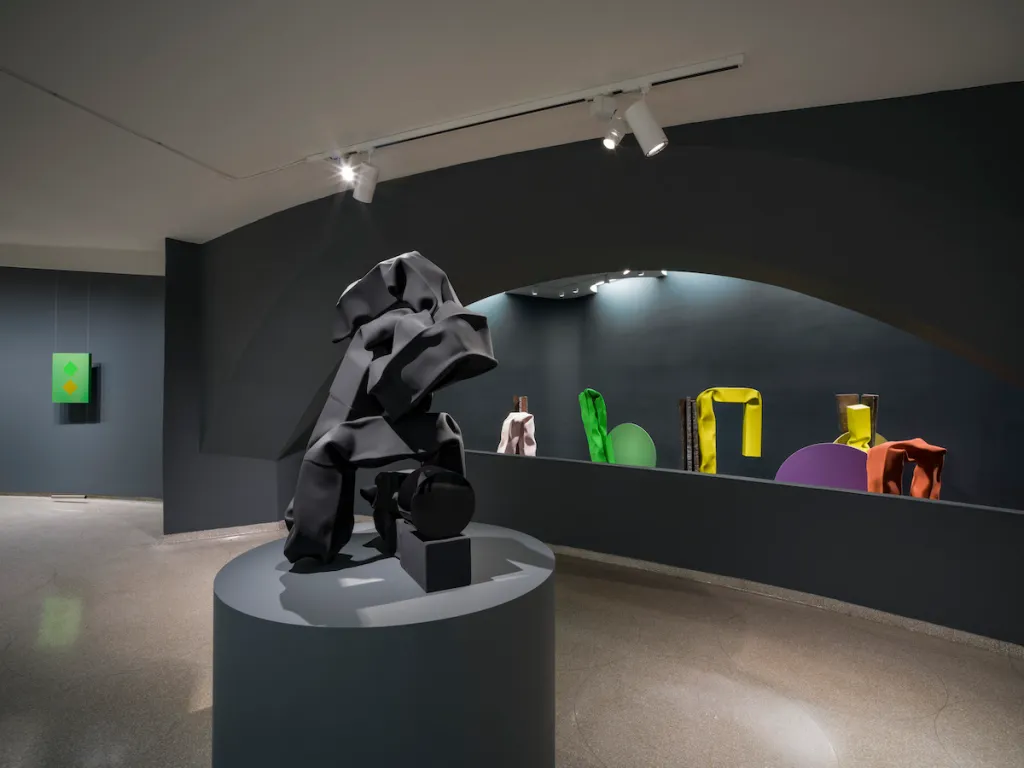
Her steel works have grown increasingly extravagant. Sweet Charity (2026), the star work of the Guggenheim show, takes on the proportions of a forest, its steel beams rising high above the heads of even the tallest viewers. The beams are accompanied by unnaturally smooth discs, their soft exteriors contrasting neatly with those of the crushed steel, which appears lush and flowy, like the drapery in a Bernini sculpture. Sweet Charity is lush, extravagant, and formalist—all qualities that lend Bove’s recent work an edge in an art world still dominated by cold-eyed conceptualism.
Carol Bove, Vase Face I / The Ascent to Heaven on a Dentist’s Chair, 2022.
Maris Hutchinson/©Carol Bove Studio LLC/Collection of the artist
More discs like the ones in Sweet Charity are exhibited throughout the Guggenheim’s ramp, all exhibited in the same location of each floor, one atop the other. They form a spine of sorts for the show, and they came from Bove’s 2021 installation for the niches in the Met’s exterior, where they formed a group called “The séances aren’t helping.” (It must be said: she has a real knack for titles.) As the name suggests, attempts to commune with other planes can be tough, but Bove’s discs very nearly get the job done. Glimpsing into one of the discs across the rotunda, others visitors might appear as blurry reflections. You might mistake them for ghosts.
