


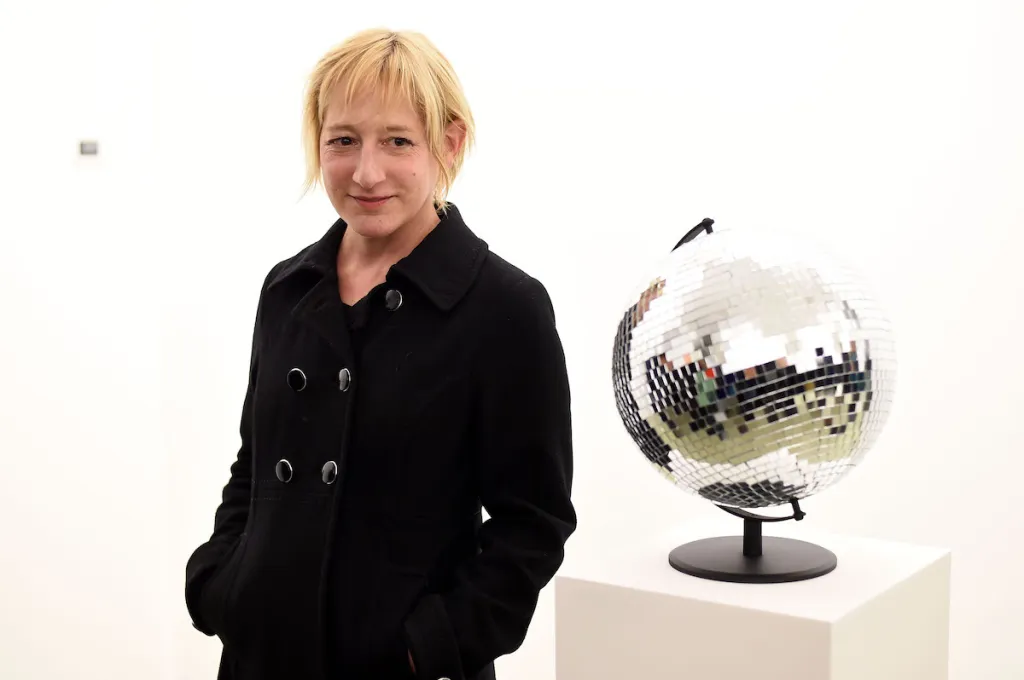
Ceal Floyer, an artist whose spare sculptures charmed and confused in equal measure, died on Thursday at 57. Esther Schipper, the Berlin-based gallery that represented her alongside Lisson and 303, said that she died after a long battle with illness.
Floyer received international attention for sleek artworks that consider how meaning is constructed. Working within a long tradition of conceptual art that extends back to the 1960s, Floyer often made sculptures using familiar objects such as ladders, umbrellas, drains, and receipts, pondering what happens to the everyday when it is raised to the status of art.
Her work was frequently sly and dryly funny. Her most famous piece, Light Switch (1992–99), featured a projector beaming an image of a 35mm slide depicting a light switch at a wall. The projection was not a light switch but an image of one, though it was ironically made possible through electric illumination.
Bucket (1999), another beloved work, takes the form of a plastic bucket with a wire leading into it. Inside, there was a CD player containing a recording of water dripping. But there was no actual water here, just the illusion of it.
“I consider the things I make to be self-reflexive; they are not necessarily about anything outside of the work itself and the context of its production, and I mean this both in terms of its being made and its being shown,” Floyer said of her art. “The activity of making the work and the consequent result of it being shown become inseparable.”
She would periodically involve performative elements in her work. Ink on Paper (Video), from 1999, is a 52-minute video of herself holding a marker to paper; little occurs, other than the white sheet turning black. Nail Biting Performance (2001) involved the artist standing on stage before a performance of compositions by Beethoven and Stravinsky at Birmingham’s Symphony Hall, then enacting the titular activity before exiting the proscenium. In both works, Floyer teased her viewers with the possibility that something might actually happen before undermining those expectations.
Ceal Floyer, Monochrome Till Receipt (White), 1999.
Photo Stefan Rousseau/PA Images via Getty Images
Floyer had heady ideas on her mind about art-making, but her work frequently spoke well for itself, as critics noted. “Floyer’s work is initially not much to look at,” wrote critic Nico Israel in an Artforum review of a show held at Casey Kaplan gallery in 2000. “It requires a double, even triple take—a process of uncanny intellection—to read the picture. Yet little in her art is hidden.”
Her art was widely seen, appearing in the 2009 edition of the Venice Biennale and the 2012 edition of Documenta, as well as in biennials held in Shanghai, Liverpool, Istanbul, and Zurich. In 2007, she won the Preis der Nationalgalerie, the top art award in Berlin, where she was based at the time of her death. Her work was surveyed by the Museum of Contemporary Art North Miami in 2010.
Few biographical details have ever been released about Floyer, who was born in Karachi, Pakistan, in 1968. According to a short biography supplied by Esther Schipper, she was raised in England. She studied at London’s Goldsmiths College, graduating during the mid-’90s, when the school was a hotbed for edgy conceptual art.
One of her first solo shows was held in 1996 at Gavin Brown’s Enterprise, a now defunct gallery whose offbeat offerings established the space as a fixture of New York’s art scene. The following year, she staged her first solo exhibition with Lisson, one of seven that she would mount with the gallery during her lifetime.

Ceal Floyer’s Taking a Line for a Walk involved a machine that typically draws lines on sports fields. Floyer dragged it around until it ran out of paint.
Photo Daniele Venturelli/Getty Images
While her work’s sparse aesthetic may have caused it to sometimes appear cold or unfeeling, Floyer also made artworks that hinted at an emotional well beneath their surface. ’Til I Get It Right, the 2005 sound piece that Floyer brought to Documenta, features words initially sung by Tammy Wynette: “I’ll keep on falling in love ‘til I get it right.” The phrase loops over and over, hinting at repeated failure at achieving success.
Fallen Star (2018), a projection of a star on a gallery floor, seemed to continue those themes and was also based on a song: “Catch a Falling Star,” as sung by Perry Como. The Como song is about remaining hopeful in the face of darkness by holding onto light. But Floyer, mysterious as ever, told Studio International that she “didn’t realize” the song had a melancholy tone until she paid attention to the lyrics. Of Fallen Star, she flatly said, “The work is not meant to be sentimental.”
