


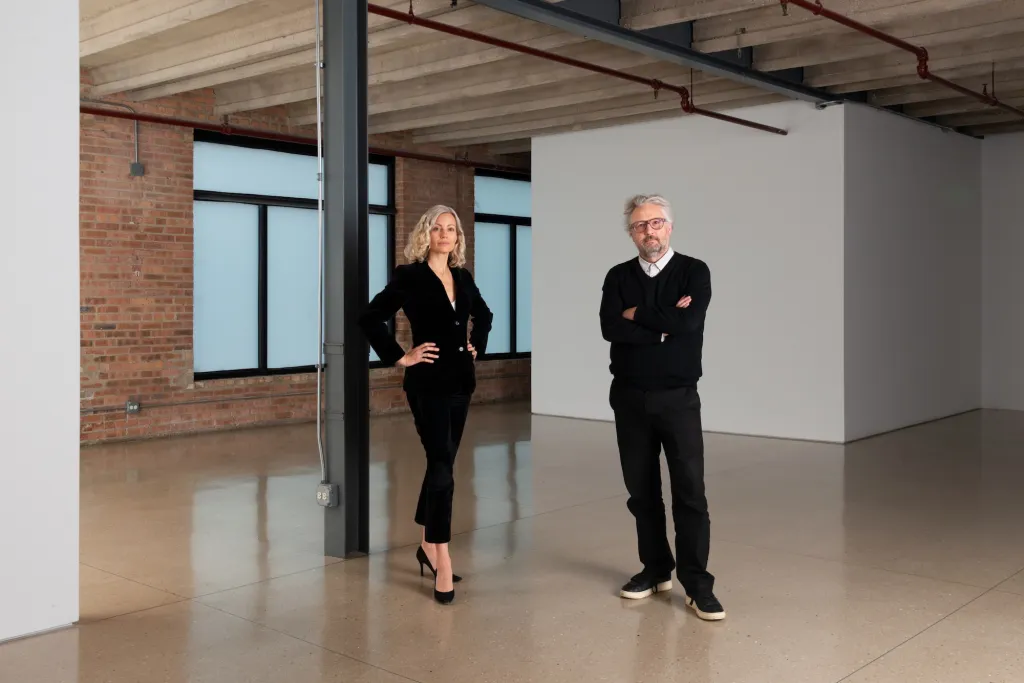
The last couple of years have seen many art galleries close in art hubs around the world amid a struggling market. But one in Chicago is tripling in size with a move to a new neighborhood. Volume Gallery will open on February 13 in a 3,500-square-foot space designed by co-founders Claire Warner and Sam Vinz at 1700 West Hubbard Street, across from mainstays Mariane Ibrahim and Monique Meloche. It’s the gallery’s third space since it opened in 2010.
If expanding a gallery in a market downturn seems counterintuitive, Warner and Vinz know all about making the best of a bad situation. They met when they both worked as specialists at Wright Auctions, and both were laid off in the economic downturn of 2008. “I have the record for the shortest employment there,” said Vinz, who was hired in May and let go after two weeks (at least getting three months’ severance out of the deal). Warner was laid off a couple of months later.
“I think a lot about that time as we are going through such turmoil,” she told ARTnews. “It’s a great time to grow!”
The inaugural exhibition, “The Heresy of Legacy,” explores times when “the heretics become the standard,” as Warner put it, and includes, among others, artists (some of whom also work in mediums often classed as craft) like Selva Aparicio, Richard Artschwager, Garry Knox Bennett, Jessica Jackson Hutchins, Howard Kottler, William J. O’Brien, and Joyce Scott, as well as architects Stanley Tigerman and the team of Robert Venturi and Denise Scott Brown.
The gallery’s roster includes Atlanta-based chairmaker Robell Awake; New York–based designer Abigail Chang; Chicago architect Ania Jaworska; New York–based design duo Snarkitecture; Chicago architect Tigerman; and New York artist Thaddeus Wolfe, who works in glass. The first year will see programming by Tanya Aguiñiga, Joe Feddersen, Christy Matson, Jonathan Muecke, and Terumi Saito.
Sarah Rosalena, Spiral Rotations (2025).
Evan Walsh for Blum Gallery
“We’ve always had a holistic view of art, and have been trying to break down hierarchies, so putting the foundation on materiality was always essential for us,” said Vinz in a video call. Fiber art, ceramics, and glass, as well as objects of design, for example, have always been part of Volume’s programming—which means they can do business not only with the contemporary art curators at museums, but those in other departments as well.
That has obviously worked out, as Volume has placed nearly 100 works in major museums internationally, including the Los Angeles County Museum of Art; San Francisco Museum of Modern Art; the Art Institute of Chicago; the Musée des Arts Décoratifs in Montreal; the Pérez Art Museum Miami; Cooper Hewitt, Smithsonian Design Museum; and the Renwick Gallery of the Smithsonian American Art Museum. In the last two years alone, its shows and artists have also earned attention from publications including ARTnews, the Los Angeles Times, NPR, Artforum, Wallpaper, WBEZ, and Bomb magazine.

Claire Zeisler, Homage to Red (1976).
Volume Gallery
There are, of course, a number of art galleries that work to bring down boundaries between art and design, including, in New York alone, R & Co. and Salon 94. Asked what galleries they feel they can relate to in their spanning of categories, though, the founders looked more to the past, and brought up Max Protetch, who opened a gallery in Washington, D.C. in 1969 and then moved to New York, where he remained in business until closing in 2009 after forty years. “He showed Scott Burton next to [architect] Tadao Ando,” said Warner. “It was fascinating seeing those two worlds combining.”
“Of course in the ‘80s, Burton was outside the realm of fine art,” Vinz pitched in, which made him think of Chicago stalwart Rhona Hoffman. “Even Rhona, part of her programming was always works from people like James Wines or Vito Acconci, people on the periphery of the art market,” he said. “That’s where we’ve always gravitated to.”
