


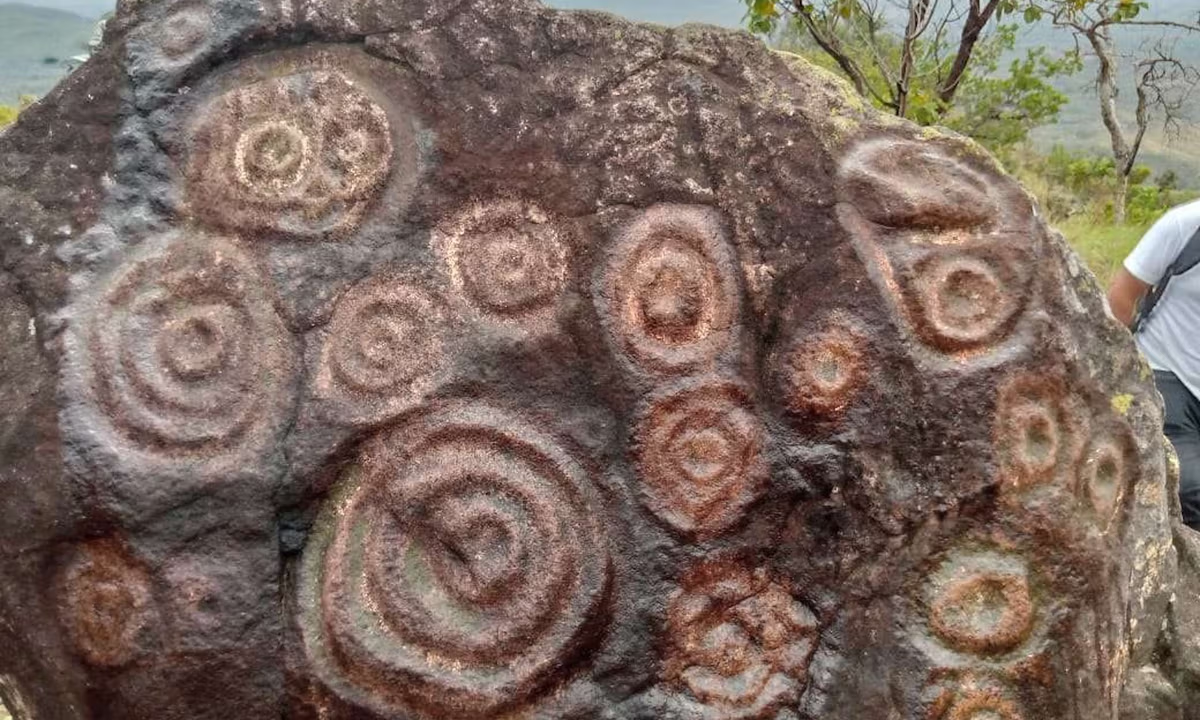
A recently discovered set of rock carvings in the Venezuelan state of Monagas is being hailed as the nation’s oldest example of rock art, possibly up to 8,000 years old. Reports in the Venezuelan publication Ultimas Noticias say that the petroglyph panel—marked by spirals, concentric circles and humanoid forms—was found in the highland area of the Quebrada Seca community in Cedeño, around 2,125ft above sea level.
Reports about the discovery came after Daniel Monteverde, the mayor of Cedeño, announced the finding on Instagram, appearing with a delegation from Venezuela’s National Land Institute (NLI). The Institute, created in 2002 to enact former president Hugo Chávez’s land reforms, has more recently been involved in issues pertaining to heritage sites in rural areas.
On the heels of a significant discovery of rock art in Canaima, the Cedeño find is in an area known as the “petroglyph capital” of Monagas because of the broader Indigenous legacy of the Chaima and Kariña peoples there. According to Ultimas Noticias, Monteverde stated that the NLI team located the petroglyph panel after a series of research expeditions. He also said that he hoped the discovery would help facilitate the development of “agritourism and adventure tourism” in the area.
The historian Luis Peñalver, who is associated with the NLI, described the discovery as a “milestone” that may represent one of the oldest archaeological records in eastern Venezuela. He added that the engravings suggest Cedeño was an important regional corridor for travel and settlement.
Monteverde indicated in his Instagram post that a meeting will soon be held with the Ministry of Popular Power for Culture and the National Institute of Cultural Heritage, in order to proceed with the formal certification of the petroglyphs. He also said the Tourism Department would initiate protocols to geolocate and safeguard the area to prevent vandalism, while the Institute of Cultural Heritage plans for the scientific study and dating of the pieces and the design of “an archaeological route that allows for sustainable tourism, respecting the integrity of the monument”.
And yet, in the Instagram video Monteverde can be seen touching a petroglyph with faint traces of pigment and spraying it with water, which can destroy evidence or lichens that provide valuable archaeological information. Many archaeologists in Venezuela have been critical of his approach of advertising the site’s location for tourists before proper dating has been done and before protection mechanisms have been put in place.
Rubi de la Valencia, a petroglyph expert and the director of the National Rock Art Archive, who has worked in Canaima, tells The Art Newspaper that the “discovery” announced by Monteverde and the NLI team was “highly debatable” and “lacking the perspective of local Indigenous communities”. She adds: “While we have documented this site within our national inventory, we find the claims regarding its dating and origin to be scientifically unsubstantiated.”
De la Valencia expressed doubt about the provenance and methodology of this dating. “Given that these artefacts were only discovered recently, which authorities formally designated them as among the oldest on record? Furthermore, which specific experts estimated their antiquity to be between 4,000 and 8,000 years? What specific laboratory analyses or geochronological techniques were employed to date these petroglyphs? Where is the peer-reviewed literature or the primary documentation regarding this dating? Who are the principal investigators responsible for these findings?”
The current claims, De la Valencia adds, “appear to rely on superficial morphological observation rather than rigorous empirical testing”, and social media rather than science.
She says that the rock art has not been “discovered” but was documented by the local Indigenous community for decades.
Representatives of the Parish of San Felix, which includes the site of the “discovery”, issued a statement that reads in part: “What the mayor has presented as something new is in fact an ancestral reality that our community has been the custodian of for decades. These petroglyphs are not new for us but part of our historic memory.”
The representatives for the parish added that they are asking local authorities to “recognise the value of the local community as original guardians of this patrimony”.
