








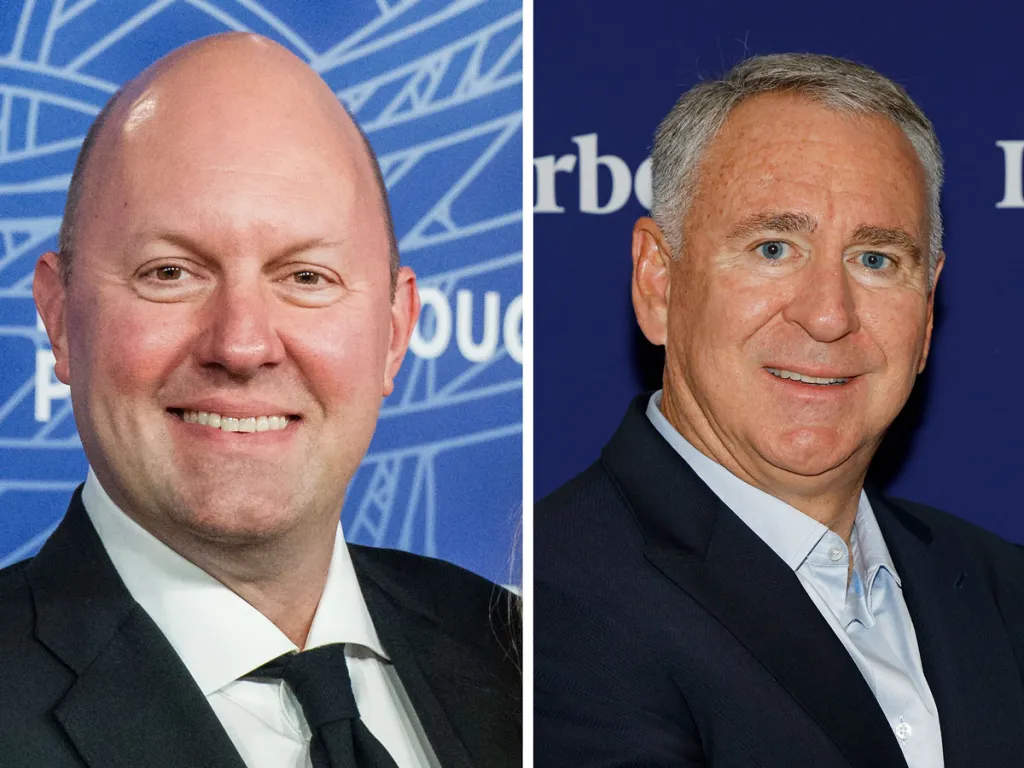
Some $1.2 billion have been funneled into this year’s midterm elections, with just over 12 percent of that being linked to two of the world’s top collectors: Marc Andreessen and Kenneth C. Griffin.
Both Andreessen and Griffin rank among the top 20 of megadonors to the midterms, a group that leans heavily Republican, according to a report published by the New York Times on Friday. As the Times put it, these megadonors are “the ones that can turn around candidates’ fortunes and sometimes even write history.” They also “tower over Senate and House races.”
Andreessen is listed alongside his business partner Ben Horowitz, with whom he founded the Silicon Valley venture capital firm Andreessen Horowitz. Per the Times, they have given $50 million to the AI-focused Leading the Future Super PAC, $46.8 million to a crypto industry–related Fairshake Super PAC, and $12 million to MAGA, Inc., the Super PAC of President Donald Trump. (These figures include money given by both Andreessen and Horowitz as individuals, as well as donations from their spouses and from Andreessen Horowitz.)
“The Andreessen executives,” the Times writes, “are part of a group of tech megadonors driven by a broad desire to deregulate the American economy, particularly when it comes to crypto and artificial intelligence.”
Andreessen and his wife, Laura Arrillaga-Andreessen, have been listed on each edition of ARTnews’s Top 200 Collectors list since 2017. They collect both postwar and contemporary art, with strong holdings of Jasper Johns and Agnes Martin. From 2020 to 2025, Arrillaga-Andreessen served as a trustee of the National Gallery of Art in Washington, D.C. According to the museum’s website, they provided the funds to acquire Robert Longo’s 2021 charcoal drawing Untitled (Insurrection at the U.S. Capitol; January 6th, 2021; Based on a photograph by Mark Peterson).
The founder and CEO of hedge fund Citadel, Griffin is also among the world’s most prodigious art collectors. He has more recently begun to publicly loan his works to museums. At the moment, he has 10 works by Jean-Michel Basquiat on loan to the Pérez Art Museum Miami, including the record-breaking Untitled (1982), which sold for $110.5 million in 2017. Griffin reportedly paid $200 million for it in 2024. He also loaned Madonna of the Yarnwinder (ca. 1500), attributed to Leonardo da Vinci and Studio, to the Metropolitan Museum of Art, where it will be on view for three years.
Beyond art, Griffin has also been a major buyer of important documents and prehistoric fossils. In 2021, he paid $43.2 million for a first-edition copy of the US Constitution. That copy as well as an early printing of what would become the Bill of Rights, are currently on view at the National Constitution Center in Philadelphia, courtesy of Griffin. He also paid $44.6 million for a complete Stegosaurus fossil, nicknamed “Apex,” which briefly held the record for most expensive fossil; it is currently on view at the American Museum of Natural History in New York.
The Times notes that though Griffin is “one of Wall Street’s most voluble Trump skeptics,” his political donations indicate that he wants to maintain Republic control of the Senate and the House. He gave $10 million to the Senate Leadership Fund, $5 million Congressional Leadership Fund, and $3 million to Republicans Conservatives for American Excellence Inc. The Times characterized Griffin as a donor who “tend[s] to back the same types of socially moderate and fiscally conservative candidates who are hawkish on foreign policy.”
The Times report also includes George and Alex Soros, who have given $103.7 million via the Geosor Corporation and the Fund for Policy Reform. Though these Soroses are not known as collectors, another of George’s sons, Robert, has a major collection of modern and contemporary art. Robert and his wife, Jamie, have ranked on the Top 200 Collectors list each year since 2020.
Beyond his political donations, George Soros is also known for his philanthropy, which has included giving $500 million to Bard College to grow its endowment. Among Bard’s most well-known programs is the Center for Curatorial Studies, which is considered one of the best programs of its kind in the US; CCS Bard also facilitates the Hessel Museum of Art, which has a collection of over 3,000 works.


