


Looking at paintings and sculpture can be hard at the best of times, but especially so in an age of chronic distraction, of addictive scrolling and attention-capturing algorithms. How, then, to look at a painting?
One way, certainly, is to think about where it came from, and to assume a “lost” origin that needs rediscovery. Paintings on the walls of museums and elsewhere appear like illustrations fallen from the pages of a small number of great books (Ovid, the Bible, The Golden Legend). It has long been the job of art historians to restore these illustrations to their context and the stories they illustrate, a little like the old-fashioned pursuit of stamp collecting.
Restoring works to their original context can be a rewarding imaginative leap and often involves engrossing detective work. Going back to origin, to the genesis of a work, enriches our experience of art, and is vital in understanding the nature of creativity. Origins explain.
In those rare cases where an image remains in its original context, the effect can be unforgettable. Giovanni Bellini’s altarpiece of the Madonna Enthroned has not moved since it was installed in the church of San Zacarria in Venice since 1505. It is astonishingly moving to encounter it there to this day. A more profound case still is that of Ice Age art. To see the drawings of bison on rock walls deep in the cave of Niaux in the Pyrenees (one of the very few Ice Age sites that can still be visited) is an unparalleled moment—infinitely more rewarding than glimpsing Mona Lisa from afar behind bullet-proof glass.
And yet San Zaccaria and Niaux are rare exceptions. We are far more likely to see Ice Age art reproduced in books or in the replica caves of Chauvet and Lascaux. For the most part, original contexts have been irretrievably lost, and trying to reconstitute them ignores the fact that even when a situation remains unchanged, we humans and our outlook have been altered.
A bigger picture
Taking restitution to its logical conclusion would mean attempting to restore the work of art in the mind of the artist who created it—trying to recover the “intentions” and life of the maker. This is the first thing we learn when studying any art form: biographical explanation reduces our view to the tiniest of apertures, a keyhole. Artists make art precisely to overcome the limitations of an individual life, just as the drive to restitute works of art to their original political contexts can seem to reduce them to tokens in all-too-human power games.
These ideas have become part of my own reckoning with the history of art. The search for “contexts” (hardly an inspiring word) can blind us to the actual effect on us of a painting or sculpture, and the reason why these strange objects and the places where we might be lucky enough to encounter them—museums and galleries—are of such importance in our contemporary world.
Perhaps the very idea of looking is the problem. Just as great art is often the product of a hand rebelling against an eye, encountering art can mean feeling its physical presence rather than simply eyeballing it. Such heightened awareness of self and surroundings is, of course, the mantra behind the deep-dive practice of mindfulness.
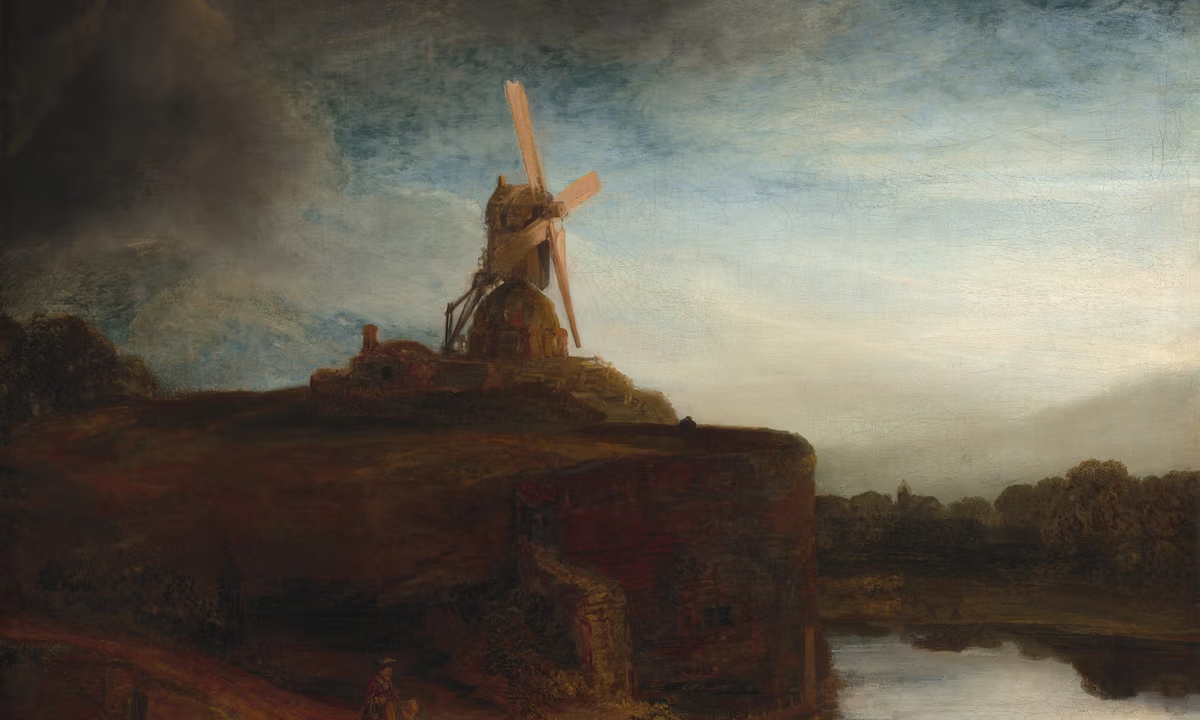
It’s an experience that can even happen online. The guided meditation viewing of Rembrandt’s The Mill (1645/1648), available on the website of the National Gallery of Art in Washington, DC, is impressive, a model for such enlightening encounters (and we all know who in Washington needs most to watch this).
And yet mindfulness only goes so far in explaining the “presentism” of art. Being with art is a shared, public experience, rather than some inward-oriented, world-denying encounter. Being with art is not always a matter of relaxation and enjoyment, or a break from reality. Museums are where we engage with the world and should be where we confront the greatest questions facing democratic life: of addiction algorithms and technological dominance, of authoritarian politics and public morality, of the clear and urgent reality of ecological collapse and the backlash to action on climate change.
Although it has not always seemed so, the decades since the end of the Second World War have been a period of unusual peace and stability. It is an era during which democracy became the dominant form of politics, and also one in which a new world of museums was forged. It is also an era that seems now to be slipping away as the world changes, almost day by day. How museums and art are part of this strange new present—and how our direct encounter with works of art has become so important—requires urgent exploration.
• John-Paul Stonard is an author and art historian. His latest book, The Worst Exhibition in the World. Degenerate Art 1937 will be published later this year
