


In his 2025 BBC Reith Lectures, the Dutch historian Rutger Bregman painted a bleak picture for Europe and its museums. We (the Europeans, that is) are currently reliving the catastrophic demise of Venice as a world power in the 14th century. “Today the whole of Europe risks turning into one big Venice,” Bregman claimed. “A beautiful open-air museum. A great destination for Chinese and American tourists. A place to admire what was once the centre of the world.”
This is a pretty bleak view of Europe, but a bleaker view still of museums. The societal decline is the result, Bregman argues, of the fundamental unseriousness and immorality of the political leaders of our day, and a culture defined by the “survival of the most shameless”. Bregman’s answer is a moral revolution, and an acceptance that none of this—authoritarianism or a tech takeover—is inevitable; we must draw on history for examples of how small groups of people can make great changes.
All paradigmatic art is news and remains news far longer than mere newspaper headlines
Bregman’s call for a moral revolution, also encapsulated in his 2025 book, Moral Ambition, should be echoing through the galleries and glass-roofed atriums of museums the world over. Curators and librarians are among the most trusted of professionals, at a time when the bottom has fallen out of public trust in any sort of expertise. And yet museums have been remarkably unwilling to acknowledge their own status as democratic institutions, the bedrock of civic society and our most important public spaces.
This lack of engagement has weakened many institutions, Bregman argues, so that they are unable to take any meaningful position on the authoritarian landslide happening all around, and all too often “bend the knee”. It doesn’t have to be so. Public museums in the UK, with their culture of free entry, are uniquely placed to intervene in these debates, to establish ethical standards for public life that go well beyond their walls. Museums are precisely the places that can make good become fashionable, as Bregman puts it. Rather than weakly promoting Instagram influencers, for example, museums might engage in the campaign against smartphones in schools, or against the culture of misinformation on the bleakness that is TikTok, especially in the age of the toxic “manosphere”.
All of this is, of course, much easier said than done. How, in practical terms, is it possible to take a stand when the day-to-day running of an institution is so pressing and money is scarce? How to think of the world in 50 years, when the next five months seems overwhelming? How to see the bigger picture, and make that part of your public task, when there is so much grimness in that bigger picture: the rise of anti-democratic politics; the epidemic of misinformation on addictive social media and the reality of climate breakdown? How, with the responsibility for shared human heritage, to confront the loss of belief in a liveable future among young people?
Big-picture thinking
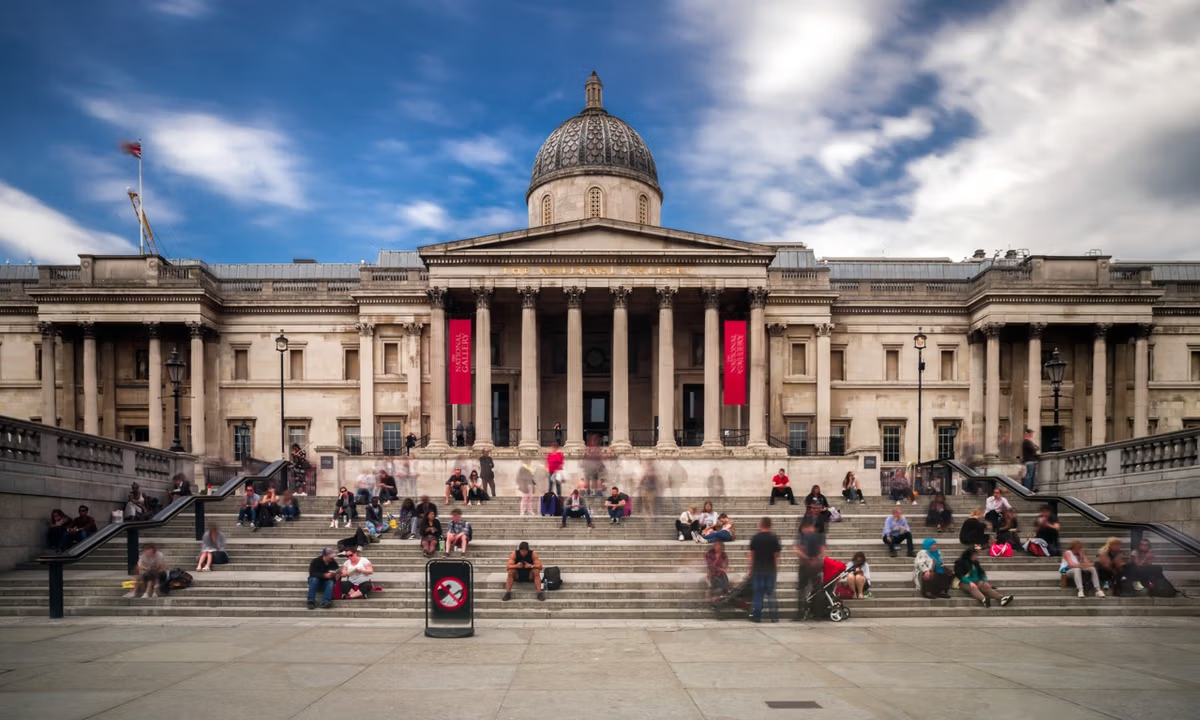
Seeing the “bigger picture” is the slogan of the National Gallery’s current advertising campaign. Few museums might be better placed to make this claim, for the way that visitors can freely engage with great works of art shown on their own terms, in a historic and genuinely public setting, quite literally looking down on the humdrum politics—immoral, unserious, much of it—being played out along Whitehall towards the Houses of Parliament.
The announcement of a new, Modern wing for the National Gallery in a new building on Orange Street only heightens expectations for how the museum might expand this sense of contemporary relevance. The long-term plan is to collect “paradigmatic” works of mostly 20th-century art (painting only) to tell a chronological story. The societal urgency, if not the moral seriousness, of art should guide the choice of works for the new collection. It was during the 20th century that democracy was shaped and tested and survived. Works of art played a key role in this turbulent history. All paradigmatic art is news and remains news far longer than mere newspaper headlines. This urgency is a matter of the truth-telling power of art, a truthfulness that is also a moral seriousness.
Bregman’s description of how you forge a “moral revolution” should be of profound interest to anyone involved in creating such a museum wing, or in charge of a collection or programme. Moral revolutions, Bregman argues, are often the result of committed individuals, and driven by “the power of small groups of dedicated citizens to determine our collective destiny”. What better description of those avant-garde movements in art throughout history, driven by individuals and small groups of visionaries, bent on seeing the world differently, reshaping our sense of reality? Bregman describes these history-shaping movements of social change as “monuments in time” rather than monuments in stone. Museums can be both.
• John-Paul Stonard is an author and art historian. His latest book, The Worst Exhibition in the World. Degenerate Art 1937, will be published later this year
