
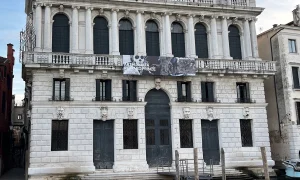






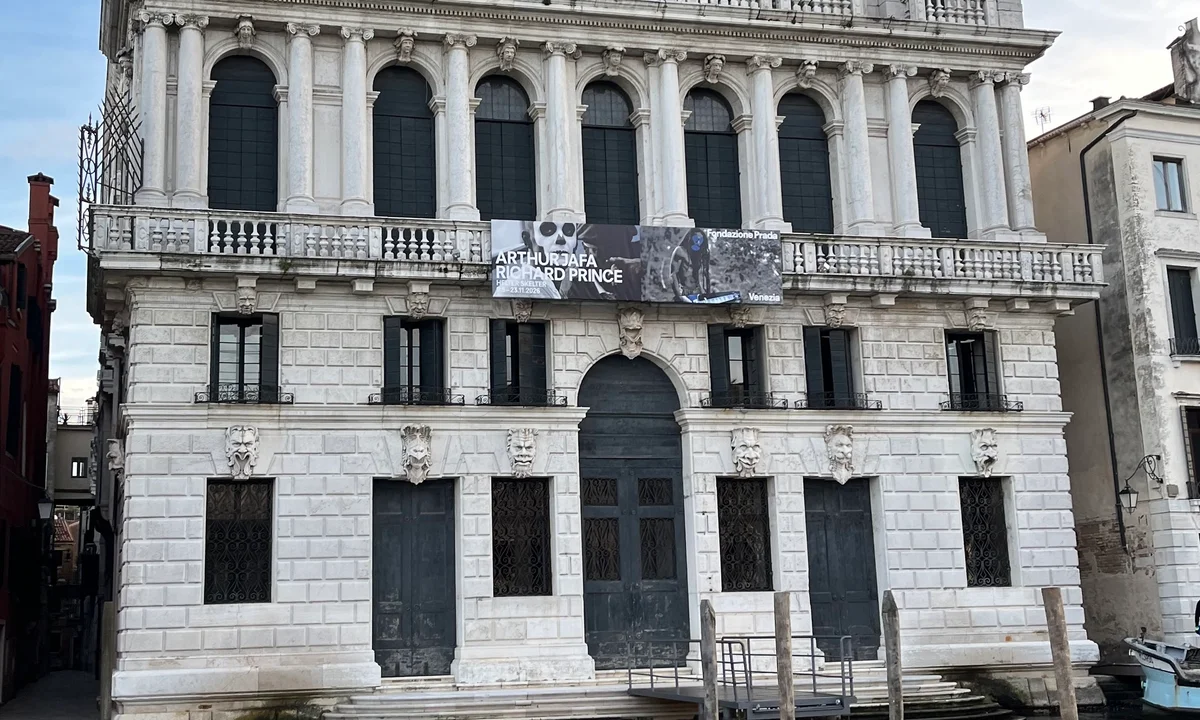
For anyone visiting the Venice Biennale this summer or autumn, one of the first things you might see is an image from a famous art dispute that took place 15 years ago. Graduation (2008) by Richard Prince appears on posters for the exhibition Helter Skelter at the Prada Foundation on the Grand Canal. The posters are ubiquitous in Venice, including at the airport ferry terminal. The show features works by Prince and Arthur Jafa, both known for reproducing images from a variety of sources in their own art.
Prince is no stranger to copyright litigation. Graduation features an image of a Rastafarian lifted from a photograph by Patrick Cariou and then (slightly) altered by the artist to create his final work. This and other photographs by Cariou were used throughout Prince’s Canal Zone series in 2008. Cariou sued Prince for copyright infringement in New York but failed at the Second Circuit Court of Appeals on the basis that 25 of the 30 works were protected by “fair use”: Prince had effectively transformed the original photographs into new forms of expression.
The beauty of La Serenissima inspires great compromise relating to art
However, five of the Canal Zone works, including Graduation, were never held to be transformative. They were remanded to the trial court, but Prince and Cariou reached a settlement before the trial commenced. The settlement was confidential, but seeing Graduation in Venice today leads one to assume that Cariou gave Prince permission to display, reproduce and disseminate the Rastafarian image. Without such permission, how would the Prada Foundation allow an infamous and contested work to feature so prominently?
Last month, I discussed the new European Union definition for “pastiche”, which provides a defence against copyright infringement. Could this poster qualify? Perhaps, though no art lawyer advising a client would take such a well-publicised risk. It is almost certain that the posters were instead the result of a licence from Cariou. If I am wrong, please correct me.
A Last Supper by any other name
This is by no means the only visual cue in Venice to a past art dispute. The city is full of them. For those visiting, do not forget to see the astonishing Veronese at the Accademia, which had been subjected to the Holy Inquisition in 1573. The artist had been interrogated by the inquisitors as to his boisterous and allegedly profane depiction of the Last Supper of Jesus Christ. To avoid further problems with the authorities, Veronese simply changed the name of the work to The Feast in the House of Levi, the name by which it is still known today.
His larger and more famous feast scene from Venice, The Wedding Feast at Cana, is no longer to be found at the San Giorgio Maggiore Monastery for which it had been commissioned: as with many other masterpieces from the city, it had been seized by Napoleon in the 1790s and shipped to Paris. Some, like the sublime Bellini altarpiece at San Zaccaria, were returned after Napoleon’s defeat in 1815, but The Wedding Feast never was—it hangs in the Salle des États at the Louvre to this day, facing the Mona Lisa.
Why was the Veronese not returned to Venice along with the other art? Because the Austrians, in charge of Venice in 1815, agreed to trade the magnificent Veronese at the Louvre for a work by the 17th-century French painter Charles Le Brun, which was sent to Venice in its place. Who? Precisely. This can only be called the worst deal in the history of art.
The beauty of La Serenissima does inspire great compromise relating to art. Some, like in the Richard Prince case, can be deemed a success. Others, like the Austrian deal for The Wedding Feast at Cana, much less so.
- Venice Biennale, until 22 November
- Helter Skelter: Arthur Jafa and Richard Prince, Ca’ Corner della Regina, until 23 November


