


Expanding the canon. As a concept and practice, it has been the dominant strain of art historical activity in Western museums this century. It has gathered particular pace in the past decade with the exhibition and collection of far more diverse artists by museums in Europe and the US.
But one curious aspect of this mainstreaming of canon expansion has been the relative sidelining of a key element of the discourse around the subject in previous decades: that the structure of the canon was itself a problem. A key, and still vital, text in this discussion is the feminist art historian Griselda Pollock’s Differencing the Canon: Feminist Desire and the Writing of Art’s Histories (1999), where she argued that “there can… be no way, and no point in ‘adding women to the canon’”, and that feminism required a new form of discourse in order not to “confirm the structure of the canon and by doing so corroborate masculine mastery and power, however many women’s names it tries to add, or fuller historical accounts it manages to produce”. Pollock argued that feminist thought and practices allowed us “to imagine other ways of seeing and reading visual practices than those locked into the canonical formation”.
Theory into practice
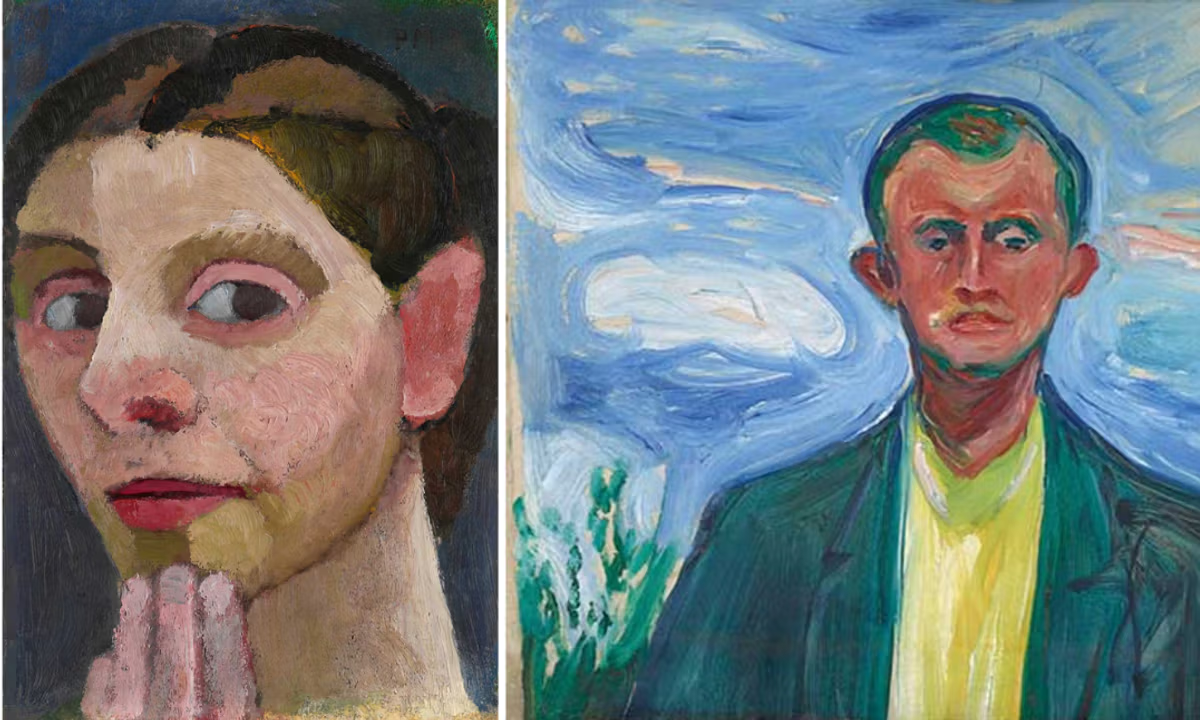
Two exhibitions opening in Europe in the coming weeks represent a chance to see how widely these and other progressive “ways of seeing” have been adopted and to what extent the canon has indeed been not just expanded but “differenced” and exploded. They pair a canonical male artist, Edvard Munch, with women artists: the German Modernist painter Paula Modersohn-Becker at the Albertinum in Dresden from February; and the late Austrian painter Maria Lassnig at the Hamburger Kunsthalle from March (and from October at the Kunsthaus Zürich).
Both women can be seen as artists who have gained long overdue widespread recognition as institutions have sought to diversify their programming. Modersohn-Becker, whose work is among the most distinctive contributions to early Expressionist painting in Germany, received scant recognition in her short life and was mostly ignored for decades before gaining recent prominence, for instance in the Royal Academy of Arts (London) show Making Modernism in 2022 and the Art Institute of Chicago’s survey in 2024, the first in the US.
Meanwhile, Lassnig—whose uncompromising paintings now seem so obviously one of the singular contributions to figurative art in the late 20th century—only gained her first UK public show at London’s Serpentine in 2008 and her first New York museum presentation at MoMA PS1 in 2014.
The Munch pairings reflect the inseparability of life and art in the three artists’ work. The Albertinum’s show, Paula Modersohn-Becker and Edvard Munch: The Big Questions of Life, frames the artists’ work in the profound intellectual shifts of their time, where their paintings embodied a new directness in confronting rites of passage, sexuality and gender roles. Though Munch was the senior artist, and Modersohn-Becker knew his work from exhibitions, this is not a presentation of influence but of two artists’ engagement with the fundamental experiences of existence.
It is significant that the Lassnig-Munch face-off is titled after—and thus framed by—a work by Lassnig, Flow of Paint = Flow of Life. And while Lassnig listed Munch, along with Titian and Vermeer, as “among the three painters most important to me, and whom I revere”, the curators insist this is not just a study of influence, but a chance, through Lassnig, “to discover new aspects in the work of her predecessor”. Even seeing reproductions of the works alongside each other in the images accompanying the show, the potential for a visceral shock is clear.
What I hope these shows will prove is that the prominence of artists once excluded from the canon does not merely readmit them to an established order but allows them to subvert and complicate it. They enrich our understanding of Modersohn-Becker and Lassnig, but they should also allow us to see Munch afresh. Through the prism of art made by women, his legacy can be deepened and even changed.
- Paula Modersohn-Becker and Edvard Munch: The Big Questions of Life, Albertinum, Dresden, until 31 May
- Maria Lassnig and Edvard Munch: Flow of Paint = Flow of Life, Hamburger Kunsthalle, 27 March-30 August
