


To receive Morning Links in your inbox every weekday, sign up for our Breakfast with ARTnews newsletter.
The Headlines
HEAR, HEAR. The HEAR Act was adopted by the House of Representatives on Monday, and now heads to President Trump for approval, reported the New York Times. The bipartisan bill is designed to make it easier to restitute Nazi-looted artworks by extending the original 2016 act, which expires later this year. However, new amendments to the bill have some worried that it goes too far, making it hard for current owners of potentially looted artworks to fairly defend themselves. Notably, the bill states that looted art should be considered a violation of international law, giving the US legal system jurisdiction in foreign cases. But others see this change as a boon. “It would be a tremendous development,” said Nicholas O’Donnel, who represented the heirs of the disputed Guelph Treasure case.
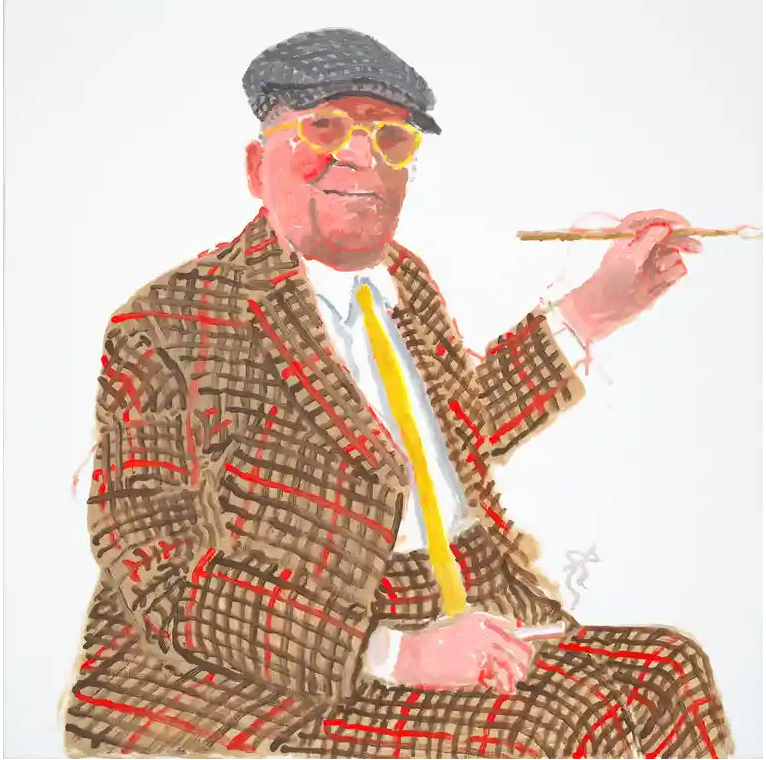
HOCKNEY’S NIGHT AT THE OPERA. Who says opera is not alive and well? David Hockney is turning Tate Modern’s Turbine Hall into a giant, immersive opera house, reports the Guardian. Hockney’s set designs for works by Mozart, Wagner, and Stravinsky, which he made in the 1970s, will fill the museum’s huge space in celebration of the British artist’s 90th birthday in 2027. “I wanted to design operas because I want to have something to look at,” Hockney said. The rest of the Tate’s 2027 program was also announced and includes several highlights, from a Sonia Boyce retrospective and Edvard Munch show, to the Tate Modern hosting Claude Monet paintings for the first time.
The Digest
Restorers have discovered a hidden El Greco painting underneath a forged artwork that had been hanging in the Vatican for decades. El Greco’s small oil painting of a Christ figure titled The Redeemer dates to the 1590s and is now on view in an exhibition of just two artworks titled “El Greco in the Mirror: Two Paintings in Dialogue.” [Artnet News]
As Art Basel Hong Kong approaches, reporter Melanie Gerlis takes the region’s market temperature and asks whether it is slowly bouncing back as galleries adapt to more conservative tastes for older or deceased artists. [Financial Times]
Researchers have confirmed the rediscovery of the lost city of Alexandria on the Tigris in Iraq, founded by Alexander the Great (356 BCE-323 BCE). [ARTnews]
The Prado Museum is reducing the max number of visitors per group from 30 to 20 to achieve “a better quality of visit.” Group visits make up nearly 17 percent of the museum attendees, but “visiting the museum can’t be like riding the subway at rush hour,” said Prado Museum director Miguel Falomir. [El Pais]
Hong Kong’s artist-founded Para Site art space has appointed James Taylor-Foster as its new director. The curator of contemporary architecture and design at ArkDes and Moderna Museet in Stockholm succeeds Billy Tang, who departed in May 2025. [ArtAsiaPacific]
Artist Jitish Kallat will be the next president of the Kochi-Muziris Biennale in 2027. [Artforum]
The Kicker
CAMERAS ON CUBA. French-Chinese photographer Lucien Lung spent some time in Cuba this winter, capturing striking portraits of life in the country, which has been reeling from a humanitarian crisis caused by low fuel supplies. Many of his images are printed in a new piece for Le Monde, in which Lung also talks about his experience in the country, where he felt “hope is not at all the same” as it once was. Now, faced with a nationwide blackout, Cuban officials said they plan to announce that the Communist country will open to foreign investment, including from the US. Whatever hope that may have spurred was not likely helped when President Trump responded by saying that given Cuba’s weakened state, he could “take” the country and “can do anything I want with it.”
