


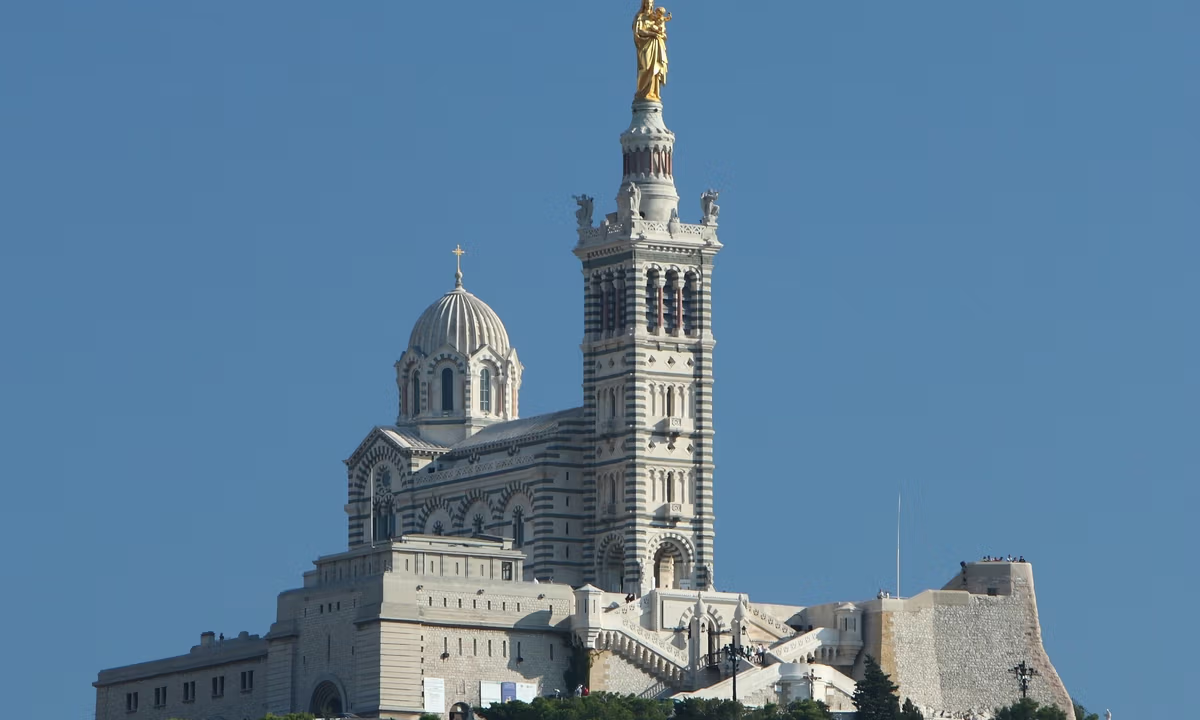
During conservation work this year, specialists discovered seven bullet wounds, inflicted by German troops during the Second World War, in the copper of the Madonna and Child statue that stands atop Notre-Dame de la Garde in Marseille, the basilica crowning the city’s highest peak.
Known locally as la Bonne Mère (the good mother), she is said to watch over sailors, fishermen and all Marseillais. Standing just 2km back from the seafront, she can be seen from as far out at sea as 20km on a good day.
From February until late October, however, she was entirely hidden from view, while extensive restoration was carried out on the statue, its stone pedestal and the four stone angels that sit on the corners of the terrace at the base of the bell tower. Emphasising how keenly her absence was felt, the chief architect and art historian Xavier David, who has worked on the church since the late 1990s, says they installed a blinking light inside the scaffolding—to replicate the Madonna’s beating heart.
A bullet hole in the arm of the statue of Jesus being repaired Notre-Dame de la Garde
The statue is made of copper with an internal iron structure. To date, the gilding has been redone seven times due to corrosion from the sea air and wider city pollution. This time round, David brought the surface back to the copper using sandblasting.
It was in preparing the surface that the team uncovered the Second World War bullet holes, four of which had pierced the infant Jesus’s hand, arms and belly, and the other three, the Virgin’s body.
Marseille was liberated from Nazi occupation by Senegalese, Moroccan, Algerian and French troops in August 1944. The French flag was hoisted atop both the Sacré Coeur basilica and Notre Dame.
“At that point, a great rumour, a great hurrah, ran through the city; everyone thought it was over,” David says. “But it wasn’t. For three days and three nights, German artillery units stationed at the base of the hill, in the Saint Nicolas fort, fired on the church. They pierced the bell tower, they broke stained-glass windows, they destroyed the ceiling mosaic and they shot at the statue.
After the war, only superficial repairs were undertaken. The destroyed mosaics were replaced with trompe l’oeil murals and the bullet holes simply filled in. A painter subsequently regilded the statue in 1989, without taking care to find out what was underneath. Knowledge of the bullet holes was lost.
Before this year’s restoration, conservators had never measured the impact of salt on the metal. “To our great surprise, there was three times too much salt on the copper, despite the protective layers of paint and gold,” David says. They therefore encased the statue under a hermetically-sealed and air-conditioned tarpaulin to protect it from winds, pollution and storms.
The Paris-based gilders Ateliers Gohard have worked to ensure a longer lifespan of 40 to 50 years for this regilding. “The sustainability of the gilding hinges on how well the surface is prepared before any gold leaf is applied,” David says.
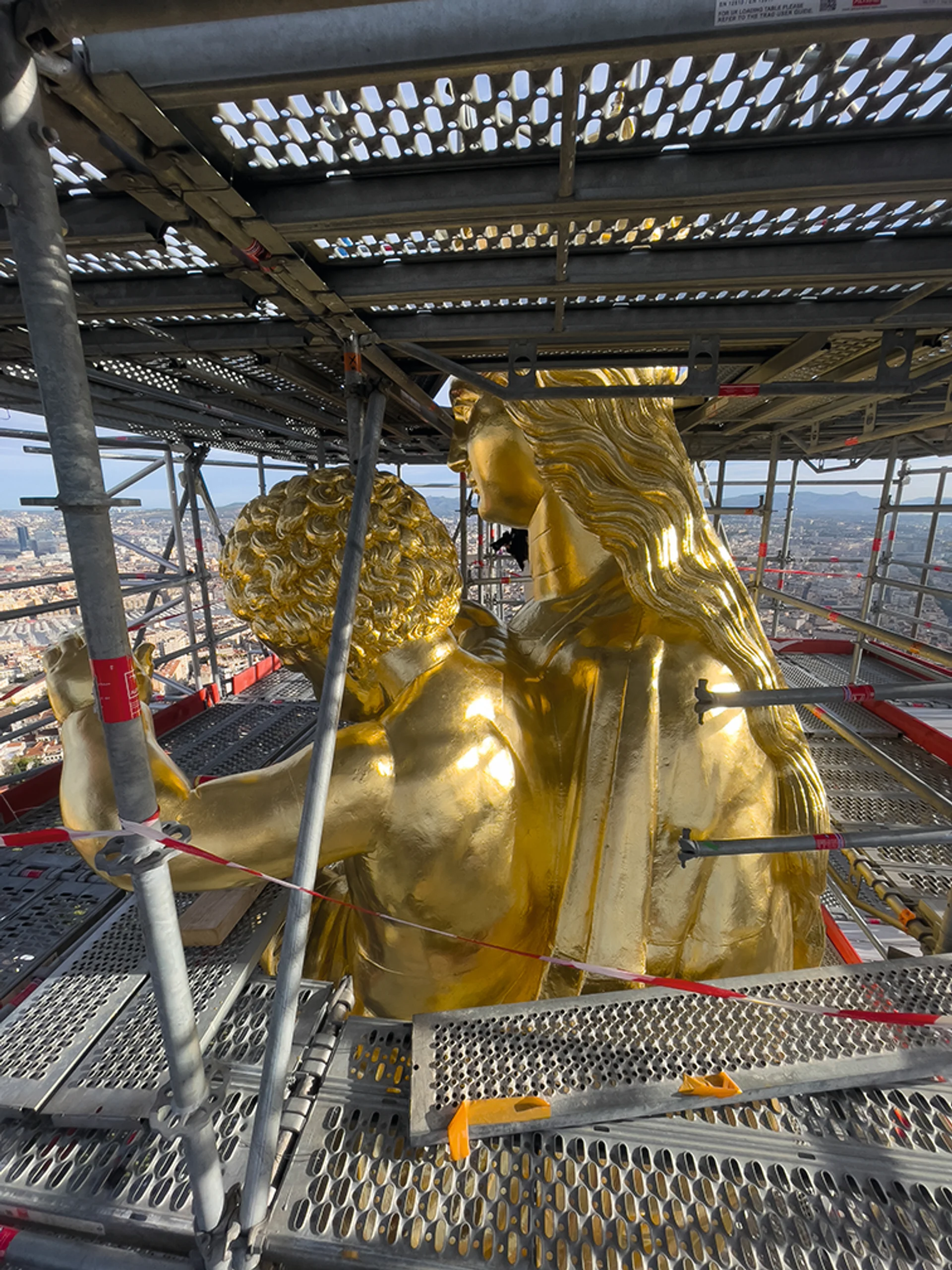
Crowning glory: the repaired and newly-gilded Madonna and Child statue that overlooks Marseille © Notre-Dame de la Garde
When David’s team removed the Virgin’s crown, 1.2m in diameter and weighing 120kg, they also saw how badly corroded the internal structure was. A local metalworker, Thomas Pagès, who restored the apostles of Notre-Dame de Paris, was called in.
Further bioconsolidation work on the four stone angels that sit on the corners of the terrace was necessary. “They have lost 2cm-3cm in thickness, due to overexposure to the elements,” David says. His team used clay compresse—of the kind successfully used to restore the stonework at Notre-Dame de Paris—to desalinate the stone, then applied bacterial products to reinforce it.
Ahead of the newly gleaming statue’s inauguration on 7 December, its crown was lowered back in place via helicopter, to great applause, in mid-October. Standing on the scaffolding, an official thanked the restoration team for their hard work and extolled the “beautiful future with her [the Madonna]… and, of course,” he said, “you are in the heart of the Bonne Mère, forever.”
