


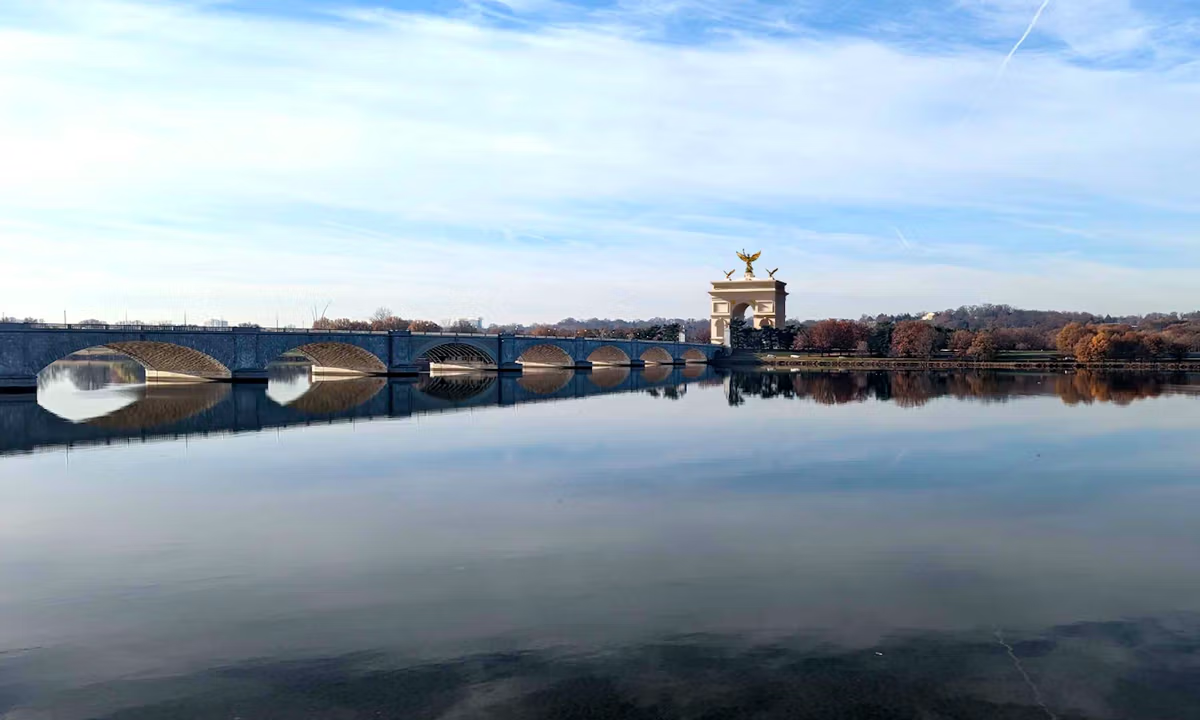
There is a risk that US President Donald Trump’s proposed triumphal arch in Washington, DC could disturb precolonial archaeological deposits located below the Memorial Circle traffic island, according to a report released by the National Parks Service (NPS) as part of the project’s historic preservation review process. However, further details of the agency’s archaeological assessment are considered “sensitive” according to an NPS official, and have not been broadly shared on the site where the public can review and comment on the project.
Before construction on the arch can begin, it must undergo what is known as Section 106 review as required by the National Historic Preservation Act of 1966 for all federal building projects, to determine how it will affect any nearby historic properties. This included an initial archaeological assessment for Memorial Circle and the surrounding areas where construction equipment and materials would have to be set up.
Columbia Island, the man-made island on which Memorial Circle sits, was created between 1915 and 1927 by piling soil dredged from the Potomac River onto existing sandbars and tidal flats. This landfill is roughly 10ft to 14ft deep, but to make sure the 250ft-tall arch is structurally secure, moorings would need to be dug to reach bedrock, which sits an estimated 75ft below the surface. According to the NPS report, “these areas have moderate to high archeological sensitivity for intact precolonial and historic archeological resources” beneath the fill layer, and that “similar buried landscapes elsewhere in Washington, DC, have yielded important archeological information”.
The report further notes that there are 13 documented archaeological and historic sites within one mile of Memorial Circle on the Virginia side of the Potomac River, including at nearby Arlington House, and that the area is closely associated with the War of 1812. The appendix that includes a more detailed archaeological assessment however is not included among the documents uploaded to on the NPS’s Planning, Environment & Public Comment website. Ruth Trocolli, the archaeologist at the DC Historic Preservation Office, which is listed as a consulting party in the report, says the city-run agency should receive the full assessment when it is completed, and that keeping information about archaeological sites on federal property protected “does make sense” since “there are active looters, even here in DC”.
A map showing historic sites and properties in the immediate vicinity of the propose site for President Trump’s monumental arch in Washington, DC National Park Service document
Six other preservation groups—the National Trust for Historic Preservation, Committee of 100 on the Federal City, DC Preservation League, Cultural Landscape Foundation, National Parks Conservation Association and American Institute of Architects—have asked to also be included in the Section 106 consultation, but have so far not received a reply from the NPS. A Section 106 meeting is due to take place on 15 June—just ten days after public comments on the project were opened.
In order to minimise potential damage to any existing archaeological materials, the report suggests further studies at the site, including a subsurface investigation. It also recommended an assessment of the utility corridors that will be used during construction, noting that there is at least one existing archeological site that could be affected, part of the Alexandria Canal, “but other known or unknown resources may exist”. The NPS estimated that, in order to finish construction of the arch within the next three years, crews would need to work 20 hours per day, year-round and approximately 20 to 30 trucks would need to transport around 80 to 100 loads per day.
The NPS report concludes by stating it will develop a programmatic agreement with its main consulting partners—the DC Historic Preservation Office, as well as the National Capital Planning Commission and the Advisory Council on Historic Preservation, the last two of which are both stacked with Trump loyalists—to identify and evaluate any further archaeological resources at the site.
