





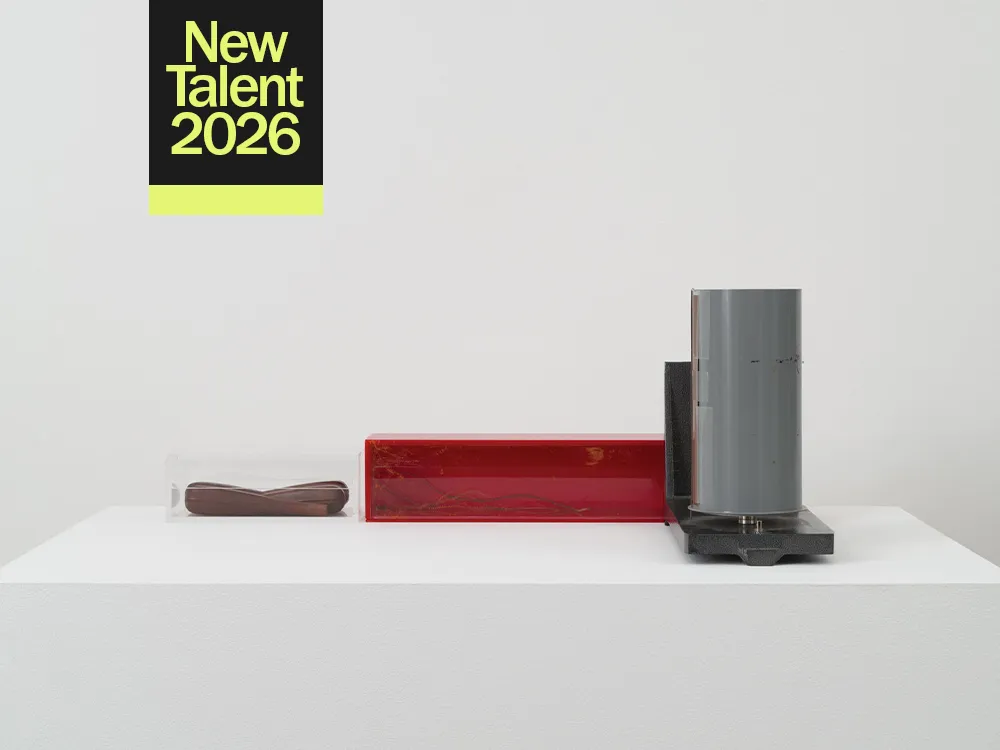
“What I do is like a show-and-tell,” Craig Jun Li explained when we spoke, referring to his displays of found objects and archival material—faded photographs, old letters, buttons. Such ephemera made up his January solo exhibition at Chapter NY. “I want to show the effect these materials have had on me,” he added. Yet the show’s title suggests deeper desires: “I Want to Love with No Fear.”
“I blocked the radiators,” he said, explaining a pedestal he built to enclose them. He lowered the gallery’s temperature to simulate the cool, dry air of a rare books room or museum storage—two types of archives he frequents. With the crisp chill, he signaled to visitors: You’re now entering an archive. Bring a jacket.
The “cold” began, he admits, as an inside joke: “I was getting sick of talking about ‘Archive Fever,’” he said, referencing Jacques Derrida’s psychoanalytic meditation on the impulse to preserve. In the show, buttons taken from his favored shirts were arranged into tiny, tactile archives set atop a pair of foreboding metallic cooling units, as if preparing them for preservation.
As a student, Jun Li—who operates the artist-run space Benny’s Video—found himself drawn to scholars like Achille Mbembe and Miwon Kwon, whose work foregrounds the conditions under which archives are created. Questions of omission—who or what is left out of the archive—structure his approach to his materials. He speaks with particular fondness of those faded photographs that he finds not in archives but in thrift stores, and of letters exchanged between artists, which sometimes make him privy to only one side of a conversation. These materials appeared in a neat row of rectangular frames at once austere and intimate, with rephotographed grayscale papers and images installed both behind and in front of the glass.
Jun Li—who has exhibited at François Ghebaly in New York, the KW Institute for Contemporary Art in Berlin, and Kurtkubin in Mexico City—aligns his practice with the conceptualists of the 1980s and ’90s who, devastated by AIDS, prioritized testimony. What first drew him to this generation of artists and writers was childhood tragedy: He was born in China in 1998 and partly raised in a town where a high number of children were infected with HIV due to medical malpractice. He was specifically drawn to the ways in which queer artists gave form to grief—which always involves an absence. Soon he found that “archival materials are structured around absence, while reminding us of their presence.” His works on the wall have images, but they are equal parts blank space.


