






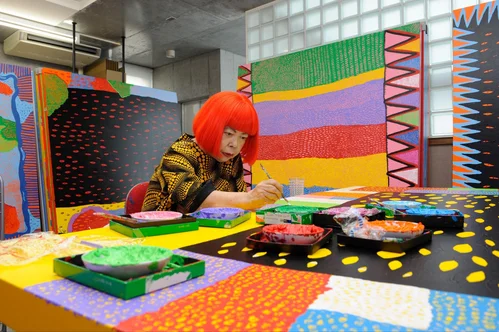
Yayoi Kusama, the iconic Japanese artist whose polka dots and mirrored rooms helped define the visual language of post-war art, died on August 14th at a hospital in Tokyo. According to her gallery, David Zwirner, the cause of death was multiple organ failure. She was 97.
“The world has lost a truly revolutionary creative force. Yayoi Kusama’s singular artistic vision has transformed the landscape of visual art forever,” said Victoria Miro and Glenn Scott Wright of London gallery Victoria Miro, which also represents the artist, along with OTA Fine Arts.
Kusama was born in 1929 in Matsumoto, Japan, and as a child began drawing the hallucinations that would shape her artwork throughout her career. Hoping to escape the conservatism of Japanese society, she left for the U.S. in 1957, landing first in Seattle, before making her way to New York. Within a few years she’d built a distinctive visual language out of repetition: the looping, obsessive canvases she called “Infinity Nets.” This repetition would become a key part of Pop art, used by Andy Warhol among many other artists.
By the mid-1960s, in keeping with the hippie ethos of the time, she began staging nude Happenings. These provocative events were part-performance, part-protest against the Vietnam War, where she painted performers with polka dots. She was one of the few women artists involved in the New York art scene, and was close with many major figures of the time, such as Donald Judd (one of her earliest supporters), Joseph Cornell, and Eva Hesse. Although she helped define the languages of Pop art and Minimalism that bloomed in New York at this time, she refused any single label. As she said in a later interview with publisher Phaidon: “I cannot imagine how I will be classified after my death. It feels good to be an outsider.”
Kusama returned to Japan in 1973. In 1977, she admitted herself to a psychiatric hospital in Tokyo, due to a relapse of the mental illness that she had experienced since childhood. She set up her studio next to the hospital, where she lived and worked for the rest of her life. There, she developed the two motifs that carried her into old age, and made her a superstar in the 21st century. During this period, she applied her trademark polka dots to every surface she touched, and sculpted pumpkins, a form she’d drawn since childhood.


And yet, as she retreated from the art world physically, she became an ever-larger figure within and beyond it. Her traveling “Infinity Mirror Room” exhibitions, which grew out of an installation first created in 1965, drew millions of visitors and hours-long lines at museums across the globe. A 2012 collaboration with Louis Vuitton put her dots on handbags and shop windows; the 2018 documentary Kusama: Infinity introduced her to a new generation. And the Yayoi Kusama Museum opened in Tokyo in 2017. In 2024 her largest permanent public sculpture was unveiled in London, and a major European retrospective will open next week at the Stedelijk Museum in Amsterdam, having traveled earlier this year from the Fondation Beyeler in Basel, Switzerland, and Cologne’s Museum Ludwig.
“Her steadfast message of love and peace has now reached millions of admirers around the globe,” said her gallerist, David Zwirner, in a statement. “Kusama’s art influenced the histories of minimalism, pop art, and performance art; more recently her large-scale installations single-handedly pioneered what is now referred to as experiential art…At the time of her passing, Kusama was, without a doubt, the most famous living artist in the world,” he added.
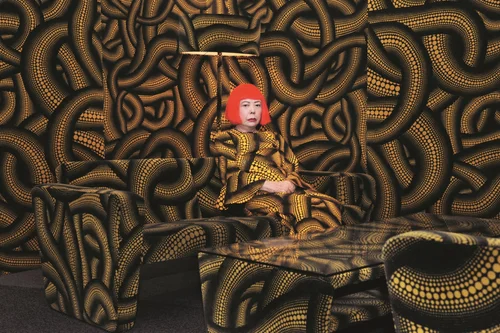

Kusama is also one of the most in-demand women artists at auction, with her work now regularly selling for seven figures, in part due to her own efforts in establishing her identity as an artist. Her auction record of $10.49 million was set in 2022 at Phillips for Untitled (Nets) (1959), a canvas from her early New York years. Today, her influence runs through generations of artists working in installation and Pop art.


