





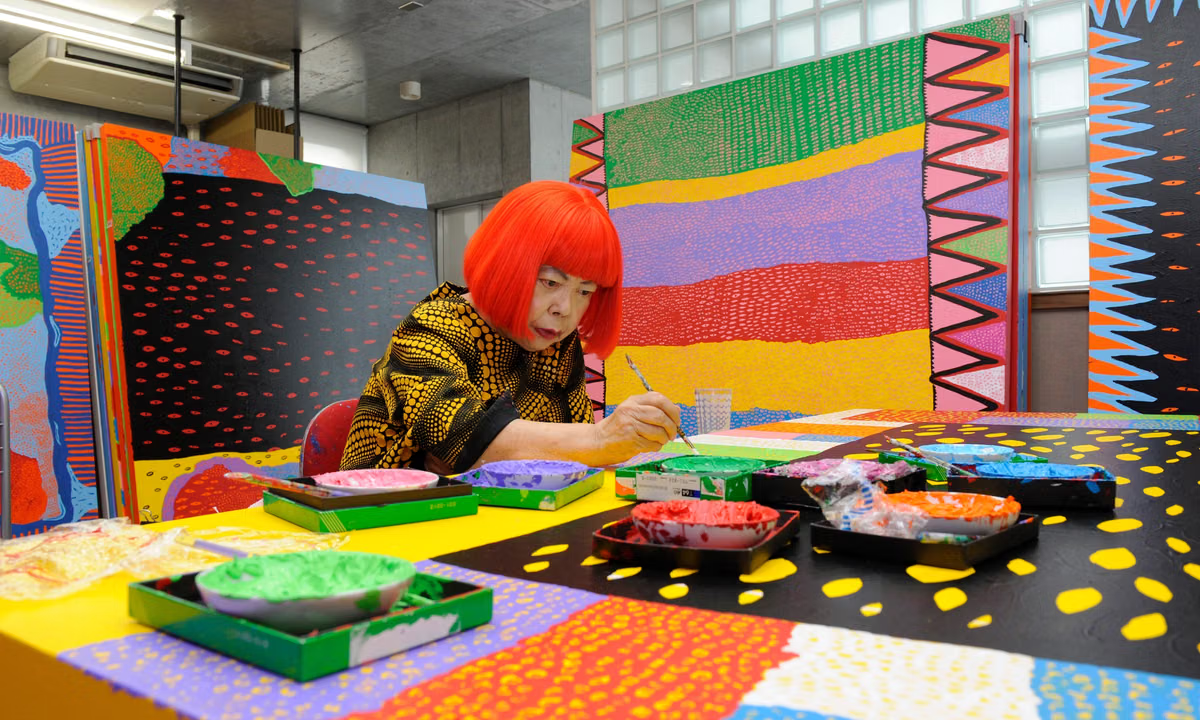
Yayoi Kusama, the pioneering Japanese artist whose polka dots, pumpkins and immersive Infinity Mirror Rooms made her one of the world’s most recognisable contemporary artists, has died aged 97.
Kusama died on 14 August at a hospital in Tokyo from multiple organ failure, according to an announcement from the Yayoi Kusama Foundation on Thursday, 27 August. The foundation said Kusama “continued to paint until shortly before her passing, never setting aside her brush”, and “remained steadfast in her lifelong belief that love can save the world”. A funeral has been held privately for close family members, with a public memorial gathering planned for a later date.
Born in Matsumoto, Nagano Prefecture, in 1929, Kusama began drawing as a child, experiencing visions and hallucinations that informed the repeated nets, dots and organic forms that would recur throughout her career. She left Japan for the US in 1957 and settled in New York the following year. There, she began making Infinity Net paintings, soft sculptures and installations using mirrors and lights that established her within the city’s avant-garde.
By the late 1960s, Kusama had expanded her practice into provocative happenings, often involving nude participants painted with polka dots and combining sexual liberation with anti-war messages. In 1966, she appeared uninvited at the Venice Biennale with Narcissus Garden, installing 1,500 reflective silver spheres outside the Italian pavilion and offering them to visitors for $2 each under a sign reading “Your Narcissism for Sale”. Biennale organisers eventually stopped the sale.
Yayoi Kusama with her Narcissus Garden installation at the 33rd Venice Biennale in 1966
© Yayoi Kusama
Kusama returned permanently to Japan in 1973, where she continued making visual art while also writing fiction and poetry. Her international reputation grew substantially in subsequent decades, and in 1993—27 years after her unauthorised intervention in Venice—she officially represented Japan at the Biennale.
Her late career brought extraordinary productivity alongside mass popularity. In 2009, Kusama began her My Eternal Soul series—comprising large-scale vibrant, abstract paintings—ultimately producing around 900 works for it before concluding in 2021, after which she embarked on Every Day I Pray for Love.
Her immersive installations meanwhile attracted audiences on a scale rarely seen for a living artist. A 2024–25 retrospective at the National Gallery of Victoria in Melbourne drew 570,537 visitors, becoming the most attended ticketed exhibition in the museum’s history. David Zwirner, who represented Kusama in the US from 2013, described her at the time of her death as “without a doubt, the most famous living artist in the world”.
Hidenori Ota, the founder of Ota Fine Arts and Kusama’s longtime representative in Japan, first worked with the artist in 1988 while at Fuji TV Gallery and continued representing her after establishing his own gallery in 1991. “To have helped bring her unparalleled artistic vision to audiences around the world has been an irreplaceable part of my life,” Ota said in a statement.
A major retrospective spanning more than seven decades of Kusama’s work opened at Fondation Beyeler in Switzerland last year before travelling to Museum Ludwig in Cologne, where it closed this month after drawing 480,335 visitors—the most successful exhibition in the museum’s history. Its final presentation opens at the Stedelijk Museum Amsterdam on 11 September, where the exhibition will now serve as a posthumous tribute to the artist.


