


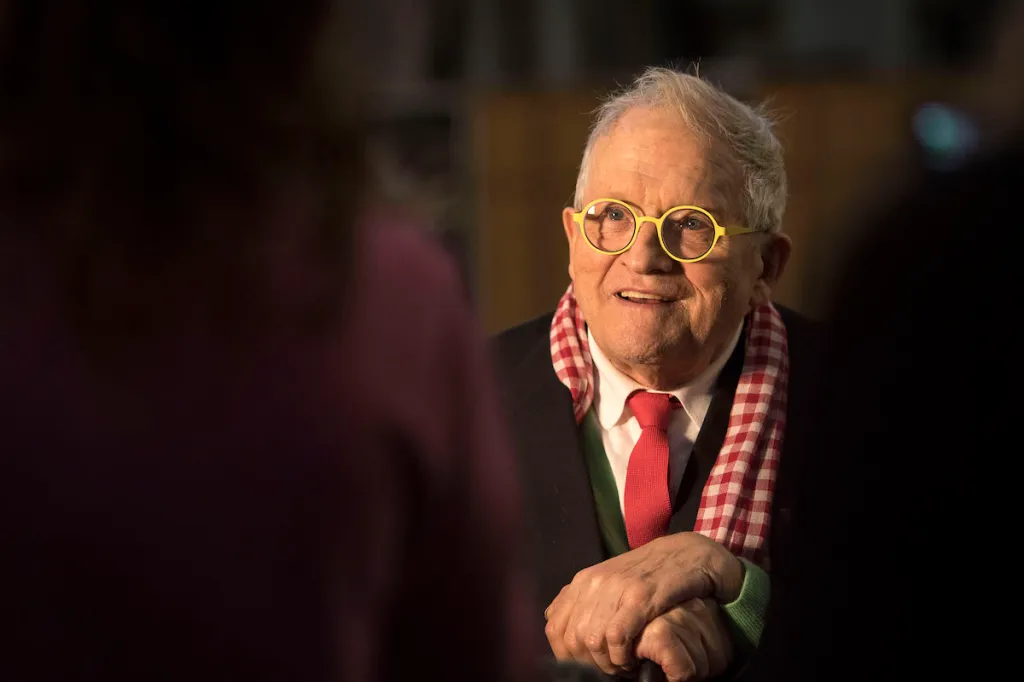
David Hockney, one of the 20th century’s most famous artists best-known for his depictions of the sunny glitz of 1960s Los Angeles, has died at age 88. His publicist, Erica Bolton, confirmed he “passed away peacefully” at home in London on Thursday, June 11, just one month away from his 89th birthday.
Hockney is one of contemporary art’s most influential and immediately recognizable figures in his signature cap, round glasses, and colorful, often checkered attire. Above all, he stands apart as one of the few artists in the last century to have captured the imaginations of both a wider public, as well as the art world’s tougher-to-crack critics and gatekeepers.
Over six decades of painting, drawing, and printmaking, he remained unconcerned with contemporary art trends. He continued painting the subjects he loved right up until near the end of his life, which included people and places he encountered over the course of years spent living in London, Los Angeles, East Yorkshire, and Normandy, to name a few. Speaking to the Smithsonian Archives of American Art in 1984, Hockney explained that his pictures sought to capture how people move through the world—a dynamic, subjective experience rather than a static one. “The point is, your body moves,” he said, comparing his exuberant landscapes to Chinese scroll paintings, which unfold through time as viewers walk alongside them, taking in their multiple viewpoints.
“The viewer gets a body back in the end,” Hockney said.
As news of Hockney’s death spread, tributes poured in from leading figures in the British art world and beyond, among them UK Prime Minister Keir Starmer, who paid tribute in a statement Friday morning.
Alex Farquharson, director of London’s Tate Britain, described Hockney in a statement to the BBC as “completely and courageously himself, both in his work and in life. He taught us the joy of looking, of seeing things the rest of us failed to notice—his witty and sharp observations a constant presence both in his work and in person.”
Tate Britain is set to mount a major exhibition of Hockney’s work next year, alongside a multimedia installation in the Turbine Hall of Tate Modern. Tate said it would collaborate with the artist’s team to ensure both projects proceed as planned.
“The loss to the art world is immense,” Farquharson added. “David’s passing brings to a close an extraordinary body of work characterized by reinvention.”
David Hockney was born in Bradford, West Yorkshire, on July 9, 1937, the fourth of five children in what he once described as a “radical working-class family.” By his own account, it was an encouraging upbringing: he developed his artistic talents from a young age and, with his parents’ blessing, went on to study at Bradford College of Art. According to the David Hockney Foundation, his first public success came in 1957, when Portrait of My Father sold for £10 at the Yorkshire Artists Exhibition in Leeds. Hockney later recalled asking his father for permission to part with the painting, since Kenneth Hockney had purchased the canvas. His father replied, “You can do another.”
Like his father, who had been a conscientious objector during World War II, Hockney registered as a conscientious objector during his National Service and worked as a hospital orderly from 1957 to 1959. By the early ’60s, he was establishing himself as a British Pop artist of uncommon talent and nonconformist sensibility.
“When I was at the Royal College, homosexuality was illegal, but I wasn’t going to be intimidated by that,” Hockney told Tate in 2017. Unusually for an artist of his generation, he began referencing his sexual identity in painting while still attending college, despite homosexuality remaining illegal in England until 1967. His 1961 painting We Two Boys Together Clinging borrowed its title from a poem by Walt Whitman in Leaves of Grass. Whitman, one of the hallowed names of American letters, has long been associated with expressions of queer desire.
Later in life, Hockney described We Two Boys Together Clinging as “partly propaganda” for homosexuality, arguing that it was a subject that “hadn’t been propagandized” in broader culture at the time. Around the same period, he produced early Los Angeles works such as Domestic Scene, Los Angeles (1963), which depict queer domestic life with a rare, quiet intimacy.
Perhaps the enduring image of Hockney in the popular imagination is his sun-drenched paintings of Los Angeles swimming pools, alongside accounts of the art-world figures he socialized with in the city, including Andy Warhol and filmmaker Dennis Hopper.
A Bigger Splash (1967), the most famous of his pool paintings, shows a yellow diving board jutting into a clear blue water, its serene surface disrupted by a dive moments earlier. The painting is part of the permanent collection of the Tate Britain, often free-of-charge to view.
“When you photograph a splash, you’re freezing a moment and it becomes something else,” Hockney told the Tate, adding that “a splash could never be seen this way in real life, it happens too quickly.”
Other works in the swimming-pool series have commanded millions at auction, most notably Portrait of an Artist (Pool with Two Figures) (1972), which shows one figure standing at the pool’s edge as another swims beneath the surface. The painting sold at Christie’s in 2018 for $90.3 million, then a record for the most expensive work by a living artist at auction.
Hockney painted some of his most iconic works during this period, including depictions of the wealthy inhabitants of these luxurious Los Angeles homes, most notably American Collectors (Fred and Marcia Weisman) (1968), a double portrait showing Fred in a suit and Marcia in a pink bathrobe in the sculpture garden of their glass residence. The composition features several works from their collection, including outdoor and indoor sculptures.
A restless innovator, Hockney expanded his practice in later life to include extensive work on the iPad, which he described as “just another way of drawing.” The tablet offered an ease of work that matched his prolific pace: “You can work in the morning, print it out, and put it on the wall in the afternoon,” he added. He drew en plein air in a digital extension of Impressionist practice, designed opera sets and stage environments, and produced etchings, lithographs, photographs, and stained glass.
Just nine months ago, his largest exhibition of his work closed at the Fondation Louis Vuitton in Paris. The more than 400-work survey included his iPad paintings, portraits—long focused on people within his personal circle—and works from earlier periods. During the COVID-19 lockdown in Normandy, he turned to the iPad, which allowed him to make what ARTnews described as “luminous compositions in juxtaposed flat tints, but with pop accents, to capture the effects of light and climatic changes.”
In that show, one recent self-portrait depicts him at work in a garden. On his jacket lapel is a sticker reading “End Bossiness Soon,” a personal slogan Hockney often repeated in interviews, particularly in defense of his smoking. “I smoke for my mental health,” he told the BBC in 2004.
He remained just as steadfast in his belief in the centrality of drawing—for himself and for all artists. “Drawing,” he said, “is the basis of everything.”
He is survived by his partner Jean-Pierre Goncalves de Lima, two brothers, Phillip and John, and their children and grandchildren.
